
BALAAM (Heb. Bil'âm). – A magician, son of Beor, from the city of Pethor on the right bank of the Euphrates, in Mesopotamia (Num. 22:5–6; cf. Deut. 23:5), probably to be identified with the Pitru of the Assyrian monuments and the Pedru of the annals of Thutmosis III (ca. 1500).
He was the protagonist of an episode described at length in Num. 22–24, and alluded to in Deut. 23:4–5; Ios. 13:22; 24:9–20; Mi. 6:5; II Pt. 2:15; Iud. 11; Apoc. 2:14.
Toward the end of their forty-year sojourn in the desert, the Hebrews, advancing eastward from the Dead Sea and the lower Jordan, had defeated the Amorite kings Sehon and Og and encamped in the plains of Moab. Balac, the local prince, fearing the ill fate of the two preceding kings, urgently sent an embassy to B., asking him to come and curse the invaders and defeat them by his magical power (Num. 22:5–6). B. at first refused to depart, following a prohibition he had received from the Lord, whom he had consulted during the night. New messengers renewed the king’s invitation; Jahweh allowed him to accept it, on condition that he do whatever he would be commanded by him. But while the diviner was setting out, God, having become angry, obstructed the continuation of his journey through his angel (Num. 22:18, 22). For what reason? In its present state, the text offers no explanation. Perhaps B. inwardly no longer felt disposed to observe the condition imposed by Jahweh, having been enticed by the lavish promises of the one who had invited him (II Pt. 2:15 particularly accuses him of venality). The she-ass on which B. was riding could no longer take a step along the straight road, because the angel stood in its way. Beaten by its master, it miraculously spoke, complaining. God then allowed B. to see the angel, who vindicated the animal.
Having corrected his intentions, the diviner, exceptionally chosen as an instrument of divine revelations, arrived at Balac’s side, and Balac immediately brought him to the height of Bamoth-Baal, from which the vast encampments could be seen
The king, dismayed and frightened, begs him to leave. But B. renews his gesture a fourth time, proclaiming among other things: «A star shall come forth from Jacob, and a scepter shall rise from Israel» (24:17); an oracle announcing the appearance among the chosen people of a personage distinguished by splendor (symbolized by the star: cf. Gen. 49:10; Is. 14:2; Apoc. 22:16), a powerful king («scepter»).
The sacred writers cited above, Catholic and rabbinic tradition have recognized the entire biblical account of B. as historical. The Fathers and the ancient and modern Catholic exegetes have interpreted the aforementioned prophecy in a messianic sense. So too has rabbinic tradition (Targum of Onkelos). It is noteworthy that, together with a large following, R. 'Aqibā' (d. in A.D. 135) and other learned rabbis regarded Bar Kocheba, leader of the Jews’ final national uprising (A.D. 132), as the Messiah; he called himself «son of the star» precisely because he claimed to apply to himself the messianic prophecy of B.
Having pronounced his oracles, the diviner returned to his own land (Num. 24:25).
In the vicinity of Settim, Israel allowed itself to be led by the women of Moab and neighboring Madian (Num. 25:1-17) into idolatrous feasts and debauchery. The one who had incited these women to bring Israel into disfavor with Jahweh was none other than B. (Num. 31:16); he does not appear to have abandoned idolatry; indeed, it was not by his own will that he had blessed the chosen people!
To avenge the scandal, Moses wages a religious war against the Madianites, killing five of their princes. B. himself is swept away in their ruin (Num. 25:16, 17; 31:1-16). He must therefore have lingered in Madianite territory on his return journey, since the events of Num. 31 follow shortly after those of Num. 22-25 (chaps. 26-30, besides the account of the census, contain only legislative material).
3 (1941), pp. 235-42; W. F. Albright, The Oracles of B. [Num. 23-24], in Journal of Biblical Literature, 63 (1944), pp. 207-33. Ermenegildo Florit
CHRISTIAN ARCHAEOLOGY. – The prophet B. was sometimes represented in ancient Christian monuments, always following what is narrated concerning him in the book of Num. 22:22–35 and 24:17. From the typological point of view, the oldest scene is the one referring to the prophecy of the star and its fulfillment, namely the well-known scene in the Cemetery of Priscilla, hitherto interpreted as Isaiah, whereas comparison with contemporary texts suggests identifying it with the prophet B., who is the only one to speak of the star (orietur stella ex Iacob); Isaiah, on the other hand, speaks only in certain passages of light, never of the star. It should also be emphasized that on Severa’s marble slab in the Lateran Museum the star is that of the Epiphany; now it is precisely B., and never Isaiah, who is cited by the Fathers when they are discussing the Epiphany. This scene is also found on several Christian sarcophagi. An abbreviated version is offered in paintings in the Cemetery of Ss. Marcellinus and Peter, where the prophet B. is shown pointing to the star.
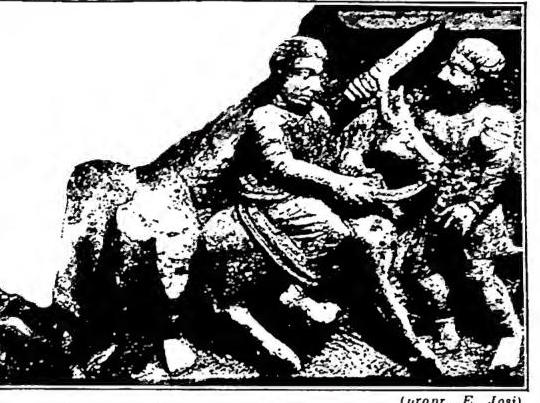
A rare example is the sarcophagus discovered at S. Sebastiano, representing the scene of B. with the she-ass, according to the account in Num. 22:21–35 (G. Wilpert and L. De Bruyne, Due sarcofagi recentemente scoperti a S. Sebastiano, in Riv. di archeol. crist., 16 [1939], pp. 253–69). The figure of B. also remains in medieval art, both in scenes with the she-ass and as an isolated figure, as in the cathedral of Siena, where he is represented on Nicola Pisano’s pulpit; or, together with the Queen of Sheba, at Chartres; or, alone, on the capitals of Moissac.