
CORONA. — This term refers to a particular form of prayer in which the Pater and the Ave Maria are recited repeatedly, guided by beads strung together on a cord or chain in the shape of a crown; hence the term "corona" (crown) is used indifferently for both the form of prayer and the physical string of beads.
The use of a corona to recite prayers is of very ancient origin and dates back to pagan times. Among Christians, it was favored especially by anchorites and monks and spread widely during the time of St. Dominic, when a special form and blessing were requested for the corona of the Rosary of the Blessed Virgin Mary. Numerous coronas thus arising from the piety of the faithful were recognized by the Apostolic See, which, having established precise norms, enriched them with particular indulgences.
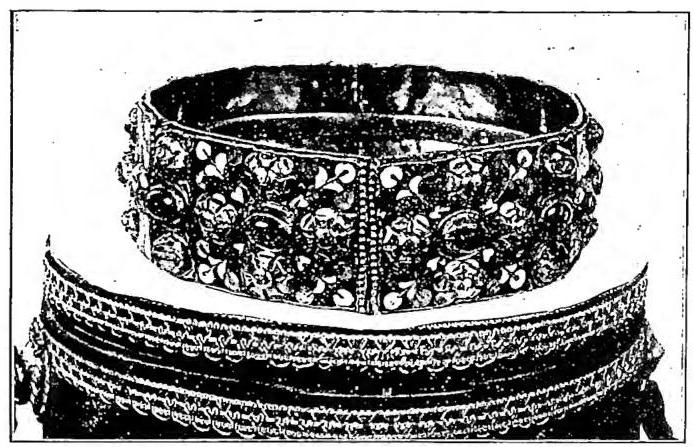
The form must be that of a crown and not a band, girdle, or anything else that hangs down. The beads must be grouped in sets of ten, seven, or three, according to the use or purpose of the individual coronas, so as to count the recitation of the established number of prayers. According to precise declarations of the Holy See, it is not permitted to substitute the beads of a corona with engraved or chased silver or gold rings; nor to replace the Pater beads with engraved medals; nor, in any case, with bracelets, which, although they may be adorned with indulgences, do not serve to replace the corona.
For a corona to obtain an indulgence, it must be blessed. The formulas found in the Roman Ritual (and its Appendices) are generally optional, with the exception of those for the corona of the Rosary and the corona of the Seven Sorrows of the Blessed Virgin Mary, for which one of the two prescribed formulas is required, either the longer or the shorter. For the others, when presented in the palms of the hands, a sign of the cross by a priest who has the faculty and the precise intention of granting the attached indulgence suffices. If, over time, one or a few beads are lost or worn out, they may be replaced without the need to renew the blessing.
The principal coronas, in addition to that of the Rosary of the Madonna—which consists of a larger bead for the Pater Noster, dividing five, ten, or fifteen decades of smaller beads for the Ave Maria—are the following:
Corona of the Crociferi: it has the same form and is recited in the same way as the Rosary, but without the obligation to meditate on the glorious, joyful, or sorrowful mysteries. To the recitation of each Pater and Ave, an indulgence of 500 days is attached, even if the entire decades are not recited. The faculty to bless it belongs to the Order of Canons of the Holy Cross (Crociferi), but it may also be granted by the Holy Penitentiary to other priests, and it is one of the faculties of priests of the Pious Union of the Clergy for missions.
Corona of the Lord: 33 Paters in memory of the 33 years of Our Lord Jesus Christ on earth, 5 Aves in memory of the five wounds of the Divine Redeemer, and a Credo in honor of the Holy Apostles. This corona, proper to the Order of the Camaldolese monks, was enriched with special indulgences by Leo X (18 Feb. 1516) and subsequently by other pontiffs.
Corona of the Seven Sorrows of the Blessed Virgin Mary: 7 decades (each of 1 Pater and 7 Aves), with the addition of 3 Aves in honor of the tears of the Sorrowful Virgin, whose seven principal sorrows must be meditated upon and pronounced with the recitation of each decade. It is enriched with indulgences recognized in the Summary of the Holy Congregation of Indulgences dated 18 July 1877. The faculty of blessing belongs to the Order of the Servants of the Blessed Virgin Mary, but it is also granted to other priests.
Corona of the Seven Joys of the Blessed Virgin Mary: similar to the previous one, divided into 7 decades (each of 1 Pater and 10 Aves), with the addition of two more Aves to reach the number of 72 Aves; a further Pater, Ave, and Gloria is recited according to the intentions of the Supreme Pontiff. With a brief dated 4 Dec. 1906, Pius X united numerous indulgences for the faithful, though these are linked to the blessing of a superior or priest of one of the three Franciscan families who have the faculty to bless this corona.
Angelic Corona, or in honor of St. Michael the Archangel and the Nine Choirs of Angels: a larger bead for the recitation of the Pater divides 9 groups of three smaller beads for the Ave; followed by 4 other beads for a further 4 Paters. Other special invocations to the individual angelic choirs are required to gain the indulgences granted by Pius IX on 8 Aug. 1851. The faculty of blessing is common to all priests who may bless sacred objects with attached indulgences.
CORONA. — Very common in the attire of members of the imperial family or those invested with imperial power between the 5th and 7th centuries, crowns were made from a metal sheet or from various metal plates joined together for better adherence to the head, or even, presumably, from a
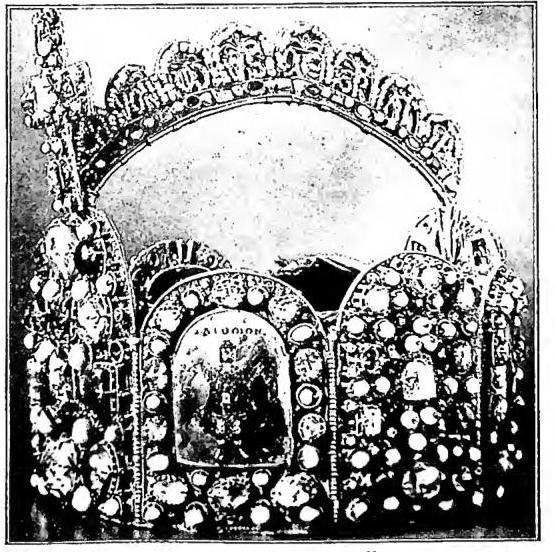
CORONA — C. of the Holy Roman Empire of the imperial treasury of Vienna (early 12th century).
(da P. Koelner, Basci Zuntikerrlichkeit, ein Bilderbuch der Zünste und Gesellschaften, Basilea III, p. 31, fig. 21)
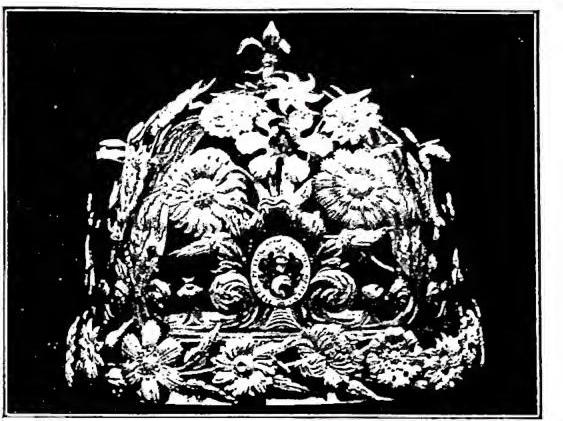
CORONA — C., a work by Hans Rudolf Meyer (1696). Basel, Museum of the Guilds.
A strip of leather to which bosses, enamels, pearls and precious stones set in cells are affixed. Sometimes crowns were also adorned with flowers and leaves, as in those held by the saints advancing toward the throne of the Redeemer in the mosaics of the nave in S. Apollinare Nuovo in Ravenna (520–30), similar to the one descending from heaven to crown the Virgin in the mosaic of the cathedral of Parenzo (543–54). The crown of Justinian, as it appears in the mosaic of S. Vitale (547), was composed of a gold band adorned with stones and enamels and a double row of pearls; the other crown encircling the head of Theodora was connected to a complex headdress with pearl pendants.
Sometimes at the midpoint of the forehead the crown had a boss, enamel or gem that stood out both for its size and preciousness. This is the case with the crown of Theodosius of Barletta, the one encircling the head of Honorius in the diptych of Anicius Probus in the cathedral of Aosta, and the other crowning the so-called Carmagnola on the balustrade of S. Marco in Venice. The latter, with large bosses, must have been composed of articulated metal plates. A similar appearance is found in the crown encircling the head of St. Agnes in the apse mosaic of the church dedicated to her in Rome (625–38).
Not all scholars agree on the dating of the so-called “Iron Crown,” preserved in the cathedral of Monza, which on the inside has a strip of iron, said to have been made from a nail of the Cross, and on the outside is entirely adorned with set stones and enamels executed in a technique that seems older than the 6th century but arranged, the enamels and stones, according to a taste not unlike that recognized in the works of barbarian goldsmithing (v. ARTE); among these must be placed, in the same cathedral of Monza, the crown known as of Theodolinda, to which is attached a cross once joined to another inscribed with the name of Agilulf. The crown of Theodolinda forms a group with others from the 7th century found in Spain in the sanctuary at Fuente de Guarrazar near Toledo, at least in part as ex-votos.
The type of crown does not seem to change in the 9th and 10th centuries, as similar ones can be seen on the head of the Byzantine emperor Leo VI in the mosaic of the narthex of Hagia Sophia (886–912) and similar ones, in the imagination of the mosaicist who decorated the vestibule of the same church between 986 and 994, were worn by the emperors Constantine and Justinian.
Indeed, from the 11th century onward crowns changed in style, both out of a desire for novelty common to the peoples of the Romanesque age and because they were meant to be more striking or imposing to better distinguish those entitled to wear them.
Thus the crown of St. Stephen, of the kings of Hungary, which is partly a Byzantine work of the 11th century, and the so-called crown of Charlemagne, today in the Schatzkammer in Vienna, a Siculo-Byzantine work, perhaps created for the coronation of Conrad II (1027), composed of gold plates, stones, enamels and filigree, very high at the front and surmounted by a crest also inlaid with gems.
With the 16th century and the following centuries, crowns once again changed style but generally came to consist of a gem-studded circlet surmounted by a cap of fabric protected by strips or metal plates joined at the top by a gem or a globe topped by a cross (crown of the Habsburgs made by David Altenstetter in 1602, now in the Schatzmuseum in Vienna, the one for Napoleon’s coronation by Nittot now in the Louvre, the modern crown of the kings of England). Similar crowns were also used to encircle the heads of the Virgin and the Redeemer in sacred carved images, as in those crowning the head of the Madonna and Child in the statue by Sansovino in the church of S. Agostino in Rome. — See plates XXVI–XXVII.
Emilio Lavagnino
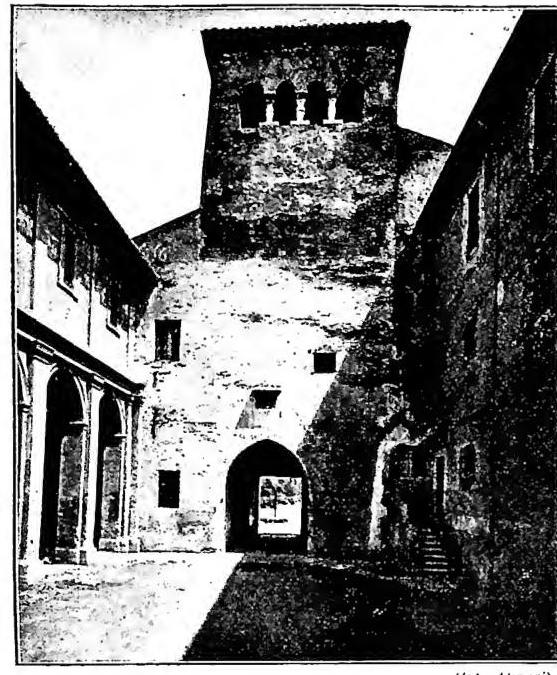
CORONATI, QUATTRO, saints — The first courtyard and the bell tower (12th century) — Rome, church of the SS. Quattro Coronati.