
ANERIO, FAMIGLIA. — Family whose members included several musicians, among whom the following are famous:
MAURIZIO, of Narni, trombone player at Castel S. Angelo, father of Giovanni Francesco and Felice. He also pursued his activity as a player at the Congregation of the Oratory, whose founder, s. Filippo Neri, had been his confessor since 1556. He died in 1591.
GIOVANNI FRANCESCO, born in Rome in 1567. From 1575 to 1579 he was a choirboy in the Cappella Giulia under the direction of Palestrina, and from 1606 until about 1609 he appears to have been at the court of Sigismondo III, king of Poland. In 1609 we find him in Verona, maestro di cappella of the cathedral, and from 1611 in Rome, “in Seminario Romano musicae Praefectus,” and maestro di cappella at the church of the Gesù (1613–20).
He became a priest after a lengthy preparation extending from 1583 to 1616, the year in which he received sacred ordination in the sacristy of S. Pietro at the hands of the bishop of Grosseto, mons. Giulio Sansidoni. On the following 7 August he celebrated his first sung Mass in the church of the Gesù, attended by all the singers of Rome, divided into eight choirs. Recent archival research has led scholars to regard the date of his death, generally placed after 1621 (on the basis of the date of his last work—the Lieti scherzi—published with a dedication by the author), as later than 1624.
In addition to his extensive sacred production, composed for the churches of the Society of Jesus, he devoted a significant part of his activity to the Congregation of the Oratory, for which he wrote Laudi and, in 1619, the Teatro armonico spirituale, which occupies an important place in the origins of the Oratory in the vernacular.

(photo Enc. Cutt.)
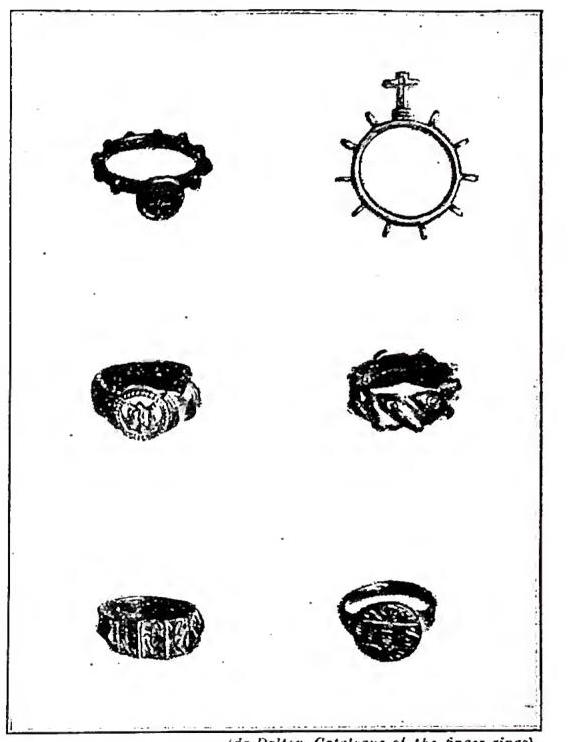
(from Dalton, Catalogue of the finger rings)
ANELLO – Devotional rings of the fourteenth to sixteenth centuries.
Responsoria nativitatis Domini, Venite exultamus, Te Deum, for 3–8 voices, from 1614 (reprinted in 1629); Salmi da Vespro for 3–4 voices from 1620; and masses, among which we should mention, in addition to the edition (from around 1600) of three masses by Palestrina (among them the notable Missa Papae Marcelli, reduced by the composer to four voices), a Mass of the Battaglia of his own, the volume of masses for 4–6 voices from 1614, containing the Missa pro defunctis (subsequently also published separately [1630] and recently reissued by F. Pustet in 1865), and others, among which, for example, a Missa Paulina Burghesia dedicated to Paolo V stands out: all of them very close to the pure Palestrinian inspiration, to which the composer’s solid contrapuntal and polyphonic training was indebted. Many manuscript compositions are preserved in the libraries of Vienna, Berlin, Brussels, London, Bologna, and Rome.
FELICE, the elder brother of the preceding, born in Rome around 1560, died in 1614, perhaps on 26 September. In 1568 he was admitted as a boy chorister to the musical chapel of S. Maria Maggiore, in 1575 as a soprano and in 1577 as a contralto to the Cappella Giulia, passing shortly thereafter, still as a contralto, to the chapel of S. Luigi dei Francesi (1579–80). His artistic training, very probably begun by his father, was effectively continued by the various chapel masters under whom he carried out his activity as a singer, namely: G. M. Nanino (v.), whose pupil he insistently liked to declare himself, Giovanni Pierluigi da Palestrina, and Suriano. His career as a maestro encompassed various fields of activity: from the Collegio degli Inglesi, administered by the Jesuits (1585), to the Compagnia di Roma (which would later become the Accademia di S. Cecilia), to the chapel of Duke Giovanni Angelo Altemps, and finally to the Sistine Chapel, where he succeeded Palestrina as papal composer.
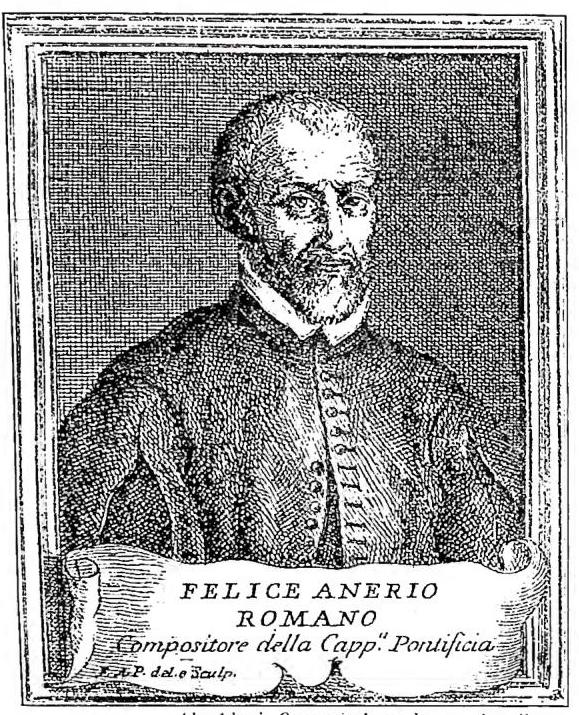
(from Adami, Osservazioni per ben vendute il testo dei cantori della cappella Pont., Roma VII)
ANERIO, FELICE – Portrait.
After the Madrigali spirituali, published by Gardano in 1585 (his first printed work), and the two books of Concerti spirituali a 4 voci, of 1593, together with a large quantity of sacred music, his official career begins in 1594, which marks the beginning of his dual activity as liturgical composer for the Altemps ducal chapel and for the apostolic chapel. Dedicated precisely to Clement VIII, who had elevated him to the position of papal composer, are the two books of Mottetti a 8 voci (1596) and a 5-6-8 voci (1602), which were published in Venice (the first) and in Rome (the second) under the title of Sacri Hymni et Cantica. Felice A.’s liturgical work comprises, besides the Responsori a 4 voci (1602 and 1606), various masses and psalms which, together with litanies and motets, were published in collections by Pustet (ca. 1853–63: V. nella Musica Divina di K. Proske i mottetti della collezione Altemps), or still lie in manuscript in the libraries of Rome (the Sistine Chapel), Berlin, Breslau, Dresden, Vienna, etc.
To express the greatness of his liturgical art, it will suffice to recall a judgment by A. W. Ambros, who maintained that the A.’s mass Veni Sponsa Christi could stand comparison with Palestrina’s mass of the same name.
Like his brother Giovanni, he incorporates in his art the two currents that, at the beginning of the seventeenth century, found their point of conjunction: the Palestrinian polyphonic tradition, with its well-equipped store of contrapuntal constructions, and the emerging monodic tendency, which, rather than in the properly dramatic form of the solo voice (as in the work of Giovanni Francesco), is expressed in Felice through a marked inclination to propel polyphony, by means of homophony, toward the predominance of the upper voice that would lead to the melodic monodism of the seventeenth century.
Felice A.’s name is also linked to the history of the edition of the Graduale, called Medicea because it was printed in Raimondi’s printing house and sponsored by Cardinal Ferdinando dei Medici. Its revision had been entrusted by Gregory XIII to Palestrina (Proprium de tempore) and to Zoilo (Proprium Sanctorum), together with that of the Antiphonarium and the Psalterium; after being abandoned by Palestrina around 1578, it was resumed in 1611, when the undertaking was entrusted, on the initiative of Cardinal Del Monte, precisely to Felice A. and Suriano. The printing of this edition was completed by the publisher Raimondi, who had by then obtained the privilege, in 1614 for volume I (Pr. de tempore) and in 1615 for volume II (Pr. Sanctorum), which appeared after A.’s own death.
BERNARDINO, brother of Felice and Giovanni Francesco, was also a musician, since he appears among the singers who, directed by Luca Marenzio, took part in the Lenten services of 1595 at the Confraternity of the Most Holy Crucifix in S. Marcello.