
ANIMUCCIA, GIOVANNI. — A musician of pure religious inspiration who, Festa (v.), inaugurated the golden tradition of the Roman polyphonic school. B. in Florence in 1514, d. in Rome on 25 March 1571. Having come to Rome as a young man, he joined the artists who attended on Cardinal Giulio Ascanio Sforza di S. Fiora and, in 1540, formed a profound friendship with his fellow citizen s. Filippo Neri, who called him to collaborate in the Oratory, where he enrolled in 1555. In that same year he was appointed maestro of the Cappella Giulia at S. Pietro, where Palestrina succeeded him upon his death. He married “madonna Lucrezia Giulia sanese,” who was likewise a penitent of s. Filippo.
(phot. Enc. Catt.)
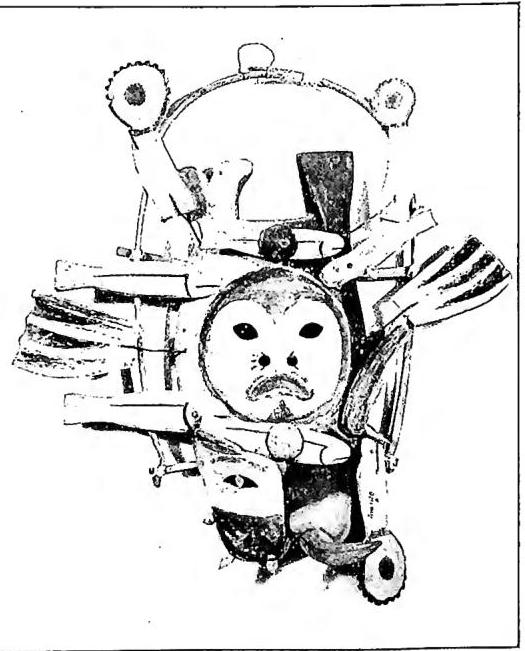
ANIMISMO — Animist mask from Esquimaux country.
Rome, Lateran Ethnological Missionary Museum.
see, Ave Maris Stella, Christe Redemptor omnium), of the antiphon (Gaudent in coelis) or of the sequence (Vicunae paschali) from which it takes its name: the cantus firmus winds its way here and there through the various parts, broken up, taken up again, elaborated and enriched with counterpoints, imitations and fugal passages, always alive and present in the most vibrant melodic transparency of the polyphonic structure. After the Masses, the magnificats occupy a prominent place; they were composed in the eight modes and printed in Rome (1568) under the title Canticum Beatae Mariae Virginis ad omnes modos factum. Here the Gregorian inspiring element is more evident in the classical intonations of the verses and in the psalmodic movement of the voices, but the greater contrapuntal restraint is compensated for by an extraordinary richness and variety of effects in the arrangement of the parts and in the fusion of the rhythmic elements. But it is in the brief pieces on vernacular texts that A.’s art takes on a wholly distinctive character: the Laudi spirituali that appeared in two books in 1563 (for four voices) and in 1570 (for eight voices), composed for the Oratory of S. Girolamo della Carità of the Oratorians. A. had written other small compositions of the motet type on Latin texts (in the manuscripts Libelli studiorum, and in the Madrigali a 3 voci of 1565), but those on Italian words assume a far greater importance if one considers that they are the earliest roots from which the oratorio would develop. At first they are for four voices only, simple and homophonic; later they become enriched with imitations and other artistic devices, such as the grandiose effects of the double choir, in which, after a varied alternation, the first and second choirs unite in majestic and solemn finales, unfolding the entire timbral richness of an eight-voice texture. Let us recall, then, some of the most significant laudi, such as Yesu sposo mia dolce, Signor dolce mia vita, Occhi pietosi e casti, Venite al cibo eletto, Su su su che stiamo a fare: small idyllic scenes that bring us back to the serene quiet of the countryside and the Roman villas where, especially during visits to the seven churches, those spiritual gatherings of the Oratorians were held, to which A. brought a fervent yearning for art and faith.