
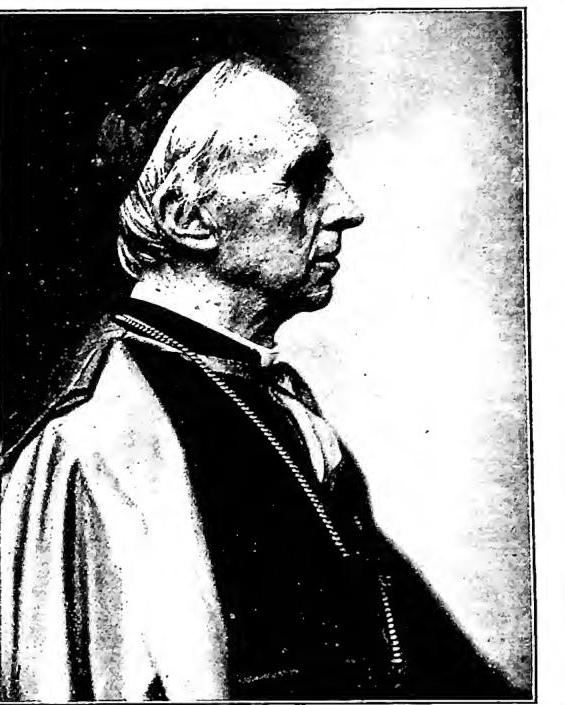
MERCIER, DÉSIRÉ. – Philosopher, founder of the Institute of Philosophy of the University of Louvain, cardinal and primate of Belgium, born at Braine l’Alleud, in Walloon Brabant, on 21 November 1851, died at Malines on 23 January 1926. Ordained a priest on 5 April 1874 by the apostolic nuncio, Monsignor Cattani, he enrolled in the Faculty of Philosophy and Letters of the University of Louvain.
Direct contact with modern philosophical currents and with the sciences, open discussions with the professors, and above all the inner travail of personal reflection gradually oriented his thought. He seems to have received his first decisive influence from the teaching of A. Dupont KLEUTGEN, JOSEPH (v.) TONGIORGI, SALVATORE (v.). By the end of his university curriculum, he had essentially formed his convictions. Having obtained his degree, he went to the Petit Séminaire as professor of logic and metaphysics. The year was 1877, two years before the Aeterni Patris, and it is known that M.’s teaching was already in line with the future encyclical. Thus, when Leo XIII asked the Belgian episcopate to estab-
The number of university students attending the course begun in the 1882–83 academic year steadily increased, as did the number of professors. Thus M.’s work emerged from its earliest years as an authentic success. The plan agreed upon with Leo XIII was gradually being realized. “To form, in the greatest possible number, men who will devote themselves to science for its own sake, and who will work at first hand...; to create the resources required by this work: such is the twofold aim of those concerned with the prestige of the Church in the world” (Relazione sugli studi super. di filos., presented at the Malines Congress on 9 September 1891). Not content with his university contacts, M. opened his Bureau de Rue des Flamands. Through those conversations and meetings, a group of deeply loyal friends and disciples gradually formed around him. Leo XIII followed these developments and urged their further progress. A brief of 7 July 1888 expressed the hope that the number of chairs would be increased and that an Institute of Philosophy would be founded; another brief, dated 8 November 1889, approved its establishment. Finally, the brief of 7 March 1894 determined the Institute’s juridical position within the University and mentioned a papal subsidy of 150,000 francs.
In that same year, the Revue néoscolastique de philosophie, published by the Société philosophique de Louvain, began to appear. The organization of the Institute did not slow the philosophical production of its president. M. worked assiduously on the Cours de philosophie, systematically inspired by Thomism and open to the philosophical and scientific problems of the time. It produced the Logique, which reached its definitive form in 1897; the Psychologie (1892); the Critériologie générale ou Théorie générale de la certitude (1899); and the Métaphysique générale ou Ontologie (1902). A lithographed summary of the Cosmologie exists, since this treatise was later entrusted to D. Nys; lithographs also exist of Théodicée and Philosophie morale et droit naturel. The Critériologie générale (the spéciale was never published) is the most famous of M.’s works, also because of the discussions provoked concerning the Mercierian interpretation of the concept of truth, and concerning the initial state and the methodical passage from the ideal to the real. It would do this great Thomistic thinker an injustice to view his thought solely in terms of these two or three theses, since the principal merit of the Critériologie was that it stimulated an effective revival of critical studies in neo-Scholastic circles, demonstrating how realist gnoseology could withstand comparison with positivist and neo-Kantian currents. Another important work by M. is Les origines de la psychologie contemporaine (1st ed. 1897). All these works have gone through several editions and translations into many languages.
If M. was unable to complete his Cours de philosophie, it was because, from being the head of a school, he was destined to become the spiritual leader of his people. Pius X, who had already sent him his approval of the Institute’s activity, appointed him cardinal and primate of Belgium when the archiepiscopal see of Malines became vacant in 1906. Thus the Pope’s choice gave M. the opportunity to become one of the most eminent ecclesiastical figures of the first half of our century. M. was first able to see the generation he had formed set out on its path and attain power. During the war of 1914–18, the cardinal’s stature grew. His vigorous defense of the rights of his people during the period of German occupation has passed into history, and the biographers have documented it extensively. Here it will suffice to note that, on M.’s part, it concluded without any trace of resentment, and that on the part of his former adversaries it ended with a frank acknowledgment.
M. possessed a profoundly pious soul, as can be seen in the works A mes séminaristes (1908–26) and Retraite pastorale (1910–26), addressed to his clergy (some passages in them occasioned a controversy recently concluded by a speech of the Holy Father on 8 December 1950, at the end of the Congress for the renewal of religious life). As a young seminarian, M. spent his holidays among Christian workers. He therefore could not fail to accept enthusiastically the initiative of an “International Union for Social Studies,” offered to him in 1921. He gathered sociologists from all the principal nations of Europe in his archiepiscopal palace and supported them through his encouragement during the compilation of the Codice sociale di Malines, published one year after his death. Another event associated with M.’s name is the Conversazioni di Malines (begun on 6–8 December 1921), which brought the Cardinal and Lord Halifax together for a private study of the possible union of Anglicans with the Roman Church. Death overtook M. when a fifth meeting was imminent (v. MALINES, conversazioni di).