Machine translation of the 1948–1954 Italian original. The original text is authoritative.
MERODE, FRÉDÉRIC-FRANÇOIS-XAVIER de. – Prelate and statesman, born in Brussels on 20 March 1820, died in Rome on 10 July 1874. Of a most noble family, after completing his classical studies at the Jesuit College of Namur and at Juilly in Paris, on the advice of the nuncio Pecci (later Leo XIII), he attended (1839) the Military School of Brussels, graduated as an infantry second lieutenant in 1841, and took part in the Algerian operations (1844–45).
On returning to his homeland, he followed an ardent priestly vocation and, encouraged by Montalembert, the abbot Gerbet, and Father Ventura, left for Rome in October 1847 and received the minor orders on 23 December 1848. During the revolutionary and republican events he had a further opportunity to give new proof of fearless courage; for this he suffered harassment and imprisonment. When the French entered the city (5 July 1849), he took part in the restoration of the pontifical government and, having celebrated his first Mass in St Peter’s (23 September 1849), served as a military chaplain.
Pius IX, on receiving him after his return from Gaeta, immediately appointed him his participating Secret Chamberlain (14 April 1850) and kept him constantly near him, soon making use of him in confidential negotiations with France and in the study and preparation of the important institutional and administrative reforms that he resumed and implemented between 1850 and 1870. But the greater part of Msgr. De M.’s activity is connected with the grave political situation that arose around the Holy See between 1850 and 1870. In the spring of 1866 he was found diligently serving as Minister of Arms in La Moricière (v.), and he sought to provide for everything with self-denial and technical expertise. Thus, CASTELFIDARDO, BATTAGLIA DI (v.) Ancona (v.), Mentana (v.), and right up to the supreme resistance along the walls of Rome, that new and excellent army, besides extending by a decade the thousand-year function of a state so venerable, sufficed, as Cochin wrote, to ensure that it “did not collapse in silence and without a resounding echo in History.” His lack of political adaptability and his conflicts with Cardinal Antonelli, who could not tolerate De M.’s activity and severe influence in the government of the State, compelled him to leave the ministry on 6 October 1865, in order instead to assume the office of pontifical almoner, with his appointment as titular archbishop of Melitene (22 June 1866). Indeed, it was the Pope’s intention to have him nearby so as to continue to make use of him as before.
De M. immediately turned his attention to reforming the elementary schools and the numerous charitable and welfare institutions of the city, while, following the example of the Middle Ages, he gave initial impetus to the reclamation of the countryside through colonies of farming monks, such as the Trappists at Tre Fontane on the Via Laurentina. Rome also owes him the city’s first master plan and the first imposing works of urban expansion and renewal. With prudent foresight he disposed of areas that were then deserted in order to create the squares of Termini and S. Maria degli Angeli, open the future Via Nazionale and its adjoining streets, begin in Prati the Via Vittoria Colonna and its connecting streets, define the present Piazza Cavour, and trace on paper what later became the great Via dei Fori Imperiali from Piazza Venezia to the Colosseum. After taking a substantial part in the work of the First Vatican Council, casting a vote against the advisability of proclaiming the dogma of papal infallibility, but submitting that same evening (18 July 1870) at the feet of the Holy Father, he spent his final years safeguarding many of his own works and many interests of the Holy See threatened by the changing times. He thus also leased the Palazzo Altemps in order to house a pontifical university there in place of the Sapienza, which had become a royal university. He also intervened to secure for his friend G. B. De’ Rossi and for the new science of Christian archaeology the resources and sites needed for further investigations (1873); he was struck by the illness that brought about his death while the excavations were under way. He was buried in the Teutonic cemetery.
A romantic and chivalrous blend of soldier and monk, Msgr. de M. united the habits of a pious cenobite with the solicitude of charity and the intransigence of justice. Of him, misunderstood by too many, Veuillot rightly said: “No one knew him better than Pius IX, and no one perhaps loved him more.”
(by courtesy of Msgr. A. P. Frutaz)
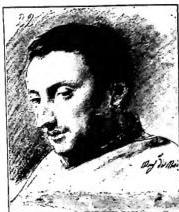
MERODE, FRÉDÉRIC-FRANÇOIS-XAVIER de. – Portrait. Drawing by F. Podesti – Vatican Library.
BIBL.: G. G. Franco, I Crociati di S. Pietro. Storia e scene storiche della guerra di Roma l'anno 1867, Rome 1869–70, capp. 31, 64, 83, 99; P. Balan, Continuazione alla Storia universale della Chiesa cattolica, dell'ab. Rohrbacher, II, Turin 1879, pp. 200 segg., 436 segg., 639, 688; L. Besson, Frédéric-François-Xavier De M., ministre et aumônier de Pie IX, archevêque de Méliène. Sa vie et ses oeuvres, Paris 1886 (excellent and complete bibliography); A. M. Bonetti, Venticinque anni di Roma capitale d'Italia e suoi precedenti (1875-95), I, Rome 1895, pp. 122, 292; G. S. Pelczar, Pio IX e il suo pontificato, Italian translation, Turin 1909–11, passim; K. von Schlözer, Römische Briefe (1864-69), Stuttgart-Berlin 1920, see index; A. Vigevano, La campagna delle Marche e dell'Umbria, Rome 1922, passim; S. Jacini, Il tramonto del potere temporale nelle relazioni degli ambasciatori austriaci a Roma (1860-1870), Bari 1931, see index; L. F. Stock, United States Ministers to the Papal States. Instructions and despatches (1848-68), Washington 1933, see index; P. Dalla Torre, L'anno di Montana, Turin 1938, pp. 4, 17, 18, 45, 59 (with an extensive bibliography, almost always connected with the life and works of de M.); S. Negro, Seconda Roma (1850-70), Milan 1943, see index; P. Dalla Torre, L'opera riformatrice ed amministrativa di Pio IX fra il 1850 ed il 1870, Rome 1945, passim. Paolo Dalla Torre
Cite this article
“MERODE, FRÉDÉRIC-FRANÇOIS-XAVIER DE.” Enciclopedia Cattolica, vol. VIII (1952), p. 443. Azione Romana digital edition, https://azioneromana.com/article/merode-frederic-francois-xavier-de.