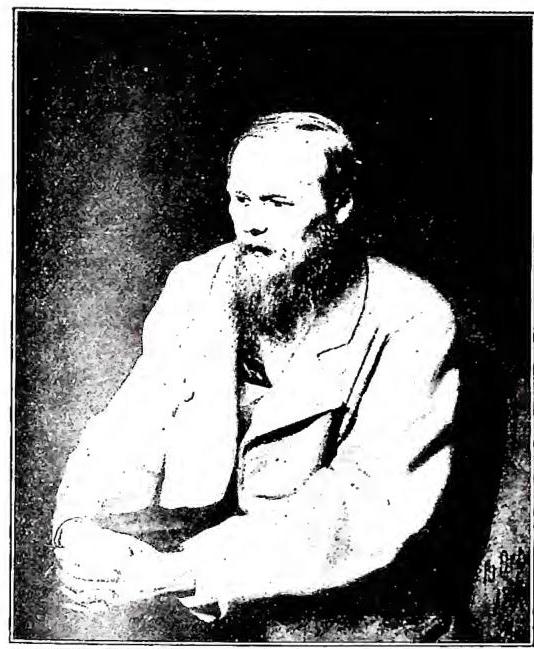
DOSTOJEVSKIJ, FEDOR MICHAJLOVIČ. - The greatest Russian novelist, born to a military doctor in straitened circumstances in Moscow on Oct. 30, 1821, died in St. Petersburg on Feb. 9, 1881.
I. LIFE AND WORKS
From 1856 he attended the military engineering school in Petersburg. He finished his studies in 1843 and subsequently was promoted
His first story, Poor Folk, found a favorable reception from the critic Belinskij, who nonetheless misunderstood its meaning. In Petersburg he became acquainted with progressive circles; and, as a frequenter of the circle of Butaževič-Petraževskij, oriented in broad outlines toward the utopian socialism of C. Fourier, in 1849 he was arrested along with other young men. Some of them, including D. himself, were condemned to death: the execution, however, was suspended at the last moment and the death sentence commuted to four years of hard labor in Siberia. His stay in the penal colony brought him closer to the people and distanced him from the Europeanizing and progressive ideas of his youth. In 1857 he married a widow, who died in 1864. In 1859 he was finally able to settle in Petersburg, where he wrote—as the fruit of the tragic experience of the penal servitude—Memoirs from the House of the Dead (1861-62). These were followed by Humiliated and Insulted (1862) and Notes from Underground (1863). More and more, an attempt at reconciliation between Slavophilism and Westernism took shape in the writer's mind ("reconciliation of civilization with the popular principle, synthesis of the educated Russian class with the forces of the popular classes, synthesis of all the ideas developed individually in the various countries of Europe into an idea of universal humanity"). This direction was finally fully developed by D. in his famous speech on Puškin in 1880, with an increasingly religious accent.
The novel Crime and Punishment (1865-66) contributed powerfully to the universality of his fame. In 1867 he remarried and, pursued by creditors and frequently ill (he also suffered from epilepsy), he left Russia with his new wife. He stayed abroad for four years (from April 1867 to July 1871). He was a passionate gambler. While abroad he wrote The Gambler, The Idiot (1869), The Eternal Husband, and The Devils (1870 ff.). Back in Russia appeared The Adolescent (1875) and The Brothers Karamazov (1878-80), a novel conceived as part of a vaster work. He also resumed his journalistic activity and
began publishing, continuing it until his death, A Writer's Diary. Having returned to Petersburg, D. died there. Considered by certain Russian critics as a mystic revealer of a great typically Russian and Slavic ideal, misunderstood by others as an "artist of chaos," and universally admired for his profound introspection of the human soul in good and evil, the most recent Italian criticism has recognized him as a great classic.
The principal problems for D. are God and man. D. is tormented by the problem of the existence of God and of atheism (cf. the dialectic and psychology of the hero of Crime and Punishment, Raskol'nikov, of the heroes of The Devils, Kirillov and Stavroghin, of Ivan Karamazov, etc.). Starting, like Gogol', from the analysis of Russian man, of Russian political and social life, he arrives at scrutinizing man in general and humanity. D. studies man, not only in his consciousness, but also in his subconscious, man between good and evil, in the duplicity of his existence which has the choice between faith and atheism, God and himself, total unity or inner isolation. For D. the Christian, the alternative holds: either the man-God (cf. Nietzsche's overman) or the God-man Christ. According to D., all purely natural attempts to organize society according to pre-established plans are in vain, given the irrational nature of man, who seeks to assert his freedom without limit, even unto destruction and chaos. Hence his aversion to socialism, the Catholic Church, and especially the papacy, which would agree in the implementation of a de-Christianized uniform society, dominated by measures of force and purely external authority (an "anthill," a "crystal palace," a "henhouse"). But in waging such a struggle against the harmony of the world (cf. Ivan Karamazov) and the Catholic Church, he fails to see that he is indirectly rebelling against God, the author of such an order. Therefore D., although purely natural humanism reached its culmination and its crisis in him—consisting in the realization that pure humanity ends up destroying itself, committing suicide, if it is not illumined from above, regenerated, redeemed by Christ—remains incapable of refuting and completely overcoming II.
In his Slavophile messianism D. shows very close ties with Ivan Kireevskij and Chomjakov. From Gogol' he took various motifs in his early tales, especially in Poor Folk and The Double (Dvojnik). Close was D.'s friendship with the young Soloviev (from 1873 onward) and their communion of ideas (this is reflected, e.g., in the application of the three temptations of Christ to the history of Catholicism, in Soloviev's Lectures on Godmanhood and in D.'s "Legend of the Grand Inquisitor"; compare also the idea of Godmanhood in Soloviev with the man-God and the God-man in D.). D. then inspired the so-called "Russian Renaissance" at the beginning of the 20th century, at the center of which were V. Ivanov, N. Berdjaev, S. Bulgakov, P. Florenskij, etc. Deriving from D. in particular is the Russian current of existentialism, of which the principal representatives were N. Berdjaev and Lev Šestov. D. has notably influenced the new modernist Russian soteriology (especially that taught by M. Tareev, Metropolitan Antony (Chrapovitskij), N. Berdjaev, N. Arsenjev, and others).
II. D. FROM THE CATHOLIC POINT OF VIEW. - Personally, D. had a deep faith and felt Christ intimately. He saw Christ at the center of the entire world ("Christocentrism"). For him, Christ is all love, gentleness, meekness, freedom; he excludes from Christ, as from the Church, everything that is authoritarian and juridical. In the mystery of Redemption, he highlights exclusively the example of Christ and His psychologically conscious regenerative influence (passing over the objective part in silence). D.'s Christianity is unilateral, overly ideal, abstract, and not without a certain sentimental accent. There are traces of paganism (e.g., the cult of the mother earth). His Christianity is decidedly national