
SOLOV'EV, VLADIMIR SERGHĚEVIČ. – The greatest Russian philosopher, born on 16 (28) January 1853 in Moscow, died on 31 July (13 August) 1900 near Moscow.
He studied at the University and Ecclesiastical Academy of Moscow. In 1874 he defended his thesis The Crisis of Western Philosophy, against the Positivists. He taught at the University of Moscow (January–May 1875). He subsequently travelled to London, Paris, Nice, and Egypt (where he had the celebrated vision of « Sophia-Wisdom »: cf. his poem Three Encounters). Between 1880 and 1881 he also lectured at the University of Petersburg. Dating from that period are: The Philosophical Foundations of Integral Knowledge (1877), The Critique of Abstract Principles (1877–80), and, more importantly, Lectures on Divine-Humanity (1878–81). In 1881 he had to give up teaching because he had publicly appealed for clemency for the assassins of Tsar Alexander II. Other journeys abroad followed (1886, 1888–89, 1893, and 1899). In 1886 he wrote in Zagreb part of The History and Future of Theocracy, and there, in 1888, the introduction to La Russie et l'Eglise universelle (Italian translation), another part of the extensive work that remained unfinished. He devoted himself entirely to the study of religious and political questions and to extensive political-religious activity for the reunion of separated Christians. Initially a Slavophile, during the years 1882–88 he increasingly distanced himself from the opinion of the earlier Slavophiles concerning the cause of the schism between East and West, and ultimately accepted Catholic doctrine on doctrinal development and the primacy of the Pope. At the beginning of that period he wrote The Religious Foundations (later Spiritual Foundations) of Life (1882–84). His last important works are: On the Justification of the Good (1894–97; 2nd ed. 1898), S.’s ethics, and Three Discourses (concluding with the Legend of the Antichrist, 1899–1900). He also began a translation of Plato’s dialogues. In 1896 S. secretly accepted the Catholic creed. He received the last Sacraments at the estate of Princes S. and E. Trubetskoj, since there was no Catholic priest, from the non-Catholic parish priest of the locality.
S. stands at the centre of Russian philosophy. He underwent very diverse influences: Neoplatonism, Spinoza, Idealism (Schelling, von Baader, and also Hegel), Böhme, Schopenhauer, E. von Hartmann, A. Comte, the Kabbalah, theosophy, etc., and was in contact with the most eminent Russians of the period (Dostoevskij, L. Tolstoj, K. Leont'ev, and many others). He sought a synthesis, both of faith and reason in an intuitive-mystical realism and of the two principal currents of Russian thought, Slavophilism and Occidentalism. He had a considerable influence on the « Russian Renaissance » at the beginning of the 20th century and on the finest Russian philosophers: S. and E. Trubetskoj, V. BEURON, S. Bulgakov, N. Berdjaev, P. Florenskij, V. Ivanov, L. Karsavin, and others.
The great synthetic and universal ideas of S.’s thought are: the « all-unity » (vseedinstvo) of God and the cosmic and historical universe (in the various stages of creation, fall, redemption, and eschatology); the « divine-humanity » (bogo-čelověčstvo) of the Logos and of Sophia (Wisdom), of Christ and the Church; the union of « theosophy, theocracy, and theurgy »; Christian « universal theocracy », that is, the reign of Christ on earth (of which the three principles of the priesthood, the kingdom, and free prophetism form part: the « Trinitarian » principle). S. later abandoned the idea of the earthly realization of theocracy, without, however, renouncing the universality of his cultural, philosophical, and religious-Christian synthesis.
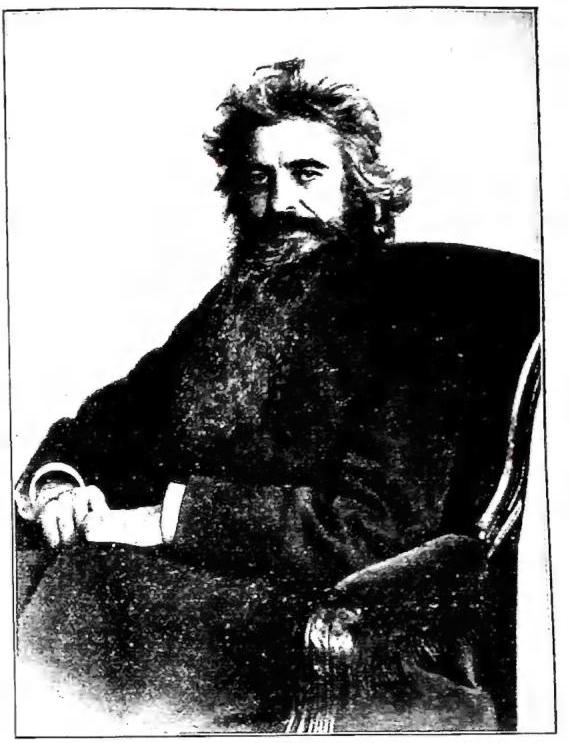
(by courtesy of Mons. A. P. Frutac)
SOLOV'EV, VLADIMIR SERGHĚEVIČ – Portrait of S. at the age of 38,
Most Holy Trinity (whose existence, on the other hand, he assumes as revealed), he indulges in a certain semirationalism. In seeking to affirm and appropriate everything that is true in the various Christian confessions, and especially in wishing to be both « Catholic and Orthodox », S. sometimes expressed himself in terms of supraconfessionalism, in which it is not sufficiently clear that the Catholic Church is the one true Church of Christ, remaining essentially universal even after the great separations of East and West.