
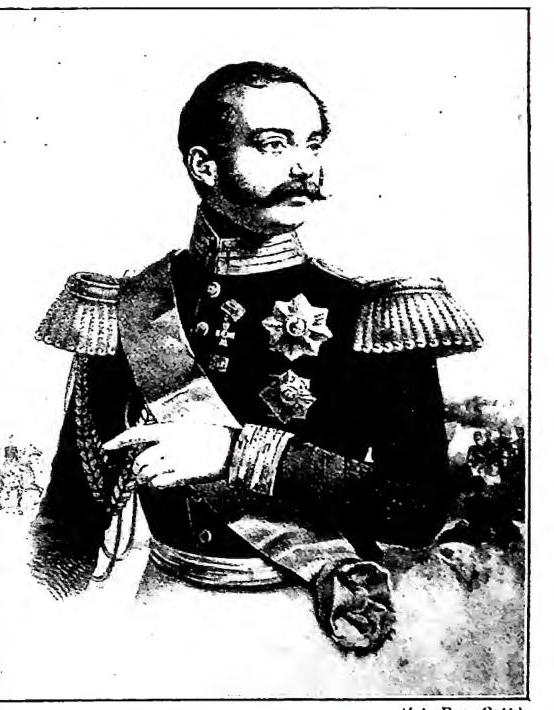
ALESSANDRO II, tsar of RUSSIA. — Born in Moscow on 17/29 April 1818, died in Saint Petersburg on 1/13 March 1881. A. began his reign in 1855 by bringing the Crimean War with France and England to an end and devoting himself to the implementation of reforms, among which the emancipation of the serfs (1861) stands out. When revolution broke out in Poland in 1863 and radical movements spread through Russia itself (the first attempt on A.’s life dates from 1866), the emperor became increasingly rigid both in foreign and domestic policy. The Polish question worsened relations with France, while strengthening those with Prussia, and the desire to preserve the statu quo led to the Alliance of the Three Emperors (A. II, Franz Joseph, Wilhelm I) in 1873. At the same time, Russia was expanding in Central and Eastern Asia. In 1877 the Balkan question led A. to wage war against Turkey, and the peace of San Stefano the following year placed southeastern Europe under Russian influence. When the great powers intervened at the Congress of Berlin (June–July 1878), A. was forced to renounce the advantages gained at San Stefano. Meanwhile, the internal situation was marked by a crescendo of terrorist acts, until the tsar himself fell victim to a bomb thrown at his carriage in front of the Winter Palace.
As regards ecclesiastical policy, relations between A. and the Holy See during the first years of his reign were characterized by propriety, if not cordiality. In response to Pius IX’s desire to see the 1847 Concordat implemented in the articles that had not yet been fulfilled, the tsar gave assurances that he would take action. The Polish question, however, subsequently gave rise to extremely bitter friction: the persecution of Catholics, the secularization of ecclesiastical property, and the suppression of dioceses prompted vigorous protests from the Pope. In writing to A. in the celebrated letter of 22 April 1863, Pius IX disclaimed any responsibility for the Polish revolt and observed that, if matters had reached such a point, this was due to the anti-Catholic policy pursued in Poland. On the other hand, the attitude of the revolutionaries, who identified their struggle for independence with the defense of Catholicism, contributed to distorting the true substance of the disagreements between the Holy See and the tsar, to the point that Meyendorff, the Russian representative in Rome, went so far as to declare to the Pope that Catholicism was equivalent to revolution. The result of this
(phot. Enc. Catt.)