Machine translation of the 1948–1954 Italian original. The original text is authoritative.
VILNA (WILNO), ARCHDIOCESE OF
Vilna is a city and archdiocese in Poland. It covers an area of 56,679 km² and has a population of 2,325,000, of whom 1,056,000 are Catholics, distributed across 442 parishes served by 548 diocesan priests and 13 regular clergy; it has two seminaries, one male religious community, and fourteen female religious communities (Ann. Pont. 1953, p. 454).
The city is situated at the confluence of the Wilejka and the Vilna rivers, in an amphitheater of hills on which the suburbs have developed. It first belonged to the Grand Duchy of Lithuania, then, from 1386, to Poland after the union; the city was devastated by fires in 1610 and 1706, by Russian occupation between 1655–60, by the Swedes in 1706, by the plague in 1710; from 1793 to 1915 it came under Russian rule, despite uprisings in 1794 and 1863. During this period the Church of Vilna suffered greatly, but conditions improved after the Edict of Toleration in 1905. In 1917 it was made the capital of Lithuania, in 1920 it was occupied by the Poles, in 1939 by the Germans, and then by the Russians.
The diocese was founded during the reign of Władysław II Jagiełło, who in 1387 sent Dobrogost, Bishop of Poznań, to petition Pope Urban VI for the erection of the diocese, which was granted by the same Pope with a bull dated 12 March 1388, as a suffragan of Gniezno. The first bishop was the Conventual Franciscan Andrew Jastrzębiec. Bishop Matthias of Troki (1422–53) founded many churches and sent a representative to the Council of Basel. A. Tabor invited the Dominicans to Vilna, entrusting them with the church of the Holy Spirit. The diocese was afflicted by Calvinism; Bishop Valerian Protasewicz Suszkowski (1556–80) invited the Jesuits, among whom shone Fr. Piotr Skarga. Under King Stephen Báthory, G. Radziwiłł (1581–91), later a cardinal and translated to Kraków, founded in Vilna the Academy and the Seminary under Jesuit direction. B. Woyna (1600–15) worked for the canonization of King Casimir of Poland and began the construction of a church in his honor in 1604. E. Wołłowicz (1616–30) invited the Canons Regular of the Lateran to Vilna. A. Woyna brought the Fatebenefratelli. A. Sapieha (1666–71) founded the church of SS. Peter and Paul, its construction inspired by that of St. Peter’s in the Vatican. Pope Pius XI, with the apostolic constitution Vixdum Poloniae unitas of 26 June 1925, which established new boundaries for the dioceses of Poland of the Latin rite, placed Vilna at the head of the third ecclesiastical province of Poland, elevating it to a metropolitan see, fixing its territory, and assigning as its suffragans the dioceses of Łomża and Pinsk (AAS, 17 [1925], pp. 51–28).
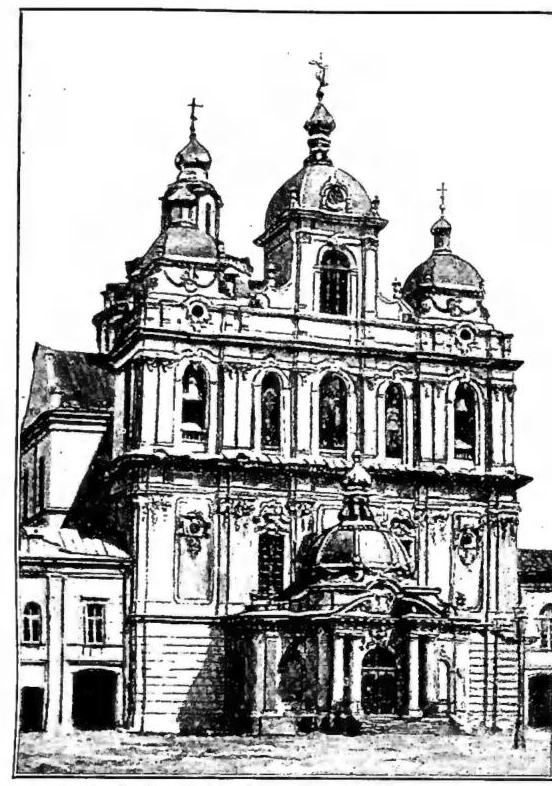
The cathedral is dedicated to SS. Stanislaus and Ladislaus. It was burned in 1399; Duke Vytautas rebuilt it in Gothic style the same year. It suffered severe damage in 1531 and 1662; its restoration in neoclassical style, begun by L. Gucewicz in 1769, was completed in 1801. Notable are the chapels of the Immaculate Conception and of St. Casimir. The church of the Holy Cross was founded in the 14th century; in 1366 fourteen Franciscans were martyred there. The church of St. Martin dates to 1380; St. Anne was erected in 1392 by Anna, wife of Vytautas; St. John the Evangelist was built in 1386 and received privileges from Leo X. The church of the Corpus Domini is from 1573; the church of St. Casimir, with its attached Jesuit college, dates to 1604; that of St. Ignatius, from 1622, was later converted into an officers’ club. The Academy was transformed into a higher school in 1781 and into a university in 1803, becoming under the impulse of Prince Adam Czartoryski a center of high culture; it was suppressed in 1832 and reopened in 1919. A higher school of political science was also founded. The public university library is rich, with over 13,000 manuscripts and 500,000 volumes; noteworthy is the State Archive.
BIBL.: M. Weber, Wilno, eine vergessene Kunststätte, Wilna 1917; Eubel, I, p. 529; II, p. 295, III, p. 355; IV, p. 369; V, p. 416; T. G. Chase, The story of Lithuania, New York 1946; A. M. Ammann, Storia della Chiesa russa e dei paesi limitrofi, Torino 1948. Enrico Josi
Cite this article
“WILNA (VILNA, WILNO), ARCIDIÓCESI DI.” Enciclopedia Cattolica, vol. XII (1954), p. 1047. Azione Romana digital edition, https://azioneromana.com/article/wilna-vilna-wilno-arcidiocesi-di.