
MEREZKOVSKIJ, DMĪTRIJ SERGĒEVIC. – Russian poet, writer, and essayist, born in Petersburg on 14 August 1865, died in Paris on 15 December 1941. Of considerable historical and cultural importance because of the influence he exerted on the literature of his country between 1893 and 1905; decadent in the taste and tone of his work, he must nevertheless be regarded as one of the initiators of Russian Symbolism, to which he gave a fundamentally mystical orientation.
He made his debut in 1888 with Poems, revealing himself as a disciple of Nadson, but in 1892, in a second collection of verse, Symbols, he already foreshadowed the poetics that he later codified in the essay On the Causes of the Decline and on the New Tendencies of Contemporary Russian Literature (1893). In opposition to the “vulgar utilitarian realism” of positivist criticism, M. proclaimed a new idealism whose principles in art were: symbolic style, mystical content, and formal refinement. M.’s mystical conception is based on a renewal of the Christian religion through a syncretism of paganism and Christianity. It envisages an eschatological cycle of three phases or kingdoms: that of the Father (Old Testament), in which truth was revealed as the power of God; that of the Son (New Testament), in which truth manifests itself as love; and that of the Holy Spirit (Third Testament), in which truth is to be realized as freedom. Between the three kingdoms of the Creator, the Redeemer, and the Liberator lies the interregnum of the Antichrist: the Advent of Ham, the “triumph of Smerdyakov,” or of vulgarity. The theory of the three kingdoms, a mystical interpretation of the Hegelian triad, is developed in Christ and Antichrist, a trilogy of historiosophical novels: The Death of the Gods: Julian the Apostate (1893, Italian trans. Milan 1901), The Resurrection of the Gods: Leonardo da Vinci (1902, Italian trans. ibid. 1913), The Antichrist: Peter and Alexis (1905, Italian trans. Turin 1932), whose protagonists, as in every work by M., are emblematic figures embodying theses and antitheses. A second trilogy consists of the drama Paul I (1908; Italian trans. Milan 1921) and the novels Alexander I (1911) and 24 December (1917). In M., architectural, psychological, and stylistic construction alike rest on a principle of polarity, of emphatic opposition between contraries, and on antilogisms and antinomies. M. also brought his mystical conceptions to critical inquiry, seeing in L'ermontov the Announcer, the Baptist; in Püskin the reconciliation of the pagan spirit with the Christian; in Gögöl the eternal struggle with the devil; and in Tolstoj and Dostoevskij, respectively, the “cryptoseer of the flesh” and the “cryptoseer of the spirit.” The essay Tolstoj and Dostoevskij (1901) is perhaps M.’s most enduring work.
The dissemination of his thought was aided, in addition to his works, by a journal he edited, Novyj pus' (The New Way), and by a circle of Philosophical-Religious Meetings that he founded in Petersburg with his wife (the poet Z. Hippius). V. Rozanov, N. Minskij, and D. Filosofov. After the disturbances of 1905 he abandoned his attitude as a supporter of the tsar, the “Lord’s anointed,” and moved over to bourgeois opposition, arguing that “autocracy comes from the Antichrist”; but from 1909 onward, alarmed by the direction taken by progressive movements, he shifted back to the right. The year 1917 found him an irreconcilable opponent of communism, the “kingdom of the Antichrist.” Having joined the emigration, he lived for a long time in France. Among his last works are the novel The Birth of the Gods (1925) and the study on Dante (1937).
They consistently reveal the concept of the “third kingdom,” that of the Holy Spirit (in which he is rather connected with Gioacchino da Fiore [d. in 1202], Tertulliano, and Montano), whereby M. does not conceive of a Christianity that is either Orthodox or traditional and historical, but rather one that is future, yet to come, and fully subjective; for this reason he proclaims that Jesus is still unknown in his true aspect or misunderstood. But he seeks to demonstrate this through arbitrary and strange antitheses and comparisons (the Virgin Mary compared with Venus or Istar, the Christian cross with the Cretan one, the beauty and art of Greece with the humiliating asceticism of historical Christianity) and through assertions contrary to Catholic truths (Jesus was begotten by Giuseppe; the adoration of the Magi, the flight into Egypt, and Jesus’ entire childhood are nothing but myth or mystery, and in any case certainly not history; Tommaso Didimo is Jesus’ twin brother, etc.; Jesus never conferred any primacy upon s. Pietro, etc.). As for Paolo, Agostino, and Francesco d’Assisi, the strength of his study lies in presenting them detached from the Catholic Church, especially from its doctrines, and as followers solely of a Word personally revealed to them; thus, rather than Christians in the sense understood by Catholics, they are disciples of Christ, but anterior to Christianity. Men living within the Church possess only a servile and external knowledge of the Gospel, whereas Paolo, Agostino, and Francesco understand the Gospel as an interior and free science, dictated directly by Christ. This is tantamount to the concept expressed by M. that it is not the Church that proceeds from Christ, but Christ from the Church, which shaped his Gospel. Not to mention that belief in a third Church, that of the Holy Spirit, is contrary to the doctrine of the indefectibility of the one and only true Church of Jesus Christ. Some reservations are also called for from the moral point of view. G. Florovskij (op. cit. in bibl.) observes that M. sought not only to sanctify and transfigure the flesh, but also to “sanctify the untransfigured flesh.”
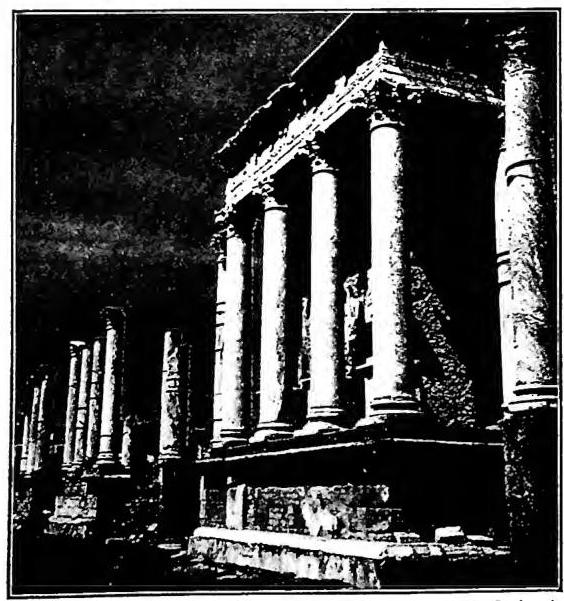
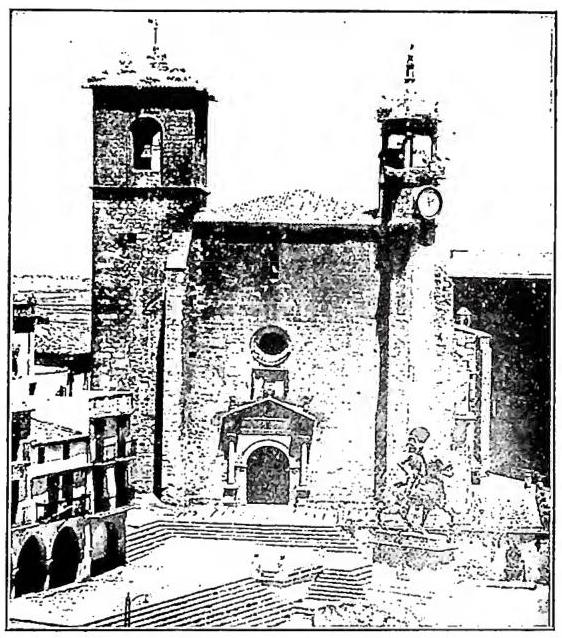
(courtesy of the Embassy of Spain - Tourism Office) MĚRIDA - Church of S. Martino (16th century) - Trujillo near M.