
SERBIA. — Historical region of the Balkans, constituting the core of the present-day homonymous unit incorporated as a federal republic into the Yugoslav state.
S. today corresponds to the inland country centered on the two river basins of the Morava, a left-bank tributary of the middle Danube, and the Vardar, which empties into the Gulf of Salonica after crossing a section of Greek Macedonia. It is a mountainous country, elevated along both its eastern margin (in contact with the Balkan arc) and its western margin (toward the Dinaric zone) into heights exceeding 2000 m., and thereby separated from Bulgaria to the E., from Herzegovina, Montenegro, and Albania to the W.; it consists of a slab of ancient formations, undulating in ridges of 1000–1400 m. and deeply cut into enclosed basins, or traversed by rivers connected with the two main drainage systems by gorges and ravines not always favorable to communications. This characteristic is accentuated in southern S., where the division into distinct small regional units is more evident: Metohija, Kosovo, the basins of Skoplie, Monastir, Tetovo, and Strumiza (the latter four belonging to Macedonia); to the N., on the other hand, the mountainous mass (Šumadija) opens toward the alluvial plains along the Danube and the Sava. Beyond the two rivers, the flatlands (Banato, Bačka) have been incorporated into S., giving rise to the autonomous region of Voivodina, which wedges itself between Hungary and Romania.
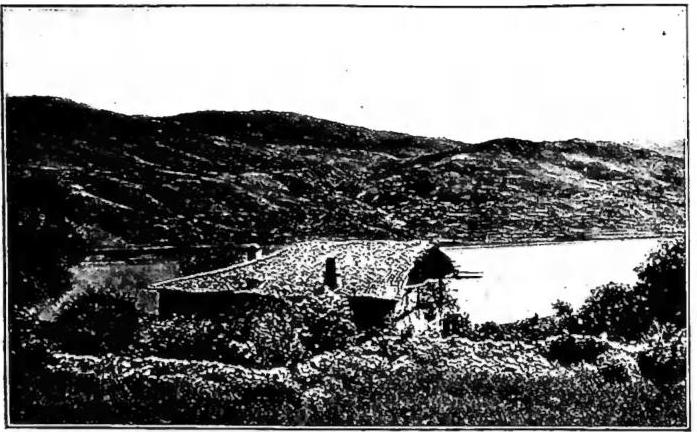
(from K. Hölscher, Jugoslavien, Berlino 1966, (av. 178)
SERBIA – Lake Ochrida.
They converge at Niš (51,000 inhabitants). Belgrade (390,000 inhabitants) represents the outlet of S. onto the Danube. In Voivodina are Subotica (113,000 inhabitants) and Novi Sad (77,000 inhabitants); the capital of Kosovo-Metohija is Priština (20,000 inhabitants).
Under Stefano di Nemanja (1170–96), the small grand principality of Rascia began to expand and to pursue a determined policy against Byzantium, which, thanks to Emanuele Comneno, had consolidated its position in the country, especially as a base for action against Venice. Stefano became involved in the struggles between the Empire and Venice, supporting the latter and entering into an alliance with Hungary. This westward orientation was continued, though with some oscillation, by his son Stefano, who, on receiving the royal crown from Pope Onorio III in 1217 (hence the appellation Primo Coronato), showed that he keenly perceived, even if merely as hostility toward Byzantium, the advantage of establishing ties with Rome. Nevertheless, a reaction was not lacking, much graver and more substantive, since the monastic and ecclesiastical element—which would remain throughout the centuries the greatest conservative force of Serbian national individuality—intervened to restore the balance: in 1219 the monk Sava, the King’s brother and later a saint of the Serbian Church, with the willing consent of the emperor of Nicaea and of the patriarch, founded the autocephalous Serbian Church, which would remain bound to the Byzantine schism down to our own days. The lack of a clear order of succession opened frequent struggles within the Nemanja dynasty, weakening the Serbian state and leaving it oscillating, according to circumstances, between Byzantium and Bulgaria, or Venice, Hungary, and the Papacy. Stefano Dušan (1345–55) rescued it from this weak and ambiguous position and from this ambivalence of affiliations; by opposing Byzantium and Hungary jointly, he was the true creator of great S. Just as Constantinople, « Roma saecunda », could bear only an imperial idea, so, faced with the chronic decline of the Byzantine Empire, Stefano Dušan, besides seeking the elevation of the exarchate to a patriarchate, attempted through conquest to assume its inheritance in full: on 16 April 1346 he was anointed and « crowned » “emperor of the Serbs and Greeks” by the patriarchs of S. and Bulgaria. Shortly thereafter he extended his rule to Epirus and Thessaly, but his death (20 December 1355) cut short his imperial dream.
After this great sovereign (who promulgated, with the Dušanov Zakonik, the first Serbian code), the weak successors—from Uroš IV to Vukašin and Lazzaro Hrebeljanović—failed to oppose a firm internal unity to the external danger, represented by the Magyars in the north and the Turks in the south; at Kosovo (Cossovo), in 1389, where King Lazzaro died, S. was brought under the power of the Turks, and only through the skill of the widow Miliza did it retain a certain autonomy as a vassal state (1389–1459). By now a field of contention and conflict between Magyars and Turks, S., after some aspirations to resistance and an independent policy under Giorgio Branković, submitted entirely to the Turks in 1459, following his death (1456). Thus began for S. a long period of complete subjection, relieved only in 1830 with the formation of the principality of S., though it was still a vassal of the Sublime Porte. The Serbs soon adapted themselves to the new situation; and if, under the name of martolosi, they advanced in the army, which at the lower levels became largely Serbian, they likewise gained ground in the administration of the state and in the army’s high command, as a result of the periodic « levies » of young boys sent to Constantinople to become janissaries, etc. The Serbian language became the language of diplomacy and of the Turkish Court, while, precisely as a result of the Turkish conquests that reached the Hungarian plain, the Serbian nation, with its military colonies, expanded considerably northward. The subsequent reconstitution of the Serbian patriarchate of Peć, carried out by the grand vizier Mehmed Sokolović (1557), himself of Serbian origin, who placed his brother Macario on the patriarchal throne, was an act of great political and religious importance for S., since the patriarchate assumed a far-reaching national mission. Through Byzantine tradition and Turkish legal custom, the Serbian Church gradually became a powerful national organization: the separation of the temporal from the spiritual was entirely foreign to the Turks’ political conception, and the patriarch necessarily became for them the supreme head of the Christians, not only spiritually but also, in a certain sense, civilly. In accordance with Byzantine tradition, the Church relied on the state, reciprocating its support by becoming an instrument for the political control of the Serbs and, almost, a guarantor of their loyalty. From the 16th century onward, the term « Serbian lands » designated those territories religiously subject to the patriarchate of Peć, extending from Macedonia to the Banat and Bačka. Thanks to the Turkish conquest and to the recognized jurisdiction of the Serbian national patriarchate, the Serbs acquired an ethnic extent never previously attained and would be in a position in the 19th century to play a leading role in the national revival of the South Slavs. Indeed, the first signs of recovery began to emerge from the peripheral « Serbian lands », as, after Passarowitz (1718), Turkey contracted into a purely defensive position. At the beginning of the 19th century, the Serbs were ready for a general revolt: between 1804 and 1815, successive insurrections began, bringing to prominence two families, that of Karagjorgje Petrović and that of Miloš Obrenović, which would contest power in S., with dagger blows, until the beginning of the 20th century.
Miloš (who had had Karagjorgje assassinated in 1817) obtained recognition of the title of prince (knez) on 29 August 1830, thanks to Russian support. An absolute monarch, no different from the Ottoman pashas, Miloš began, insofar as possible, to involve himself in the conflicts among the powers, in order to advance S. along the path to independence. In June 1839, unwilling to govern under the constraint of a lifelong Chamber with very extensive powers, imposed by Russia and Turkey, the protecting powers, he abdicated in favor of his son Milan; when the latter died after two weeks, he was succeeded by his second son Michele, who, continuing his father’s policy, was deposed by an armed insurrection in 1842. The family of Karagjorgjević was then called to the throne, in the person of
Alexander. Under him, his prime minister I. Garašanin, in the Načertanije, set forth what would be, for seventy years, the foreign-policy program of S., as the “Piedmont of the Balkans” and the unifying center of the southern Slavs, beyond every internal dynastic dispute. Alexander remained on the throne until 1858 and gave the country its own administrative structure, but in foreign policy his submissiveness toward Austria and Turkey (despite the fact that from 1856 the Russian protectorate had been replaced by the guarantee of the Powers) alienated public opinion. Expelled precisely in 1858, the old Miloš Obrenović was recalled to the throne and, upon his death, was succeeded in 1860 by his son Michele. By adopting Garašanin’s program, he entered the arena of European politics, created an army and, supported by France and Sardinia (later Italy), reduced the bonds of dependence on the Porte almost to nothing, urging the Montenegrins, Croats, Bosnians, etc., toward unification. Assassinated in 1868 by an emissary of the Karagjorgjević, he was succeeded in 1872 by Milan Obrenović. With the Congress of Berlin, S. obtained considerable territorial expansions, which increased its importance in the Balkans, so much so that Milan was able to assume the title of king. The defeat suffered against Bulgaria and internal dissension compelled him to cede the throne to his son Alexander. After the latter was overthrown in 1903, together with Queen Draga, by a military conspiracy, Pietro Karagjorgjević ascended the throne, under whom S. adopted a parliamentary way of life. By then decisively oriented against Austria and Turkey, especially after Austria’s annexation of Bosnia Erzegovina (1908), S. emerged enlarged from the Balkan Wars (1912–13). The assassination of the heir archduke Francesco Ferdinando by the Bosnian G. Princip (28 June 1914) opened the way to the First World War, at the end of which—following the declaration of Corfu (20 July 1917)—Croats and Slovenes joined S. under the scepter of Alessandro Karagjorgjević to form the Kingdom of the Serbs, Croats and Slovenes, later called Jugoslavia. In it, S.—and the Serbian national element—has to this day occupied a leading position, often involving national and religious domination, to such an extent as to preserve a bitter dispute with the Catholic Croats, which erupted during the Second World War, taking the form of a grave and bloody war of a national character. With the advent of Tito’s regime, S. has, since 1945, constituted one of the six republics of Federativa jugoslava. For the juridical relations with the Holy See, literature and art,
V. JUGOSLAVIA
Vedi tav. XXII.
(fot. Felici) SERÉDI, GYÖRGY JUSTINIANUS - Ritratto.