
ESTONIA. – Since 3 November 1940, it has constituted one of the federated republics of the Soviet Union; formerly a Danish, Polish, Swedish (1629), and Russian (1721) dominion, it had become independent in 1918.
I. GEOGRAPHY
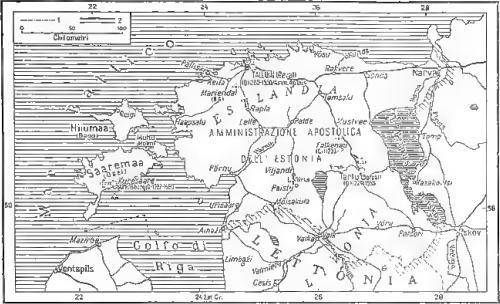
The territory (46,200 sq km; twice the size of Lombardy) is a strip of the Sarmatian lowland (the narrow peninsula enclosed between the Gulfs of Riga and Finland, which inland reaches Lake Peipus), level or hilly. In the population (1.2 million inhabitants, 26 per sq km), Estonians, of Finno-Ugric stock and professing Lutheranism, predominate (80%). The economy is based on agriculture and livestock raising (butter and meat), with modest industrial development (textiles, cellulose). The capital, Tallinn (Reval, 15,000 inhabitants), is a port on the Gulf of Finland; inland lies Tartu (Dorpat, 60,000 inhabitants), an intellectual centre (University).II. ECCLESIASTICAL HISTORY
It is held that the Estonians, who formerly lived together with the other Finno-Ugric peoples between the Volga and the Urals, were already occupying the territory of present-day E. at the beginning of the Christian era. The first attempts to Christianize E. by the Slavs and the Danes date from the 11th century, but they were unsuccessful. The Estonians, attached to their animistic tradition, and being bold warriors and pirates, made commerce throughout the Baltic Sea unsafe, extending their raids as far as the cities of Sweden and Denmark. At the end of the 12th century there were still no cities in E., nor had a centralized state organization been formed. The chiefs (canemad) of the small regions united their forces only in time of war.Around 1180, Pope Alexander III entrusted the evangelization of E. to the archbishopric of Lund and hence to Denmark. No decision, however, was taken regarding Livonia and Courland, which later became the center for the Christianization of the Baltic countries. German merchants travelling by the Latvian river Dvina to the Russian cities brought with them the Augustinian monk Meinhard of Segeberg. A native of Germany, he was consecrated the first bishop of Livonia by the bishop of Hamburg-Bremen in 1186, with a territory whose boundaries were not precisely established and which was subject to the metropolitan of Hamburg-Bremen. After Pope Alexander III’s struggle against Frederick Barbarossa, it was natural that his successors should wish the mission in the Baltic to be regarded as purely pontifical. Yet, as children of their age, they believed that anyone who abandoned the Christian faith was gravely guilty not only before God but also before men, and they were convinced that such a person had to be compelled by force to remain faithful and likewise protected against the pagans. The successor of the peaceful Meinhard (1186–96), the Cistercian abbot Berthold of Lekkum (1196–98), arrived with a troop of crusaders but fell in battle. The third bishop, Alberto di Riga (v.), founded the Order of the Sword Brothers and the fortified center of Riga (1201). Shortly afterward (1207), Alberto abandoned the Pope’s policy and swore an oath of vassalage to the German king Filippo di Svezia; the German Empire, assuming the form of a purely ecclesiastical state in mission territory, began its policy of expansion there.
As soon as the Livonians and Latvians had been converted, the Sword Brothers began (1207) the subjugation of E.; but, owing to the exceptionally tenacious resistance, they won the decisive battle only in 1217. Subsequently they were forced to request the aid of the Danes, who arrived in 1219 under the leadership of Waldemar II in northern E., where they founded the fortress of Reval, present-day Tallinn. By 1224 the country was practically subjugated; the conquest of the largest island, Saaremaa (German Üsel), required a special crusade in 1227.
In the Livonian War, which began in 1558, the Russian tsar Ivan IV the Terrible defeated the Teutonic Order; the Germans now accepted the political domination of the Swedes (who, under Gustavus Adolphus, introduced the Swedish Protestant ecclesiastical system), of the Poles (1562–1629), who began the recatholicization, and of the Danes, who remained in the islands. There is information concerning the visitations of several Swedish Protestant “bishops” (1585–1700), who resisted the barons’ claim to participate in the Synod. From 1692 to 1694 the Swedish ecclesiastical system of 1686 was in force, revised only in 1832.
In 1710 E. was conquered by Peter the Great (definitively through the Treaty of Nystad in 1721). The situation of the surviving Estonian peasants worsened because of the concessions made by the Russians to the local barons. Only after an imperial decree concerning E. (1816) was serfdom abolished. The nobility obtained from the Russian Senate control of the Estonian Protestant consistory and retained this privilege throughout the entire period of Russian rule. From 1730 onward, the Protestant sect of the Vennastebogaftured (in German Herrnhuter) made many converts among the peasants. From 1830 to 1848, more than 75,000 Estonians and Latvians of Livonia, hoping in this way to free themselves from the great landowners, joined the Russian Orthodox State Church. This movement was encouraged and at times especially promoted by the bishop of Riga, Filaret Gumilevskii (1831–48).
Favored by political circumstances, E. declared its independence in 1918 and won a hard-fought struggle against Bolshevik Russia and the German armies organized by the barons. In 1925 the separation of Church and State was legally defined. In E. (1934), there were 78.6% Protestants; 19% Orthodox (autocephalous), of whom 8.2% were Estonians; 1.5% members of other Christian sects; 0.4% Jews; and 0.3% without a religion. The Catholics, approximately 2,500, or 0.2%, were divided among six parishes (Tallinn, Tartu, Narvi, Valga, Pärnu, Kuressaare), formerly belonging to the archdiocese of Mohilev and, from 1918, to the diocese of Riga. In 1924 the bishopric of Tallinn, already suppressed by the so-called Reformation, was restored and placed under an apostolic administrator.
In 1940 E. was occupied and incorporated into the Soviet Union; from 1941 to 1944 it underwent German occupation; afterward it was reconquered by the U.S.S.R., which extended its anti-Christian legislation there.
III. LITERATURE
The first books in the Estonian language (a branch of the Finno-Ugric family) are severalCatholic religious manuals by Bishop Giovanni IV Kievel and the Jesuits Th. Busilus, J. A. Weltherus, and W. Buccius (the sole one to have come down to us is the Agenda Parca of 16aa), as well as Protestant works of the 16th–17th centuries; these were followed by Protestant religious and practical manuals (New Testament, 1715; Bible, 1739). Estonian folklore, which has assimilated many Germanic elements, is exceedingly rich and was collected following the impetus given by J. Hurt at the end of the 19th century. The language of the educated class long remained German; only after 1850 did genuine Estonian literary works appear.
After books of Pietist inspiration (especially those of the Herrnhuters) at the beginning of the 18th century, popular secular literature arose under the influence of the Enlightenment. A romantic current with a historical coloring (which became increasingly national over time) gave a distinctive imprint to the emerging culture. Against the background of the Estonian Learned Society (founded in 1838), F. R. Kreutzwald created the Kalevipaeg (1861), an epic imitating popular poetry. This work greatly influenced the national awakening and the whole of the literature of the national revival, culminating in the patriotic lyric poetry of Lydia Koidula. At the end of the century, the “pure lyric poets” Julian Liiv and Anna Hauva distinguished themselves, while in prose the realism of E. Wilde, E. Peterson-Sargava, and A. Kitzberg was gaining ground. Around 1905, the lyric poets G. Suits and V. Ridala, and the short-story writer and critic F. Tu-
The independence achieved in 1918 created favorable conditions for the development of a national culture. After a period in which lyric poetry influenced by the West predominated, the realism and naturalism of A. Kivikas, H. Raudsepp, O. Luts, A. Jakobson, M. Messenuck, and the notable A. H. Tammsaare prevailed; the last two often deal with religious subjects. Other prose writers worthy of note are K. A. Hindrey, K. Ristikivi, A. Mälk, and the Finnish-Estonian writer Aino Kallas. Among the poets, B. Alber, A. Talvik, and B. Kangro may also be mentioned.
Estonian figurative art and music, properly so called, began with the national awakening of the 19th century and are represented by the painters J. Köler, A. Laipman-Laikmaa, P. Burman, K. Raud, N. Tnik, K. Mägi, A. Wabbe, E. Ole, E. Wiralt; by the sculptors A. L. Weizenberg, A. Adamson, J. Koort, V. Melnik-Mellik, F. Sannamees, A. Starkopf-Rea; and by the composers A. Kapp, R. Tobias, M. Saar, J. Aavik, C. Kreek, H. Eller, E. Aav, and E. Tubin.
With the annexation to the U.S.S.R., the cultural life of E. was subjected to Marxist ideology, while numerous intellectuals continued the cultural traditions of free E. in exile. In E., numerous intellectuals were deported.
Otto A. Webermann