GIOVANNI CRISOSTOMO, saint. — The greatest Christian orator, and one of the greatest orators of all
time, was G., called by posterity—from the sixth century onward—C. (that is, “golden-mouthed”).
Born in Antioch between 344 and 347, into a distinguished family, he was the son of Antùsa, who, widowed at the age of twenty, devoted herself entirely to him. He received the most careful education: in secular studies, under the guidance of Libanius and of a philosopher, Andragazius, now unknown; and in religion, under that of Bishop Meletius, from whom he received Baptism around 369, and of Diodorus, the future bishop of Tarsus (and, it seems, also of the ascetic Carterius). After his mother’s death, G.—who had renounced withdrawal into the desert only because of her prayers—escaped consecration to the episcopate by flight (it is difficult to regard this detail as a literary fiction), lived a monastic life for four years, and then spent two years as a hermit. Returning to Antioch, in 381 he was ordained deacon by Meletius and, five years later, priest (386) by Bishop Flavian, his successor. For twelve years he exercised the apostolate of preaching at Antioch, arousing the most ardent and passionate response among the crowds, and also intervening with persuasive and fiery words to offer comfort and counsel in extraordinary circumstances, as in 387, when the city, having risen against certain harsh taxes imposed by Theodosius, had gone to violent extremes, destroying the statues of the Emperor, and was passing through a period of terror and anguish while awaiting punishment, which only the intervention of Flavian succeeded in averting.
Toward the end of 387, when the see of Constantinople became vacant following the death of Nectarius, he was called to that position against his will, with the consent of the clergy and people, by the Emperor Arcadius, at the suggestion and with the support of Eutropius, who wielded great influence over him, but secretly opposed by the ambitious bishop of Alexandria, Theophilus. The latter’s candidate was the elderly priest Isidore, but he nevertheless had to resign himself to consecrating G. bishop of Constantinople; the position, however, was not the most suitable for G. Austere, forthright, and uncompromising by nature, he soon aroused around his person and his work of courageous renewal and purification enmities, jealousies, and conflicts in court circles and among part of the clergy. The first conflict broke out with Eutropius himself, who was working to have the churches’ right of asylum abolished, and had succeeded despite G.’s resistance. Shortly afterward, having fallen from favor, Eutropius himself sought asylum in a church and experienced G.’s generosity: G. energetically and at his own risk opposed his being dragged out by force. G.’s popularity continued to grow, partly as a result of these events, and from the beginning of his episcopate his efforts toward the conversion of the Arian Goths settled in the city or its environs had produced excellent results. He enjoyed the highest prestige, both because of his personal merits and because of the pre-eminent position that the see of Constantinople held over the churches of the surrounding regions. Toward the end of the winter of 401, he left Constantinople for several months and went to Asia on a kind of inspection tour. On that occasion he presided over a synod at Ephesus, caused several simoniacal bishops to appear and be deposed (thereby creating new enemies), and had the monk Heraclides elected bishop of Ephesus; on the return journey, at Nicomedia, he deposed the bishop Gerontius. His enemies took advantage of his absence to plot intrigues against him; among them was his substitute, Severian of Gabala, with whom G. broke off all relations upon his return, but was later reconciled through the intervention of the Empress. In that same year his conflict with Eudoxia began. After the downfall of Eutropius, she had acquired a dominant position at court, exercising ever greater influence over her husband, the weak Arcadius.
It is difficult to reconstruct all the details of this conflict and to clarify its true causes, since none, or almost none, of the sources is free from suspicion of partiality; and G.’s own writings, which could provide the most reliable testimony, are themselves subject to the doubt that some are apocryphal or interpolated. It is said that the cause of the conflict was Eudoxia’s usurpation of a vineyard belonging to a widow, which allegedly provoked the patriarch’s harshest, though veiled, censures. But the authenticity of the Life of Parfirius, Bishop of Gaza, written by his deacon Mark, which would be a valuable testimony because it was contemporary with the events, has been questioned; moreover, the report itself, which does not appear elsewhere in sources earlier than the seventh century, may have been constructed on the basis of G.’s homily, where reference is made to Naboth’s vineyard and Jezebel’s crime. The fact is that at a certain point the Empress and Theophilus are found allied against G.
Theophilus had never looked favorably upon G.’s election; the case of the “Tall Brothers,” four Egyptian monks whom he accused of Origenism and forced into exile—who had been warmly received, together with other monks from Nitria, by G., although he did not admit them to Communion and limited himself to attempting, unsuccessfully, to intercede for them with Theophilus—openly turned him against G. Despite the accusation of Origenism brought against him by the bishop of Salamis, Epiphanius, who, at Theophilus’s instigation, had come to Constantinople in 403 to direct the anti-Origenist campaign there, and despite the intrigues of other bishops, who continued the struggle after Epiphanius’s departure, as well as those of other persons, G., still in Eudoxia’s favor, initially prevailed over his enemies. The same Theophilus, the moving spirit behind all the machinations, was summoned by Arcadius to Constantinople in 403 to answer the accusations brought against him by the monks before Eudoxia, in the presence of a council that was to be presided over by G. But when Eudoxia changed her attitude toward G., it was not difficult for Theophilus to turn the situation to his advantage, also because of the moderation displayed by the bishop of Constantinople, who, as he relates in his letter to Pope Innocent, did not wish to preside over the Council that was to judge Theophilus, because, on the basis of the canons of 381, he did not consider himself obliged to concern himself with Egyptian affairs. Having landed at Constantinople at the head of twenty-six Egyptian bishops loyal to him, Theophilus set about securing the support of other members of the clergy hostile to G. and having libelli of accusation against him presented to the Emperor. Then, now certain of the Emperor’s support, who was dominated by Eudoxia, instead of appearing as the accused before a council, he convened one at Chalcedon (in Constantinople the people’s support for C. was too great). From the place where it met, this council is called ad Quercum. This Synod, consisting of thirty-five bishops, proceeded against G. in absentia. G. had declared himself willing to appear if Theophilus and three other bishops, including Severian, who were notoriously hostile to him, were excluded from the Synod. The Synod brought various more or less calumnious accusations concerning the bishop’s private life, his administration, and his conduct toward certain persons; the accusation of lèse-majesté was also added, on the grounds that he had offended the Empress. As a result of this odious judgment, G. was deposed and sent into exile.
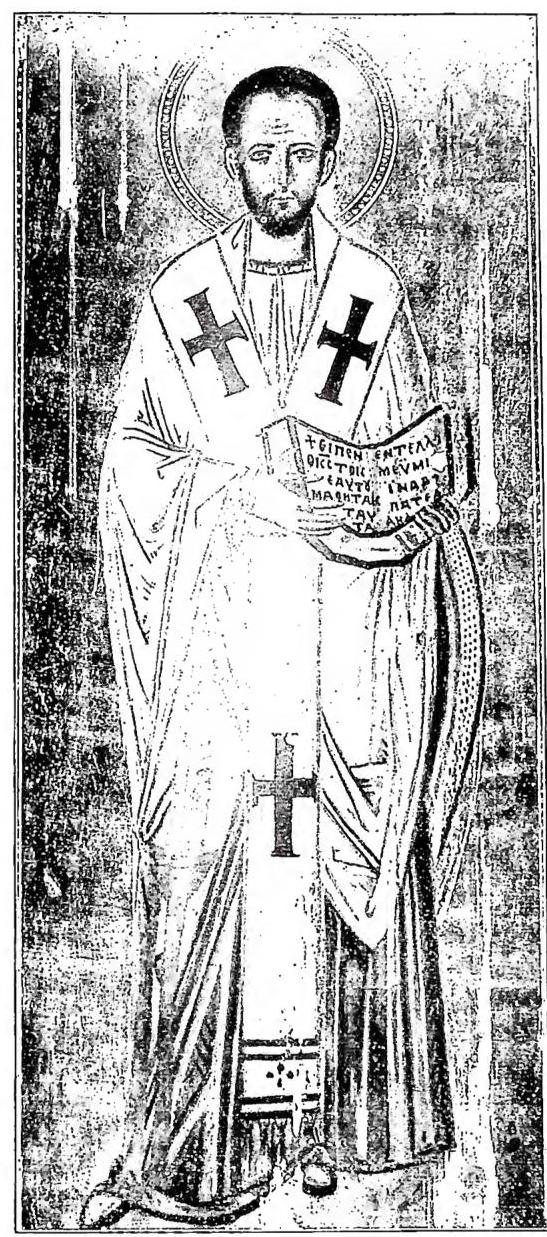
(phot. Biblioteca Vaticana)
GIOVANNI CRISOSTOMO, saint - The figure of the Saint on a wooden casket (11th cent.) - Biblioteca Vaticana, Museo sacro.
because he had returned spontaneously from exile and resumed possession of his office, although he had been deposed by a council, without the consent of another, more numerous synod (a faculty which, moreover, he had lost by virtue of the fourth of the Antiochene canons). The machination was directed, as always, by Teofilo: it was of no avail to object that G. had not returned spontaneously and that the canon invoked was Arian; it was not deemed necessary to depose him a second time, but only to drive him from the position he occupied without right. G. was therefore arrested and compelled into exile for the second time; in order to avoid disturbances among the people, who plainly wished to oppose his deportation, he surrendered himself voluntarily to the imperial soldiers and left through the eastern gate of the church, eluding the waiting crowd. It was an especially harsh exile, first at Cucusa in Cataonia, then in the fortress of Arabissus, and finally in Pontus. Death overtook him on the journey at Comana, in Cappadocia, on 14 September 407. His last words were: « Glory to God for everything ». In 438 his remains were brought back in triumph to Constantinople and deposited upon the episcopal throne in the Church of the Apostles by the son of Eudossia herself, Teodosio II. It was the recognition, on the part of the entire people, of the holiness of the pastor who, through his speech—for no one ever possessed a more magnificent gift—and through the example of a life that remained ascetic even amid the turmoil of action and struggle, had renewed, it has been said, the age of the Apostles.
BIBL. Sources: the works of Crisostomo himself, especially the Letters and the De sacerdotio. In addition: Palladio, Dialogo storico sulla vita del b. G.; id., Historia Lausiaca; the historical works of Socrate, Sotomeno, Filostorgio, Zosimo, Teodoreto, and Nicotero Callisto. On the Synod ad Quercum, G.’s letter to Pope Innocenzo and the Acts preserved by Fazio (Bibliotheca, cod. 59). Other biographies: by Giorgio, patriarch of Alexandria (630), by Teodoro, bishop of Trinitunte, Intorno alla vita, all'esilio e alle vicende del beatissimo G., detto C. (10th cent.), by an Anonymus Scriptor, Vitae S. Chrysostomi (10th cent.), Vita di s. G. C., in Simeone Metafraste (10th cent.), treatment in the Suda; an encomiastic fragment by Martirio, bishop of Antioch (5th cent.). Information also in Marco Diacono, Vita Porphyrii, and in Vita Sanctae Olympiadis diaconissae (in Anal. Bolland, 15 [1896], pp. 409-23). - Studies: Tillemont, I, Parigi 1714; E. Martin, St J. Chr., 3 vols., Montpellier 1860; A. Thierry, St. J. Chr. et l'impératrice Eudoxie, Parigi 1872; F. Ludwig, Der heilige Ort in seinem Verhältnis zum byzantinischen Hof, Braunsberg 1883; W. R. W. Stephens, St J. Chr. his life and times, Londra 1885; G. Rauschen, Jahrbücher der christlichen Kirche unter dem Kaiser Theodosius dem Grossen, Friburgo in Br. 1897; P. Ubaldi, La Sinodo « ad Quercum » dell'a. 404, Torino 1902; F. Cavallera, Le schisme d'Antioche, Parigi 1905; various authors. Χρυσεσχηλικέ, Studi e ricerche intorno a s. G. C., edited by the committee for the fifteenth centenary of his death, Roma 1908; A. Puech, St J. C., Parigi 1913; H. Lietzmann, s. V. in Pauly-Wissowa, IX, col. 1811 SGR.; Chr. Baur, Johannes Chrysostomos und seine Zeit, 2 vols., Monaco 1929-30; A. Puech, Hist. de la litt. grecque chrétienne, Parigi 1930; H. Grégoire et M. A. Kugener, La Vie de Porphyre, évêque de Gaza, est-elle authentique?, in Bulletin de l'Association G. Budé, 26 (Parigi 1930); G. Lazzati, Teofilo d'Alessandria, Milano 1935, especially pp. 49-69.
II. WORKS
The work of G. C. is of impressive breadth: it comprises treatises, discourses, and letters. He was above all a preacher, and the treatises too are, so to speak, a kind of preaching, directed toward practical aims: exhorting, enlightening, and instructing. The treatises belong to almost every period of G.’s life, though most of them date from the period extending from 381 to 386.Belonging to the period preceding his diaconate are the two books—an exhortation and a letter—To Theodore, after his Fall, written, it seems, between 371 and 378, to lead the future bishop of Mopsuestia (for it seems that the addressee of the treatise should be identified with him) back to the ascetic life of which he had grown weary; the two books On Compunction, dedicated, the first to Demetrius and the second to Stalechius, perhaps composed at different times, between 375 and 376, or, according to others, between 381 and 383; the three books Against the Opponents of the Monastic Life, which are a defense of asceticism against the accusations of the pagans (the inspiration of the work is Platonic; it also displays Stoic influences and expresses certain personal pedagogical ideas; its date is uncertain, though it probably belongs to the same period as the other work); and the Comparison between the King and the Monk, which develops a theme mentioned in Against the Opponents of the Monastic Life (the well-known Stoic proposition, developed in the form of a σύγκρισις, is here applied to the relationship between the king and that figure of the practical philosopher who, in Christian times, is the monk; the word “philosophy,” moreover, takes on the meaning of “ascetic life”; the Stoic paradox almost ceases to be such in the Christian vision of life). To the period of his diaconate and then of his priesthood belong the consolatory work To Stagirus, a young man who had not found peace of spirit in the ascetic life and was wasting away in a morbid melancholy—which he attributed to demonic possession—and which also drove him toward thoughts of suicide (G. demonstrates to him the providential function of suffering and points to active life as the remedy); the treatise On Virginity, perhaps from 381 (in which he displays notable maturity, both formal and intellectual; it follows the teaching of Paul, according to which marriage is approved, but virginity is considered superior; it is directed against the Marcionites); and To a Young Widow, a kind of consolatory letter, dedicated to the widow of Tarasius, who had lost her husband after five years of marriage (some regard the work De non iterando coniugio as an appendix to this treatise). Perhaps belonging to this period—although it may be somewhat later, as the greater experience that the author appears to have attained would suggest—is the six-book treatise, in dialogue form, On the Priesthood, concerning the duties of the priest and the greatness of the priesthood: a work of great elevation and profundity, demonstrating a marvelous knowledge of the human heart, and written in a lucid and animated style which, together with its other compositional and conceptual qualities, makes it a work without comparison in all literature, even secular literature, of the fourth century. It cannot be stated whether the two disciplinary treatises Against Those Who Keep Co-resident Virgins in Their Homes and On the Necessity That Religious Women Not Live with Men belong to the Antiochene or the Constantinopolitan period. Certainly belonging to the earlier period is the apologetic work Against Julian and the Pagans, or On St. Babylas, composed twenty years after the events narrated in it, namely the burning of the temple of Apollo, which followed the transfer of the Saint’s relics, carried out by order of the Apostate, from Daphne, where Gallus had had them brought, to the city: religion is defended against the Emperor’s attacks, on the basis of the miracles of Jesus and the wonders that occurred on the occasion of the translation of the martyr’s relics; and, in all probability, also the short work Against the Jews and the Gentiles: That Christ Is God. To the period of exile belong two treatises which may in fact be two letters: one, To Those Who Were Scandalized by the Recent Events, is a kind of apology for divine Providence; the other seeks to demonstrate That No One Can Be Harmed Except by Himself.
Of the Discourses, most are exegetical; a considerable number concern episodes and isolated passages of the Bible (Lazarus and the rich man, the beginning of the Acts, individual verses of Paul’s Epistles, etc.). More important—also because of the total bulk of such works, which number approximately 700—are the homilies commenting on entire books or substantial portions of the Old and New Testaments. Particularly noteworthy among them are the sermons On the Epistles of St. Paul, numbering 250, which constitute the finest commentary on the epistles themselves. The 32 homilies On the Epistle to the Romans in particular represent the best that the activity of the Fathers of the fourth century produced in this field: because of the heights reached there by G.’s speculation on dogma, the dialectical vigor he displays, the fact that exegesis is not separated from morality—as, indeed, none of his exegesis is—the feeling of paternal love that warms and pervades these writings, and the sense of sublimity and almost ecstasy communicated to the reader. Except for the homilies on the Epistle to the Colossians and those on the Epistles to the Thessalonians, these homilies commenting on Paul’s Epistles date from the Antiochene period; those on the Epistle to the Romans belong to the Constantinopolitan period. Other exegetical discourses are devoted to the Psalms (approximately 60 psalms; they are among G.’s most valuable works), to Genesis (9 on certain portions, 67 on the whole of Genesis: the first group from 386, the second from 388), to other historical books of the Old Testament (Hannah, David, and Saul, from 387), and to the Prophets (6 homilies on Isaiah, I–VI, and 2 De obscuritate prophetarum). Commentaries were also given on St. John the Evangelist (in 88 homilies, directed especially against the Anomoeans; from 389), St. Matthew (90 homilies, written at Antioch, apparently in 390, admirable for the vigor of their exegesis and the elevation of the morality taught in them), and the Acts of the Apostles (numbering 55, from 400–401; they seem to lack the necessary refinement). Other discourses are moral in character (such are the homily Against the Games of the Circus and the Theaters, the 9 On Penance [the authenticity of the last three is doubtful], the 2 Ad illuminandos, delivered before their Baptism, the one On the Calends, the one On Almsgiving, the 3 On Temptations, the 2 De precatione, and those On the Mysteries [they refer to the great feasts of the Lord: Christmas, Epiphany, Holy Thursday, Good Friday, Easter, the Ascension, and Pentecost; not all are of certain authenticity]). Discourses that are both polemical and moral are the 12 sermons Against the Anomoeans, on the Incomprehensibility of God (in which the consubstantiality of the Son with the Father is defended), the homily De non anathematizandis rudibus, and the 8 Against the Jews (from 386, like the sermons Against the Anomoeans, some of which, however, are later, while the last two are also later than 389). Related to this genre of homily are the Panegyrics, of which noteworthy are the 7 delivered at Antioch in praise of St. Paul, that of Philo-gonus, and the Eulogies—of Job, Eleazar, and the Maccabees—the 3 homilies On the Martyrs, and the Discourses on St. Ignatius of Antioch, Romanus, Lucian of Antioch, Eustathius of Antioch, Meletius, and Balaam.
Certain discourses are of greater interest, and in various respects: although always moral in subject, they are closely connected with the occasions that prompted them, such as his first homily, delivered in 386, immediately after he had been ordained a priest, in which he expresses his gratitude to Flavian. Famous among these discourses are the 31 homilies On the Statues, of 387 (properly 19, since the first predates the uprising and the 19th is unrelated to the events), delivered on the occasion of the tragic events at Antioch, which they accompany and allow one to follow, day by day, in their dramatic reality; and the two discourses On Eutropius, delivered after the fall of Arcadius’s powerful favorite (particularly famous is the first of them, for the profoundly dramatic vitality with which morality is invested there; it begins with the words of the Ecclesiastes: “Vanity of vanities, and all is vanity”), and the two Before His Departure into Exile (of 403) and After His Return from Exile, of the same year. Some of these orations are of doubtful authenticity, and some are certainly apocryphal and interpolated, or have come down in stenographic versions: very probably apocryphal is the oration that is said to have provoked the wrath of Eudoxia and brought about his second exile, from which he was never to return, the one that begins Again Herodias rages, again she raves, again she dances and asks for the head of John on a platter. But the question of the authenticity of G.’s orations is far from being resolved.
G.’s eloquence is natural—skilled, but not enslaved to the teachings of the schools—and is always sustained by the sincerity of faith and by emotion, which ensure that nothing in it sounds false or declamatory. Penetrating powers of observation, lucid and closely reasoned argumentation, warmth of feeling, richness of ideas, and imagination combined to give his eloquence that capacity, still alive in it, to conquer souls and move them. From the familiar homilies, which may be said to be his own creation, to the exegetical orations, and to those that might be called historical, in which the accent of the great Demosthenic and Ciceronian eloquence has rightly been recognized (though there is, in addition, the influence derived from the Sacred Books), there is one and the same breath of greatness animating and elevating his eloquence, even when it descends to the tone of conversation, one and the same abundance proceeding from the heart; one and the same breath of “charity.”
The Letters, numbering 328, belong almost entirely to the period of his exile (404–407), and are addressed to friends left behind at Antioch and Constantinople; two are addressed to Pope Innocent; particularly noteworthy are those addressed to the deaconess Olympias, to whom he speaks words of comfort and hope; not very important for the history of the times, these letters are the complete testimony of a soul illumined, amid the harshest trials, by the light of Faith.
III. THE DOCTRINE
G. C. was not properly a philosopher or a theologian; it would be better to say that he was not an original philosopher or theologian. He certainly possessed a broad knowledge of pagan philosophy, of Platonic and Stoic philosophy, and perhaps also of Neoplatonism. This knowledge did not remain inactive in his spirit, although some have regarded the action of Hellenism in G.’s work as external and irrelevant; rather, it was a leaven that in some manner operated in his thought, together, though to a much lesser degree, with the inspirations and influences that came to him from the Sacred Books and from the apostolic tradition.As a theologian, G. certainly did not possess the speculative spirit of an Athanasius or a Basil, or of a Gregory of Nyssa; but one must also consider that he lived at a time when certain problems were no longer felt with the urgency they had once possessed, and Arianism was no longer as threatening as it had previously been, while the Trinitarian dispute seemed, and in substance was, concluded. His doctrine is therefore of the most scrupulous Nicene orthodoxy, which he defended against the Anomoeans; the accusation of Origenism brought against him by Epiphanius, but subsequently withdrawn by Epiphanius himself, has not the slightest foundation. He does not address the problem of the two natures in Christ in depth (he never gives Mary the name of theotókos, but neither does he compromise himself in the opposite sense, although he sometimes attributes excessively human sentiments to her); but he affirms Christ’s humanity in his life, works, and death, while at the same time glorifying his divine attributes and stopping before the mystery of his unity. He expounds the doctrine of the Eucharist and transubstantiation with such clarity as to merit the title of “Eucharistic Doctor,” affirming, with a realism that may even seem excessive, the real presence of Christ. He is an energetic and convinced defender of free will, but not in such a way that one can make him a denier of Grace or virtually a Pelagian in the strict sense: in any case, the problem would not be posed until later. He believes, although he does not explicitly affirm it, in the existence of original guilt; he believes in the dogma of hell and eternal punishments, which he describes in vivid colors, and defends it against those who regard it as irreconcilable with divine goodness; he believes, against the Donatists, in the efficacy of Penance (and Confession), which he extends to all sinners and does not restrict to a single occasion (which was one of the accusations made against him at the Council of the Oak).
G.’s exegetical method was what one would expect of a man who had received the teaching of Diodore of Tarsus and been influenced by it: that is, it was the method of the Antiochene school (of which he was the most illustrious representative), which, in opposition to the Alexandrian approach, without excluding allegorical interpretation, assigned greater importance to the literal method.
As a moralist—one of the greatest moralists Christianity has had in all ages, although at certain points his vision may have seemed to some somewhat limited and insufficiently universal—he may rightly be defined as a reformer of Christian society. The ideal toward which he strives is inspired by the life of the primitive Christian communities, and is a kind of “angelic society,” the translation into social life of the life of cenobitic communities, which he would like to see established on earth: a society in which there would be no mine and thine, and in which those that were the two scourges afflicting society in his time—pauperism and slavery—would, if not eliminated, at least be reduced to a minimum. Although he regards the origin of wealth as—often, if not always—unjust, he does not condemn private property (which he nevertheless considers an evil) and wealth in themselves, but rather their misuse; and he points to the remedy for social inequality, which is a consequence of wealth, not in its abolition or in its distribution among the poor, but—and here the problem assumes its moral character—in a kind of “adoption of the poor by the rich.” Slavery too is condemned, and its limitation, if not indeed (which should not be ruled out) its abolition, is advocated, as is also an improvement in the slaves’ conditions; but both matters are placed on the moral plane, entrusted to the masters’ sense of humanity (decidedly, G. has nothing of the tribune).
Since G.’s morality is profoundly “optimistic,” it perhaps has the fault of often assuming in the mass of his hearers the purity of his own sentiments and their natural goodness; it relies upon man’s will (whence does evil come? he asks in hom. LIX on St Matthew, 2–3: from what we will or do not will, he answers; and upon what does this willing or not willing depend? upon ourselves, he concludes); it points to conscience, as well as the Gospel, as the guide of action; it resorts to persuasion rather than coercion or threats; it abstains from personal attacks (he who declares that he combats heresy, not heretics); it is far removed from every air of self-sufficiency; it takes its stand upon concrete, living reality, not upon rigid systems and theory, and is therefore, in the final analysis, an indulgent moralism. Indeed, he considers intention meritorious even when the act does not follow it, and he does not measure the latter by its magnitude, for example, almsgiving; he finds that certain vices are justified by certain natural dispositions; he does not preach asceticism, impose bodily privations, or demand absolute continence; he does not condemn the flesh, but only lust and unchastity; he advises treating those who insult us as weak and sick persons; he finds that anger, in certain cases, can serve the good...; he makes the light of hope shine before men and strengthens their faith in divine mercy.
From all his works an entire