
SLAVERY. - From the Old German slav, a term applied by the Germans to Slavic peoples taken prisoner by them, and it may be defined as the state of a person who belongs to another as a thing and depends entirely on the will of another.
Captivity in war is the oldest and most universal way of falling into slavery, as the prisoner becomes the property of the captor. This is the servitus that Roman law admits by virtue of the law of nations. Alongside captivity in war (external war, however, not civil or brigandage), there is a slavery that arises either from the condition of nature: thus the child of a slave woman is a slave; or from special circumstances in which the individual has come to be: thus in Rome, the insolvent debtor becomes a slave, sold by the creditor trans Tiberim (that is, outside Roman territory); he who evades military service or registration in the census lists (and who, by order of the consuls, is likewise sold trans Tiberim); the free woman who has relations with a slave, against the will of his master; in the imperial era, the condemned ad bestias or ad metalla (servitus poenae).
I. SLAVERY IN THE ANCIENT WORLD
The importance and extent of slavery in the ancient world are founded on the fact that the entire economy was based on manual labour, which, in countries with a centralised regime, such as the Eastern Empires, where subjects were considered the property of the sovereign, his great feudal lords, and the temples administering vast estates, was performed by the inhabitants of the country. Conversely, in countries with a free political regime (city-states), where citizens were absorbed by the affairs of the state, labour was carried out by servile manpower.Aristotle himself, in his Politics, bases the necessity of slavery on the impossibility for the citizen to attend to tasks incompatible with his condition as a free man. He justifies the right of war, which is its primary source, insofar as the victor demonstrates an external superiority that proves his internal qualities. This viewpoint had already been expressed by Heraclitus, who asserts that war, by pitting forces against one another, sifts the powerful from the weak and thereby founds and organises society.
Plato, too, in his Republic, takes no account of the servile masses, as they have neither the time nor the means to acquire the culture of the spirit, which alone confers the right to govern the state.
In Athens during the 5th and 4th centuries B.C., slaves were estimated to number over 100,000, either in the service of the family into which they were born (σίλλογενεῖς) or of the state (δημόσιοι), which employed them in armed police service (τοξέται) or other public duties. They could be manumitted, that is, regain their freedom (ἀπελεύθεροι), in various ways: by consecrating them to a deity, proclaiming them free through a herald, or by virtue of a will.
In Rome, during the earliest times, slaves were not numerous; names such as Marcipor and Gaipor, meaning "slave of Marcus" or "slave of Gaius," indicated that one slave sufficed. Their numbers later increased significantly. Augustus fixed their number at 20, but in the countryside (familia rustica, under the direction of a vilicus, himself a slave), the number was unlimited and certainly exceeded that of free men.

In Rome, too, a slave could be manumitted, thus becoming a freedman. This could occur through particular legal acts, such as a will, in iure cense (manumissio vindicta), or the inscription of the slave, with the master’s authorisation, in the census lists (manumissio censu). Alongside these forms of manumission, known as civil, which in historical times made the freed slave a Roman citizen, there were others lacking solemnity (manumissiones inter amicos, per mensam, etc.), whose efficacy was later guaranteed by the praetor.
With the advent of Christianity, a new form of manumission was introduced, with the same effects as civil forms: manumissio in ecclesia.
The condition of slaves, initially harsher in Rome than in Greece, gradually softened under the Empire. This occurred precisely when, due to the dire state of agriculture—caused by vast latifundia and an abundance of free labour no longer occupied in wars—slavery began to diminish, also due to the lack of slave imports, while free labour under the colonate system increased.
Claudius declared free any slave whom the master wished to abandon due to old age or illness. Hadrian and Antoninus Pius deprived masters of the right to kill their slaves. Constantine equated the killing of a slave with that of a free man.
II. SLAVERY IN THE BIBLE
Among the ancient Hebrews, as among other peoples, prisoners of war particularly supplied the slave market (I Sam. 30:3; Am. 1:9; Ez. 27:13; I Mach. 3:41). Furthermore, all the children of a slave were considered the property of the master (Ex. 21:4). An Israelite could not be sold as a slave to foreigners; indeed, he should never have been reduced to such a condition (Lev. 25:42-46). In practice, however, often for financial reasons or due to insolvency toward a creditor, even Israelites were subjected to slavery (II Reg. 4:1; Neh. 5:5, 8). A thief who could not return the stolen goods became the property of the robbed party (Ex. 22:3). The poor sometimes found themselves in such conditions that they had to sell their own family and even themselves (ibid. 21:7 ff.).
Hebrew legislation in many cases limited the master’s rights, prohibiting the sale of his slaves. Indeed, he was required to grant freedom to his fellow-countryman slaves after six years of service, ensuring them a minimum essential for living (Lev. 25:39-54; Ex. 21:2; Deut. 15:12-18). The slave was permitted to renounce his freedom; in such a case, he remained the property of the master (Ex. 21:5, 6). Freedom could also be regained through flight (Deut. 23:16 ff.) or following mistreatment by the master (Ex. 21:26, 27).
The law insists on prescribing humane treatment, especially adducing religious motives. Slavery among the Hebrews was far more bearable than that practiced among the pagans. The Essenes and the Therapeutae openly declared themselves opposed to II. But in practice, the condition of those wretches must not have been at all enviable. The very humane law that obliged the return of an Hebrew slave to freedom after six years of service was never observed. In the Bible, only once is a general manumission of slaves described, but it was immediately followed by the far from generous claim to reclaim the right of ownership as soon as the danger of Jerusalem’s capture seemed averted (Jer. 34:8-22).
Angelo Penna
III. CHRISTIANITY AND SLAVERY
Against slavery, Christianity did not organize revolutions, but acted through an indirect, patient, and constant effort aimed at creating the premises and a favorable environment so that slavery might be almost naturally and logically eliminated from society. It acted by teaching and implementing the principles of equality, fraternity, and love among all men within its own institutions. It exhorted slaves, it is true, to be patient, resigned, and obedient, but at the same time commanded masters to treat them as brothers, as themselves, because before God there are neither slaves nor free (Gal. 3, 28; Eph. 6, 5-9; Col. 3, 22-24). Moving is the letter of St. Paul to Philemon in favor of Onesimus, his fugitive slave, who was received, converted, and sent back to his master: "receive him no longer as a slave, but as a beloved brother" (v. 16).
(Photo: Biblioteca Vaticana)
SLAVERY - Bronze slave collar with the inscription: "Servus Dei fugitivus." The name "Servus Dei" indicates a Christian slave - Vatican Library, Sacred Museum.
Alongside this work of moral redemption, the Church also sought to restore to those wretches the longed-for good of freedom. Not only did it concern itself with emancipating those who had become slaves by right of war or for other reasons, alienating and selling sacred vessels and furnishings for this purpose, but it also induced masters to do so spontaneously. No less intense was the Church's activity in combating the proximate causes of slavery; it condemned excessive luxury and the ambition to possess many slaves, sanctified family affections to prevent the exposure of children, and above all ennobled labor by removing the humiliating mark of degradation and presenting it as a means of elevation and sanctification. The Church also gave strong impetus to the manumission of slaves.
The Church's daily and patient activity was accelerated and legalized by Christian emperors. It was forbidden to brand slaves on the forehead, and the punishment of the cross, once reserved for them, was abolished. According to the decree of the Council of Elvira (305), which imposed temporary excommunication on masters who in any way caused the death of their slaves, it was established that the master who directly caused the death of a slave should be punished (Codex Theodosianus, ed. Th. Mommsen, Berlin 1905, IX, 12, 1). It was forbidden, in the division of an inheritance, to disperse slave families (ibid., II, 25, 1); slaves were given the faculty to defend their free origin in court (ibid., IV, 8, 5); it was established that a slave sold as a child, once grown, could reclaim his freedom (ibid., IV, 8, 6). To the various forms of manumission was added that practiced in church in the presence of the bishop; full civil rights were granted to such freedmen, and if the master was an ecclesiastic, a simple declaration without any formality sufficed (ibid., IV, 7, 1). Slaves sold by their parents due to economic necessity regained their freedom without any compensation for the master, to whom the service already rendered was to be considered sufficient recompense (ibid., III, 3, 1). Masters who prostituted their slave women were punished (ibid., XV, 8, 1), and these could appeal to the bishop, who had the power to declare them free (ibid., XV, 8, 2). Finally, the right of asylum, already granted to churches, was extended to annexed buildings and lands (ibid., IX, 45, 4). Special privileges were granted to Christian slaves of pagan or Jewish masters; the latter were forbidden to buy Christian slaves under penalty of death (ibid., XVI, 9, 4-5), and if a master had his slave circumcised, the slave became free and the master was punished with death (ibid., XVI, 9, 2). The same provisions applied to heretical masters who forced their Catholic slaves to act against the faith (ibid., XVI, 5, 40; XVI, 6, 4; XVI, 9, 4).
With Justinian, the liberal movement of legislation reached its peak, and slavery steadily lost its substance. In the 4th-6th centuries, it was very common to see masters freeing their slaves, either upon embracing a more perfectly Christian life, at the moment of receiving Baptism, or more often at the point of death, pro remedio animae, as it was said.
Naturally, in this work of redeeming slaves, there was a difference between the city and the countryside; social exigencies and economic necessities did not permit a total and complete abolition of slavery: servile labor was still considered too indispensable to be eliminated outright. Nevertheless, even for rural slaves, though slowly, progress was made. The law that prohibited selling slaves independently of the land on which they worked, creating stabilitas loci, was the origin of the gradual transition from true slavery to colonate and serfdom. It was not yet complete abolition, but it undoubtedly constituted a great step forward, especially when considering the initial state.
IV. SLAVERY IN MEDIEVAL LAW
Regarding the Middle Ages, it has been believed that the absence of a condemnation of slavery corresponded to a non-unfavorable evaluation of it, whereas the ecclesiastical sources of both East and West offer various judgments and solutions with a constant and lively interest in the problem. The Church admits slavery, but advises manumission whenever possible, and while establishing a relationship of "proportional equality" (Imbert) between slave and free, it protects the slave from the master's cruelty and the master from the slave's anarchic violence. The Church's doctrine, elaborated in the early centuries, has as its sources the Jewish tradition, the New Testament, and, within certain limits, Stoic philosophy, pagan jurisprudence, and literature. The equality of all men, both before God and in the essential conditions of human personality, in the end (salvation of the soul) and in the means (participation in Grace), without distinction of lineage, wealth, doctrine, or social conditions, is expressed by the exclusive term προσωπολογία in the sacred texts. The fundamental norm is the acceptance of one's own state.The explanation of slavery found in its origin does not lead to its passive acceptance: "Poverty and wealth, freedom and servitude entered life together with vice and originated from vice... But you, consider the original equality, not the subsequent division" (St. Gregory Nazianzen). The maintenance of slavery, due only to temporal exigencies, will end with the triumph of truth: "Natural order wished that the rational man should not dominate, but slavery is ordained by that law which commands that the natural order be preserved; therefore, slaves... if they cannot be free, let them make their servitude almost free until iniquity passes and every principality ceases and God is all in all" (St. Augustine). Indeed, the very nature of slavery makes it worthy of condemnation: "Slaves steal out of misery, flee out of fear... lie out of dread, are gluttonous due to lack of goods; masters flee from the Lord and show graver faults. The lesser guilt of certain slaves compared to that of certain masters shows that if both dishonor the entire Christian people, the latter particularly discredit the class to which they belong" (Salvian). In opposition to the Jewish concept of manual labor as punishment and the pagan one that excluded it from citizens as artes sordidae, the Christian concept exalts it as the fulfillment of a sacred duty determined by three causes: the expiation of sin, the remedy for passions, and the testimony of love for God. The Apostolic Constitutions are interpreters of this, directing exhortations to work and condemnations of idleness to both rich and slaves. This critical process leads to a terminological distinction: the title of master in the proper sense is exclusive to God, and abusive when applied to man (St. Cyril of Jerusalem). This is proven by its opposite: "If you need the inferior, you are not truly a master" (St. Augustine). Thus, while the destruction of slavery was already implicit in the premises of Christianity, the Church's work gave it a non-ephemeral value and defense.
To an absolute equality, Marriage and the Priesthood stood in contrast. The Church did not intend to oppose the laws in force; therefore, it did not establish canons contrary to the law and customs of the first centuries of the Christian era, but sought to make the union of man and woman indissoluble, whether free or slave. Thus, for its validity, the master's consent was required, from which derived his obligation to respect II. The premature authorization of Callistus, which permitted the marriage of a slave woman as if she were free, remained without effect. Various solutions were offered by the Apostolic Constitutions and the Sanctiones et Decreta of Nicaea, excluding marriage between slaves before manumission and the payment of a dowry. Similarly, for the admission of a slave into the clergy, which some councils and St. Leo proposed under the condition of the master's assent—a cause of abuses by those who sought only to escape their obligations through this means. But already in 452, Valentinian III, while admitting this practice, protected the threatened interests of masters, and Zeno in 484 prohibited any ecclesiastical office to slaves, establishing that freedom should precede the onores clericorum, except for anchorites as long as they remained such.
The Church adhered to Valentinian's solution, granting slaves the possibility of accessing sacred Orders, provided certain guarantees for masters were observed. The Apostolic Constitutions protected slaves by excluding offerings from masters who mistreated their slaves, which constituted almost a ban from the assembly of the faithful, as did the aforementioned Council of Elvira. To protect masters, the sect of the Eutychians, which incited slaves to class hatred and refusal of obedience, was struck with anathema.
Manumission, also recommended pro remedio animae, remained, however, always an act of charity that did not become a legal obligation. This explains how Churches could have slaves for their ecclesiastical patrimony, to which they were attached as serfs of the glebe, although it remained the practice for wealthy Christians to redeem slaves or prisoners—a thing done countless times even at the cost of great sacrifices and even through the sale of liturgical ornaments by St. Ambrose, St. Augustine, and St. Hilary of Poitiers. This had as a counterpart an impressive increase in freedmen who had freedom as their only good without knowing how to earn their bread; hence the advice to masters to teach them a trade beforehand.
The barbarian invasions did not change the condition of Roman slaves. The general conditions of medieval society continued the movement already begun in the late Roman age, and the upheaval of classes raised their ancient condition, equating slaves to the semi-free in cities and extending in the countryside that form of colonate which included the former serfs of the glebe... These semi-free cultivators would be one of the most powerful elements in the origin of communal liberties (Roberti).
But already among the barbarian populations settled in Italy, the slave, although considered equal to a thing or an animal by the Salic Law as by the Edict of Rothari, had his own family, a limited legal capacity, could perform legal acts, and bring suit in court for his own cause. And just as the inhumane master was struck with the maximum ecclesiastical penalty, excommunication, so the Edict of Liutprand, influenced by the Church, denied the primitive right to kill the slave.
Predominantly of Roman and Christian origin were the ways of exiting slavery. With the near-disappearance of wartime captivity, birth remained a cause, confirmed by Gratian’s Decretum (C. 32, q. 4, c. 15) and by Roman and Lombard sources; crime, extended beyond Roman laws; and the insolvency of certain obligations. Freedom was obtained by law when a conspiracy or grave crime of the master was discovered: thus, the Edict of Theodoric (c. 17-19) and possibly the Lex Wistigothorum (c. VII, 6, 1) revived Roman provisions; or against the master’s abuse of power, as seen in the Edicts of Liutprand (c. 140) and Ratchis (c. 7); for the protection of religion, excluding Christian slaves from Jews. The thirty-year prescription of the Romans was adopted by the Lombards but not admitted by the Franks (Cap. II. Kar. M., c. 8 [a. 801]). Freedom was also obtained through manumission, in forms derived from Roman or Germanic law, whether solemn or private, by liberality or onerous agreement. In solemn forms, intermediaries served as witnesses for any future disputes and released the servant from all bonds. The manumissio per gairethinx or in quarta mano transferred the servant from the master to three free men, and from the last of these he was led to a crossroads, given arms, and set free.
The manumissio ante regem, among the Lombards and Franks, possibly derived from an earlier Roman precedent, as Tamassia explained, entrusted the servant to the king, who was paid a symbolic coin. The manumissio in ecclesia circa altare involved the servant carrying a candle around the altar in the presence of clergy and people.
But freedom could also be granted by a declaration of will inter amicos or per testamentum. Onerous redemption cost the servant his peculium, or was paid by private individuals or religious associations, some of whom made offerings pia causa.
Yet, as Schupfer noted, a point had been reached where the slave’s legal personality could no longer be denied: "He gradually withdrew his body and his land from the master’s hands to answer only with a portion of his labor and income, and slavery itself ended by transforming into serfdom." Thus, with the disappearance of ancient slavery, other forms of dependence emerged.
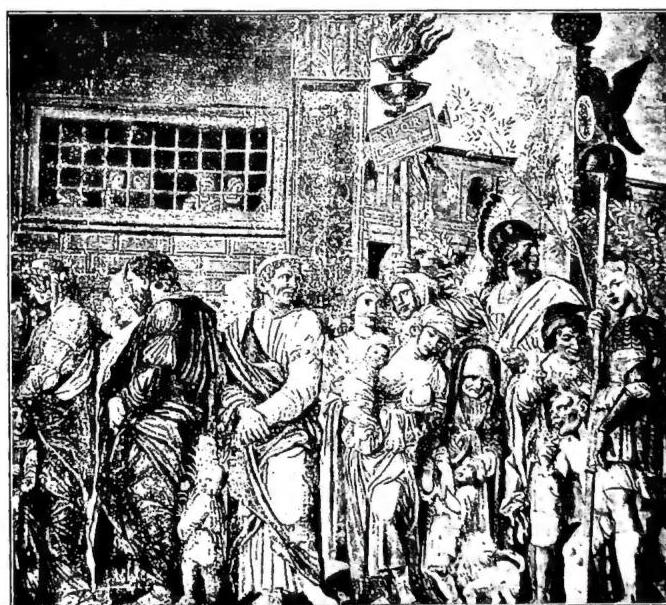
(fot. Alinari)
SLAVERY - Slaves in chains. Detail from The Triumph of Caesar. Tempera on canvas by A. Mantegna (between 1484 and 1492) - London, Hampton Court Gallery.
The 12th and especially the 13th centuries are characterized by provisions in favor of serfs, which, by diminishing the power of great lay and ecclesiastical lords, granted new authority to the Commune and simultaneously brought about a profound social evolution that preceded and surpassed the far more celebrated ones in England and France. Between 1205 and 1289, Pistoia, Assisi, Piacenza, Padua, Vercelli, Bologna, and Florence issued solemn declarations of freedom, established free boroughs, and reclaimed the rights of the human person.
In the cities, middle and lower artisans still endured certain political limitations, and the corporative organization, which reached its peak development in this period, excluded the lowest classes: hence their restlessness and attempts to assert their rights within the Commune, which also resulted in bloody episodes such as the Ciompi revolt. Meanwhile, in the Commune of the people, anti-magnate statutes excluded nobles from residing in the city, as in Viterbo and elsewhere, or their houses were demolished by the fury of the populace.
Without entirely eradicating domestic servitude and serfdom, the Communes dealt them a fierce blow almost everywhere. Serfdom languished in the countryside with the dependence of peasants on their lords. A special form of domestic slavery persisted during the era of the signorie, and the slave trade experienced periods of prosperity. Despite the vehement condemnations of popes Innocent IV, John XXII, and Martin V, Venetians and Genoese obtained slaves from the Middle East, the Black Sea centers, and the African coasts, as well as from naval victories over corsairs, supplying European markets, traces of which remain in wills and dowry contracts. It was a point of pride for noble families to have Black children as pages and Circassian or Saracen slave women to care for wives and daughters, though their condition was almost always favorable.
Against these remnants of ancient slavery, Italian legislations of the 17th and 18th centuries acted: in Tuscany, Pietro Leopoldo; in Piedmont, after Emanuele Filiberto in 1561, the reforms of Carlo Emanuele III and Vittorio Amedeo II; elsewhere, the Napoleonic Code. In France, serfdom was abolished on royal estates and limited on seigneurial lands in 1779. Though seigneurial rights were reaffirmed by the Estates General in June 1789, by August the feudal bonds of every kind were overthrown without compensation. Just as cities had once preceded the countryside on the path to liberation, so European nations preceded the colonies, where the trade and labor of slaves still proceeded unchecked. In 1790, the Convention extended to Blacks the rights belonging to French citizens. After some fluctuations during the Consulate, slavery was then definitively abolished.
SLAVERY IN MODERN TIMES. THE SLAVE TRADE OF NEGROES.
Under this name, the vile commerce in human flesh entered history, beginning with the great discoveries and involving the transfer of population groups in a state of slavery from one region to another for the exploitation of colonial lands. In almost all cases, these slaves were Negroes from Africa. Truth be told, slavery had not entirely disappeared from Europe,
since, apart from Muslims, the trade was still practiced by Christian countries; frequent mentions of slaves—mostly of Eastern origin—are found in Italian cities (cf. Pastor, cited in the bibliography).
Matters took a different turn when Portugal came into contact with the Black Continent through the gradual discovery of the western coasts of Africa. The great ease with which slaves could be procured there led many to be brought to Portugal and Spain, where there was a shortage of labor and the example of the Moors favored the institution of slavery. This also seemed morally justified by the savage state of many of those peoples, among whom slaves and human sacrifices were numerous. From then on, the importation of Negroes into Europe developed.
The discovery of the New World in 1492 gave slavery a new direction. The devastation wrought by adventurers upon the indigenous populations, who were resistant to labor and of low productivity, gave rise to the idea of replacing the natives with Negro slaves imported from Europe—stronger and more robust, whose productivity offered greater hope of wealth. The idea, and its implementation, was for the moment merely a lesser evil, in the sense that men of good will, deeply moved by the fate of the Indians, suggested this expedient; it even seems that among Las Casas (v.), who in any case soon repented and in 1518 proposed a colonization project in which no mention was made of importing Negroes. Cardinal Ximenes (v.), regent of Castile, rejected with indignation the proposal to import Negroes into America; but under Charles V, the legal barrier was broken, and in 1517, after much hesitation, the first shipment of four thousand Negroes was authorized. From then on, a veritable market was established between the Spanish government and private individuals or companies; later, the commerce in human flesh was conducted between states. All nations resorted to the trade, either in the interest of their own colonies or those of others. Africa was invaded by raids carried out by whites, who established authentic commercial agencies for this traffic, so that by the end of the 18th century, thousands upon thousands of Negroes were taken, sold, and transported to America. Among all nations, England became most notoriously infamous for this ignoble commerce. While France was inclined to limit it and Spain (especially after the condemnation by Urban VIII in 1639) was for a long time without agencies in Africa, the English kings, from Elizabeth to the beginning of the 19th century, encouraged the trade, even threatening war with other nations to preserve the monopoly they had managed to obtain.
At the beginning of the 19th century, the pens of many writers stirred European public opinion, until at the Congress of Vienna (1815) a declaration against the slave trade was signed by all the major powers. However, the trade as contraband continued for a long time, and its extent cannot be calculated. The institution of slavery then persisted through the children of slaves, and the concern to maintain them led to a veritable breeding system, with all the brutality this term implies. Gradually, however, it weakened and diminished due to the activity of missionaries and the ideological-social movement that spread with the French Revolution and the wars that followed. Further international conventions for the repression of the slave trade were established with the Treaty of London in 1841, the Treaty between France and England in 1845, and the Treaty between the United States and England in 1862 (v. STATI UNITI (U.S.A)).
Particular mention deserves the war in the United States, caused by the anti-slavery ideal of the 17 Northern states (abolitionists) and the will to maintain slavery in the 15 Southern states (anti-abolitionists). The antagonism began in 1780 but reached a critical point in 1860 LINCOLN, A (v.) was elected president. After fierce battles lasting from 1862 to 1865, the Northern states achieved complete victory, and slavery was abolished. The example was instructive; it was gradually followed by all the states of the two Americas, with Brazil being the last in 1888, when Emperor Pedro II, with the cooperation of his consort
and daughter, decreed the abolition of slavery to celebrate the priestly jubilee of Leo XIII.
A posthumous consequence of the slave trade, even after the abolition of slavery, is still today the state of inferiority, prevailing in some states, of Negroes and their altered legal status in relation to whites.
VI. THE CHURCH'S WORK
One must honestly acknowledge and praise the missionaries and pontiffs who acted decisively against the slave trade and against slavery.Initially, when the importation of Blacks into Europe was at issue, the following observations must be made: in many places, the African population was already almost entirely composed of slaves; they had been reduced to such a state either as punishment for some crime (adultery, theft, murder) for which local laws decreed death, and this was commuted to slavery. Secondly, it was difficult for missionaries to know exactly the origin of the human merchandise, since traffickers were very cautious in carrying out their raids in places where they were not monitored. Given these circumstances and the ideas of the time, missionaries were led to conclude that the sale and purchase of Blacks by Europeans was not entirely an injustice for those who merely changed masters.
Regarding the slavery of the American Indians, the documentation provided by Bartolomé de las Casas, the antagonist of slavery, suffices. The missionaries (Dominicans and Franciscans, and later all others) who went to the New World following the explorers soon found themselves having to fight against the exploiters, and not a few suffered greatly and even death at the hands of Europeans. Later, when Blacks were imported primarily from Africa, only the missionaries pitied them, alleviated their sufferings, attempted to induce the colonizers to a sense of human and Christian compassion, sought by all means their redemption, and denounced with vivid writings the inhumanities committed. Among all, St. CLEVE (v.) stood out. If cruelty first, and then slavery, disappeared, this was due primarily to the work of the missionaries. The certainty of slavery’s disappearance is to be attributed to the colonizers and European government officials who had an interest in its continuation.
As for the activity of the pontiffs, it is recalled that Pius II, on 7 October 1462, at the beginning of the slave trade in Europe, denounced slavery as a magnum scelus and ordered bishops to strike with ecclesiastical censures those who practiced it (O. Rainaldi, Annales, X [a. 1482], Lucca 1752, pp. 341-42). Paul III (Bullarium Taurinense, XIV, Turin 1868, pp. 712-13), on 29 May 1537, gave the archbishop of Toledo a mandate to protect the American Indians and imposed excommunication, reserved to the pope, on those who would reduce them to slavery or despoil them of their goods. In the same year, with a bull addressed to all Christendom, he pronounced the absolute condemnation of slavery, even retroactively annulling every contract of this kind, so that all slaves had the right to escape their condition. Urban VIII, on 22 April 1639 (ibid., pp. 712-714), renewed these provisions with even stronger words. Slavery was diminishing, but too slowly, and Benedict XIV in 1741 wrote to the bishop of Brazil and the king of Portugal, lamenting that the dispositions of his predecessors had not been fully implemented (Bullarium Benedicti XIV, I, const. 38, Rome 1845, p. 123). Pius VII at the Congress of Vienna exerted his authority so that the slave trade would be prohibited, and he effectively obtained its proscription. Gregory XVI, on 3 December 1837, issued an encyclical exhorting bishops to employ all means to eradicate and abolish slavery, by then illegal, and to alleviate the sufferings of slaves (Acta Gregorii XVI, II, Rome 1901, pp. 387 ff.). Pius IX raised his voice in the same sense when, in 1851, he beatified St. CLEVE (v.). Leo XIII, seeing the last remnants of slavery abolished in parts of Brazil, expressed his great satisfaction in a letter to the bishops of that nation (5 May 1888), summarizing at the same time the documentation of what the Church had always done in favor of slaves (Acta Leonis XIII, VIII, Rome 1889, pp. 169-92). Finally, Pius X, with the letter Lacrimabili statu Indorum of 7 June 1912, reserved to the Ordinary the absolution of anyone who reduced a human being to a state of slavery (AAS, 4 [1912], pp. 521-25). Among moralists, it is debated whether this disposition is still in force.
In the Catholic episcopate and laity, the Lavigerie (v.) is well known, as are the merits of the Claverian Sodality, founded on 29 April 1894 by M. T. Ledóchowska. In Italy, ROVINA (v.) founded an Anti-Slavery Society.
Despite the Berlin Convention of 1885, the Brussels Convention of 1890, the Saint-Germain Convention of 1919, and the Geneva Convention of 1926, a commission of experts from the League of Nations had to recently acknowledge the existence of slavery in some nations: Tibet, Arabia, Abyssinia. For the latter country, the Paedoglio decree of 12 April 1936, during the Italian occupation, was not entirely ineffective for the abolition of slavery. The issue of slavery and the slave trade was revisited at the international level with Human Rights (v.) at the UN (1948).
VII. SLAVERY AND CHRISTIAN MORALITY
Slavery, understood and practiced as the full subjection of one man to another, or as the denial of juridical personality (such that the man is considered a thing), or as the deprivation of the essential disposition over oneself, connected with the autonomy of the human person, is contrary to natural law.However, the opposition to natural law of a state of servitude in which the fundamental rights of the human person are recognized, but which, on the other hand, entails a permanent bond between servant and master—even if a broader availability of one’s own labor, as established by the law of all civilized nations, clearly appears more consonant with the autonomy and dignity of the human person—has not been demonstrated.
This bond, however, does not affect the person as such, but only their labor: to demonstrate its opposition to natural law, it would therefore be necessary to prove the unnatural character of perpetual obligation.
Thus, for an ethical evaluation of slavery in the various forms in which it has been and still is, albeit illegally, practiced among some peoples, it is necessary to consider all the features and circumstances that accompany it: one must distinguish between law and fact; and within the realm of law itself, it is necessary to consider all norms and to understand the contradictions that are not infrequently found between one and another.
For instance, while the slave is not considered a juridical person, in some forms of slavery he is nonetheless recognized the right not only to marry but also the fundamental right of redemption. If, in addition, one considers certain advantages that derive to the slave from his condition—such as, for example, the right to be supported by the master for life and the connected economic security—it will not be difficult to understand how, even within the Christian milieu, the institution of slavery could endure for so many centuries.