
NOCERA DEI PAGANI (ALFATERNA), DIOCESE of. — City and diocese in the province of Salerno, with a population of 90,000 inhabitants, all Catholics, distributed among 24 parishes served by 85 diocesan priests and 45 religious priests; 1 seminary, 5 male and 18 female religious communities (Ann. Pont., 1951, p. 290). The diocese is suffragan to Salerno. The Cathedral, formerly dedicated to St Priscus, is now under the invocation of St Mark.
I. HISTORY. – N. soon embraced the new religion, and it seems to have given the faith two martyrs as well: Felice and Costanza, mentioned several times in the Hieronymian Martyrology, but not unanimously accepted by hagiographers. The origin of the episcopal see should likewise date back to the pre-Constantinian period or shortly thereafter; Bishop Prisco, celebrated in poem XIX (v. 515 ff) by s. Paolino da Nola, may be assigned to the 3rd–4th centuries.
The names and existence of Prisco’s successors are unknown. One must reach the 5th century to find a Felice (401–17), known from an epistle addressed to him by Pope Innocent I (Jaffé-Wattenbach, no. 314). After approximately a century, there appears Celio Lorenzo, who, elected (498) pope by the Roman people in opposition to Simmaco, was compelled, following Theodoric’s judgment in favor of Simmaco, to leave the city and accept the episcopal see of N., in Campania. He remained at N. only briefly: dissatisfied with the see and a persistent agitator of discord, he was by the Roman Synod “e coetu... sacerdotali proiectus” and replaced (502) by Aprile, who at the Council had signed in favor of Pope Simmaco. Among his successors, Numerio (593) and Primerio (598) are known from two letters of s. Gregorio Magno (Jaffé-Wattenbach, nos. 1244 and 1569). Another letter of the same Pontiff (Jaffé-Wattenbach, no. 1846) refers to a Nucerinus episcopus, but it is not known whether Primerio was still living in 601 or whether this was a successor. There then follow, at long intervals, three bishops whose attribution among N. Umbra, Lucera, and N. dei P. is much disputed: Amanzio (743), who signed the Roman Synod of Pope Zaccaria; Liutardo (826), present at the Council of Eugenio II but more properly assignable to N. Umbra; and Lando (1063–67), deposed by Alessandro II, whose attribution to Nuceria or Luceria is disputed, depending on how the Micernium of the text is interpreted (PL 146,
1320 and 1406; Jaffé-Wattenbach, nos. 4538 and 4640; Kehr [V. BIBLICA.], VIII, p. 304 ff.). The successor Felice (1199) is a repetition of Ughelli’s account; but Valerio Orsino (1228), without being a saint, is recorded as present at the blessing of the new church of S. Lazzaro at Capua (G. Orlando [V. BIBLICA.], III, p. 453), and may have been one of the first prelates elected after the city’s total destruction by Ruggero II (1138). At this point, historians relate that in 1260 a bishop whose name is unknown was killed by the people, whereupon the city was deprived of its episcopal see by Alessandro IV and the diocese divided, until 1386, between the archbishop of Salerno and that of Amalfi. Orlando (op. cit., p. 433 ff.), however, would establish the existence of two bishops: Stefano (1304) and N... (1315), the latter conjectured but not identified in any document. Finally, in 1386, Urbano VI appointed fra Francesco da Nocera, who was consecrated only later (1389) by Bonifacio IX. Thereafter, the succession of prelates is uninterrupted. Among others, Paolo Giovio (1528), the celebrated historian of the Renaissance, who died in 1552, may be remembered; he left the see to his nephew Giulio (1552), and it then passed to another nephew, Paolo Juniore (1560–85). The most distinguished bishop was Simone Lumadoro (1602–10), who reformed the clergy, wrote the history of his diocese, rebuilt the Cathedral, and completed the extensive works begun by his predecessors.
In 1818, following the Concordat with the King of Naples, Pio VII united the diocese with that of Cava; but in 1833 Gregorio XVI, by the bull In vinea Domini, restored II. Finally, it was at N. dei P. that s. Alfonso M. de' Liguori, buried in the church erected in his honor in nearby Pagani, founded his Congregation.
II. MONUMENTS
The ancient Nuceria paganorum (or Alfaterna) is still disputed between Nocera Superiore and Nocera Inferiore, without decisive arguments; although many incline toward the former, which, among other things, preserves the ancient church of S. Maria Maggiore. Long regarded as a pagan temple or a thermal hall transformed into a church, it is instead, following Stettler’s latest studies, certainly an early Christian baptistery, unique in its constructional type among the baptisteries existing in Italy. Although it was altered during the restoration work of 1856, it still preserves much of its primitive structures, making its reconstruction possible. It is a circular building, preceded by a portico with four pillars (not original) and closed by a semicircular apse with an altar, which belonged to the ancient structure. The interior consists of a double annular gallery, divided by a peristyle of 30 paired columns arranged radially, all monolithic but unequal: those of the outer circuit are cipollino marble; those of the inner circuit are of various kinds and different workmanship. Worth noting, in addition to some magnificent capitals and several fine bases, are the abaci of the intercolumniation, formed from a single rough monolith resting on double capitals. At the centre is the large baptismal pool, enclosed by 8 columns of Parian marble or granite (only five now remain), which rest on a circular wall adorned with fine slabs, in which decorative motifs and influences of the Justinianic period can be discerned. The outer perimeter wall, now entirely rebuilt, was a light structure, made slender by small light-giving openings, but without any essential function in the building’s structure. The dome(phot. Gab. fot. no. 2.)
NOCERA UMBRA, DIOCESI di - Panorama.
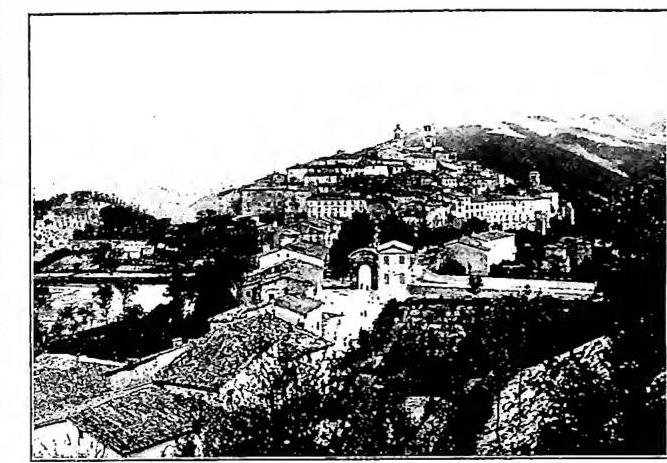
supported the roof. The dome was therefore visible, and the construction appeared more harmonious and lighter than it does today, weighed down and encumbered by the added structures. As for its date, both on account of the decoration and of the structural innovations introduced in comparison with the constructional method used at Rome for S. Costanza and S. Stefano Rotondo, it is not possible to place it earlier than the sixth century, nor later than the seventh, owing to the absolute absence of Lombard elements.
A short distance from N. Superiore is the sanctuary of S. Maria di Materdomini, a Romanesque construction entirely rebuilt in 1700 by the school of Vanvitelli. Of some interest inside are the frescoes by Giacinto Diano. Another ancient little church is that of S. Maria di M. Albino, near N. Inferiore, remodelled and decorated in 1530 by G. B. Castaldo, the captain of Charles V, who presented this chapel with the artistic remains removed during the sack of Rome.
Pasquale Testini