
MADABA. — City (Heb. Mēdhhbā'; Septuagint Mᾶᾶᾶᾶ and Mᾶᾶᾶ; Vulgate Medaba; Mesha stele: Mhab') of Jordan, 8 Hesebon (v.). It is mentioned for the first time in a victory song of the Amorites over the Moabites (Num. 21:30), together with Hesebon and Diban, so that it seems already to have been a place of importance. After the region had been conquered by the Hebrews, Moses gave the city to the tribe of Ruben (Is. 13:9, 16). In the war of Ammon against Israel, during the reign of David, the Aramaean army summoned by the Ammonites encamped near M., but was defeated by Ioab (I Par. 19:7). Mesha (lines 7–8) boasts of having taken it from the Israelites, who had occupied it under Omri. It was under the Moabites in the time of Isaiah, who foretells its misfortunes (Is. 15:2).
(phot. Eac. Catt.)
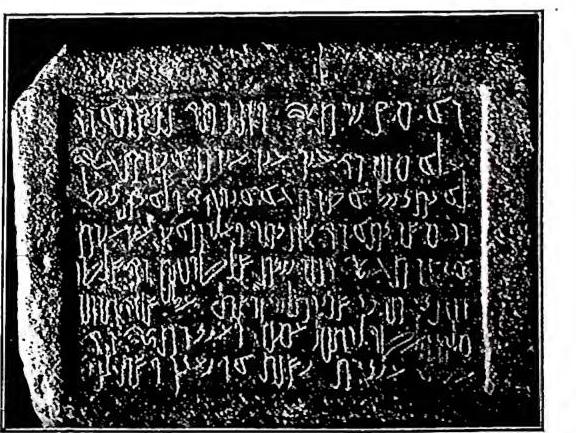
MADABA - Nabataean funerary inscription from the time of King Areta, originating from M. - Rome, Lateran Museum, wall A, 2.
The identification of the ancient city with the modern one, reoccupied by Christians in 1886, is certain because of the name, which has always remained unchanged, the location, which accords well with the literary evidence, and the remains that have been discovered.
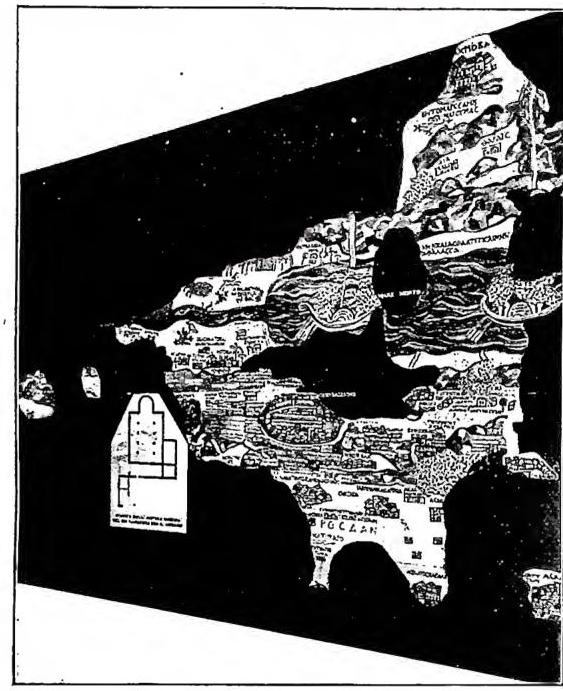
In the northern part of the city, a first church was found, divided into three naves by Corinthian columns and preceded by a narthex: it was the one that revealed a floor mosaic representing a map of Palestine accompanied by 140 explanatory captions in Greek, according to the Onomasticon of Eusebius of Caesarea; the mosaic has been attributed to the Justinianic period (M.-J. Lagrange, La mosaïque géographique de M., in Revue biblique, 6 [1897], pp. 165-84; E. Stevenson, Di un insigne pavimento in musaico esprimente la geografia dei luoghi santi scoperto in una basilica cristiana di M. nella Palestina, in Nuovo Bull. di arch. crist., 3 [1897], pp. 45-102; J. Germer-Durand, La carte mosaïque de M., Paris 1897; H. Lammens, M., la ville des mosaïques, in Etudes, 73 [1903], pp. 721-736; 74 [1898], pp. 44-61; A. Jacoby, Das geographische Mosaik von M. Die älteste Karte des heiligen Landes, Leipzig 1905). A second church was found along the Forum Road, in a characteristic form with a rotunda and apse: it had been dedicated by the city of M. to the Blessed Immaculate Virgin, for the salvation and reward of all the living and deceased benefactors of the sanctuary, as the mosaic inscriptions discovered there teach (G. B. De Rossi, Conferenze di archeologia cristiana, in Bull. arch. crist., 5th series, 3 [1892], p. 245; M. Séjourné, Médebu, in Revue biblique, 1 [1892], p. 640; E. Michon, L'inscription en mosaïque de Médebu, et la mosaïque de Kabr-Hirom, in Bulletin de la Société nationale des antiquaires de France, 1896, pp. 96-98). A third church, dedicated to S. Elia, was also found a short distance from the preceding one; it had a rectangular plan, with three naves and an apse inscribed within the rectangle; it was equipped with a crypt and decorated with a mosaic floor; in the apsidal section, two gazelles approach the tree of life; elsewhere, amid geometric and animal decorations, three medallions contain three mosaic inscriptions. A large mosaic inscription was found in the floor of the church. The inscriptions show that the work was completed at the end of the 6th century under the direction of the presbyter of the Elian church, Sergio, and during the time of Bishop Sergio.
The church of S. Elia was restored at the beginning of the 7th century by a presbyter, Leontius, as an inscription attests (M. Séjourné, L'Eliane de M., in Revue biblique, 6 [1897], pp. 652-94; E. Kalinka, Inschriften aus Syrien, in Jahreshefte des Österreich. archäologischen Institutes, 3 [1900], p. 22). East of the Elian church, a fourth building appeared, with three naves, an atrium, an apse, and pastophoria. West of the Elian church, remains were found of a now-demolished raised apse, together with one of the side walls. South of the Forum Road, the remains were recognized of a sixth apsidal building with perimeter walls and Corinthian capitals. South of the acropolis, among the vestiges of a basilica, a decorated slab belonging to a screen was found.
Also south of the acropolis, an eighth basilica, measuring 36 x 21 m., was identified, with columns, large Corinthian capitals, pilasters, architraves, and traces of mosaics. Near this building, an inscription in Nabataean script and language was found, containing the date of the reign of Aretas, mentioned by S. Paul (II Cor. 11, 32). The inscription is now in the Pio Lateranense Christian Museum (G. B. De Rossi, Iscrizione in scrittura e lingua nabatea trovata in M., in Dissertazioni della Pontif. Accad. rom. di arch., 2nd series, 5 [1893], pp. 449-454). Not far from the monumental remains of this great church, a Greek mosaic inscription recalls the same presbyter Leontius of the Elian Basilica, who is said to have carried out work on the building in the year 603-604 (R. Savignac, Nouvelle inscription grecque de M., in Revue biblique, 9th series, 8 [1911], pp. 437-40). For these churches V. G. Manfredi, Piano generale delle antichità di M., in Nuovo Bull. di arch. crist., 5 [1899], pp. 149-70 and pl. 7. Another church of M., dedicated to the holy Apostles, was completed during the time of Bishop Sergio in 578-79, as a mosaic inscription reveals (H. Vincent, Nouvelle mosaïque à inscription à M., in Revue biblique, 11 [1902], pp. 426-28; id., L'église des Saints-Apôtres à M., ibid., p. 599).
Among the bishops of M. are known Gaiano I, ca. 451; Gaiano II, ca. 458; and Sergio, known from two inscriptions, one from 578-79 and the other from 595-96. Enrico Joni