
DECRETUM AD ARMENOS. - The Bull Exultate Deo, concerning the union of the Armenians with the Catholic Church, published at the Council of Florence on November 22, 1439.
STORIA. - I primi contatti per condurre gli Armeni dissidenti all'unità della Chiesa risalgono al 1433-34 e si devono ai legati del Concilio di Basilea
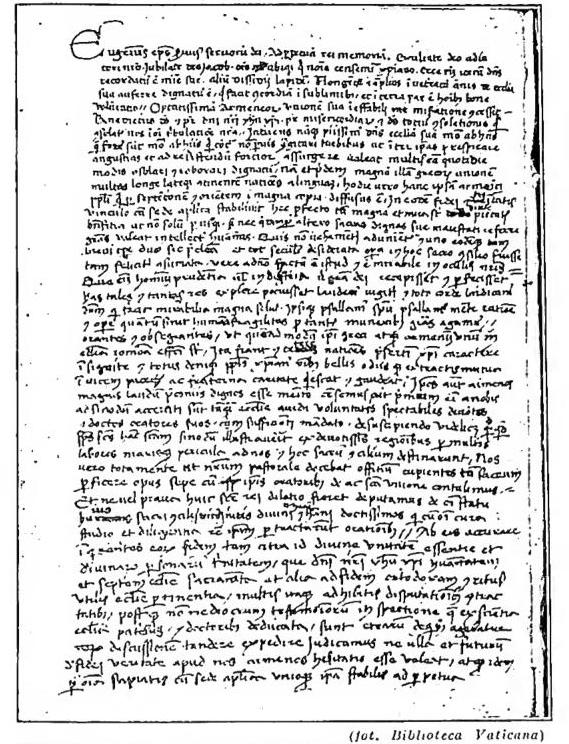
In facilitating the union, the Republic of Genoa earned particular merit (G. Hofmann, De Unione Armenorum, Roma 1935 [documenti]; id., Die Einigung der armenischen Kirche mit der katholischen Kirche auf dem Konzil von Florenz, in Orientalia christiana periodica, 5 [1939], pp. 149-85 e passim; Concilium Florentinum, Documenta et scriptores [Pont. Inst. Orient., series A]; Epistolae pontificiae, parte 2°, ed. G. Hofmann [Roma 1944], n. 226, pp. 139-40).
CONTENT. - The D. ad A. contains the doctrine and prescriptions that the Pope and the Council imposed on the Armenians in accepting them into the unity of the Church.
It consists of 8 parts: 1) Nicene-Constantinopolitan Creed; 2) profession of faith of the Council of Chalcedon; 3) definition of the Council of Constantinople concerning the two wills and two operations in Jesus Christ; 4) command to accept the Council of Chalcedon and all subsequent councils held under the authority of the Pope, and to venerate Pope Leo the Great as a saint; 5) compendium of doctrine on the Sacraments; 6) Athanasian Creed; 7) decree of union with the Greeks promulgated by the Council on July 6, 1439; 8) decree on the date of certain feasts.
VALUE. - Before proceeding to the union, the two parties wished to reach a precise understanding on the doctrine to be held "both regarding the unity of the divine essence and the Trinity of Persons, and regarding the human nature of Jesus Christ, the seven Sacraments of the Church, and other matters concerning the right faith and the rites of the universal Church." The D. ad A. is drawn up to offer a "brief compendium" of the Church's doctrine on these same points. However, the D. is not merely doctrinal. It also contains "precepts and statutes," e.g., it sets the date of certain feasts (bull Exultate Deo, cited ed. of the Conc. Florentinum, loc. cit., pp. 125, 135, 134, 125).
Point 8 has a disciplinary character, while points 1, 2, 3, 4, 6, and 7 have a dogmatic character, although even in them not everything is strictly dogmatic (e.g., point 4 contains the precept to sing the "Credo" with the "Filioque" in the solemn Masses of Sundays and major feasts). The value of point 5 is debated. Some theologians consider it an official exposition of Catholic doctrine on the Sacraments, given that it was made by an ecumenical Council. Others see in it an act of the ordinary magisterium, in which the infallibility of the Church would not be engaged. Others think it is a practical instruction for the use of the Armenians, imposing upon them the ceremonies and rites of ordination already in use among the Catholic Armenians. The reason for this varying evaluation is what the decree says regarding the matter and form of the sacraments of Confirmation and Holy Orders, and the fact that it is based on the booklet of s. Tommaso: De articulis Fidei et Sacramenti Ecclesiae, with additions and variations suited to the needs of the Armenians. The apostolic constitution Sacramentum Ordinis of Nov. 30, 1947, does not establish the value of this part of the D. ad A.
Taken as a whole, the D. ad A. is a conciliar decree, possessing full juridical value because it was promulgated in a solemn session of the council. But it is not imposed on the entire Church and does not establish conciliarity for the whole Church regarding the matter and form of every Sacrament (F. Hürth, Commentarius ad Const. Apost. [Sacramentum Ordinis], in Periodica de re morali et canonica, 27 [1948], pp. 17-18).