
SPIRIT AND FLESH. – An antithesis of biblical anthropology between the perishable and the enduring in man, analogous to the antithesis between man and God already clear in Is. 31:3.
In the ethical-psychological language of the New Testament, two elements compose man: one external
and one internal (Mt. 15:17-20); the former, the body (σῶμα), to which animal life (ψυχή) is connected, has no moral significance and may be considered in itself indifferent to justification and salvation (I Cor. 6:12-13), whereas the latter, the seat of thoughts and feelings (καρδία, νυός), is fundamental and decisive before God. “The outward man” tends toward corruption, “the inward man” toward eternity (II Cor. 4:16-18); since it is “flesh and blood,” the outward man is excluded from the Kingdom of God (Mt. 16:17; I Cor. 15:50).
Sin, and death, which is its “wage” (Rom. 5:12-21; 6:23), are connected with the former, which derives from the old Adam; the new Adam, Christ, provides the remedy, renewing man in Baptism by immersing him in the mystery of Christ’s death and resurrection (ibid. 6:1-13). Yet here below there remains in man, dramatically, a struggle between the external man and the internal man, between the old man of sin and the new man of righteousness (ibid. 7:5-25). The former, called “the body of sin, of death” (ibid. 6:6; 7:24), which tends toward moral and physical disintegration, is ordinarily called “flesh” in the pejorative sense already apparent in Gen. 6:3, 12 (cf. Is. 40:6; Eccl. 14:18; I Cor. 1:20) and widespread among the Stoics. “Flesh” is human nature abandoned to itself, and therefore fragile because deprived of God, and deadly because corrupted by sin, which conceals within it its seed, concupiscence (Io. 1:13); it is connected with sin both by origin and by tendency (Rom. 6:12-18, 13). Opposed to flesh, or animated matter (σάρξ) enclosing the ψυχή, was the invisible dynamism of man called “spirit” (πνεῦμα; I Cor. 5:5); “fragile flesh” resists the “ready spirit” (Mt. 26:41; Mc. 14:38), in which God, or the Spirit of God (Sap. 1:6-7; Iob 10:12; Proc. 8:31), works with mysterious efficacy (Io. 3:6-8; 6:64). The spirit-flesh dualism (πνεῦμα-σάρξ) is one of the great antitheses of Pauline preaching.
“The flesh of sin” (Rom. 8:3) is opposed by the πνεῦμα (“spirit”); ibid. 8:1-15; Gal. 5:13-25. Flesh, with its vices and concupiscences (Gal. 5:24), is the antagonist, often personified, of the spirit (ibid. 5:17). The spirit, which is fundamentally the divine Holy Spirit, is, in the innermost being of the regenerated man, the new spirit infused by God (foretold by Ez. 11:19-20; 36:26-27; cf. Ps. 50:12), which constitutes the new man or new creature (Eph. 4:22-24; Col. 3:9-10; II Cor. 5:17; Gal. 6:15); it removes “the body of flesh,” or the carnal body (Col. 2:11).
The term spirit is used 145 times by St. Paul; although its general sense is indisputable, the precise sense of spirit is debatable approximately 70 times, since there is an intimate interpenetration between the thinking principle of man (called spirit in I Cor. 2:11; 5:3; 7:34; etc.), or his manner of thinking (ibid. 2:12, “the spirit of the world”; etc.), and the activity of the Holy Spirit in man (ibid. 14:12, 32; I Thess. 5:16; II Thess. 2:2: the charisms), or man under the influence of the Holy Spirit (I Cor. 14:14-16; “with your spirit”; Gal. 6:18; Phil. 4:23; II Tim. 4:22; Philem. 25), and the person of the Holy Spirit. A typical case of the intersection of these three semantic aspects is Rom. 8:2-16, where spirit occurs 17 times with various meanings that are difficult to determine; the Sixto-Clementine Vulgate writes Spiritus with a capital letter only 4 times, whereas R. Cornely understands the Holy Spirit 11 times; in Gal. 5:16-25 the Vulgate, in 7 instances, regards Spiritus as a proper name only once, R. Cornely never, and J. B. Lightfoot always. In general, the expressions “Spirit of God, Spirit of Christ, Holy Spirit” are equivalent in designating the divine Person; but “Holy Spirit” sometimes rather indicates his influence or charism (Act. 6:5; 10:38; 11:24; 13:52; II Cor. 6:6); the surest criterion is to examine whether personal functions are attributed to the Spirit or whether he is distinguished from the other two divine Persons. As the rival of flesh, spirit is less the Person of the sanctifying Spirit than his action in the soul, or, better, the soul itself vivified by him.
In the New Testament, the divine personal Spirit is the power presiding over the Incarnation, the foundation, and the development of the Kingdom of God (Lc. 1:15, 35, 41, 67; 2:25-27; Mt. 3:16; 4:1; 10:20; 12:28; Lc. 4:1, 14; Io. 14:17; 16:7-15). The Acts of the Apostles constantly emphasize the action of the divine Spirit, the supreme messianic gift (Act. 2:17), in the primitive Church (Act. 1:2, 8; 2:2-33; 4:8; 8:17-19; 10:44-47; etc.; I Cor. 12-14).
St. Paul in particular insists that the divine Spirit is reflected in the spirit which, within every Christian, is the dynamic principle of a supernatural life: it is a heavenly gift and the transformed human spirit; it is the ontological justification involved in divine adoption, the pledge of eternal life (Rom. 5-8). In Pauline style, life in Christ is identified with life “in the spirit.” Hence the continual exhortation to live according to the spirit and to flee the life of the flesh, from which the baptized have been “washed, sanctified, justified” (I Cor. 6:11). As in Johannine pneumatology, in St. Paul the spirit is intimately related to life; it is the source of life: “we must not live according to the flesh, because if you live according to the flesh, you will die; but if by the spirit you put to death the deeds of the body (Vulg.: ‘flesh’), you will live” (Rom. 8:12-13). The vitality of the spirit will also be communicated at the final resurrection to the bodies of the faithful (I Cor. 15:44), who with Christ are one body and one spirit (Eph. 4:4).
Men are therefore divided into two categories: the carnal and the spiritual. “Those who live according to the flesh (κατὰ σάρκα) set their minds on the things of the flesh, but those who live according to the spirit (κατὰ πνεῦμα) set their minds on the things of the spirit; the impulse of the flesh is death, whereas the impulse of the spirit is life and peace” (Rom. 8:5-6). The irreducible antagonism between flesh and spirit is also described by Gal. 5:16-17 (“the flesh has desires opposed to those of the spirit,” and vice versa); 6:8. Connected with the flesh are the Mosaic law with its “letter that kills” (II Cor. 3:6), Judaism and its external circumcision (Rom. 2:29; Gal. 4:20), sin, and death; connected with the spirit are faith in Christ, holiness, and life. Spirit consequently stands opposed to the natural life of the flesh, the ψυχή, and St. Paul contrasts the “animal” man (ψυχικός) with the “spiritual” man (πνευματικός); the former follows “the wisdom of this age,” the latter “the mysterious wisdom of God” (I Cor. 2:10-3:3).
The contrast between Judaism and Christianity is summarized in II Cor. 3:17: the Mosaic law (“letter”) is servitude leading to death, whereas Christianity is “spirit,” that is, freedom (from the Mosaic veil), leading to life. Therefore one must not know anything, not even Christ, according to the flesh (II Cor. 5:16; J. Dupont [V. BIBLICA.], pp. 180-86). The antinomy “letter-spirit” (Rom. 2:27-29; 7:6; II Cor. 3:6, 7, 17) is transposed into worship “in spirit,” opposed to external Jewish worship (Io. 4:24).
BIBL. (of the last thirty years): W. Schauf, Sarx. Der Begriff « Fleisch » beim Apostel Paulus unter besonderen Berüchtigung seiner Erlöungslehre, Munich 1924; F. Büchsel, Der Geist Gottes im Neuen Testament. Gütersloh 1926; H. von Baer, Der
(from V. Leroquan, Les pontificieux manuscrits des bibl. pub. de France, Parigi 1927, tzn. 19)
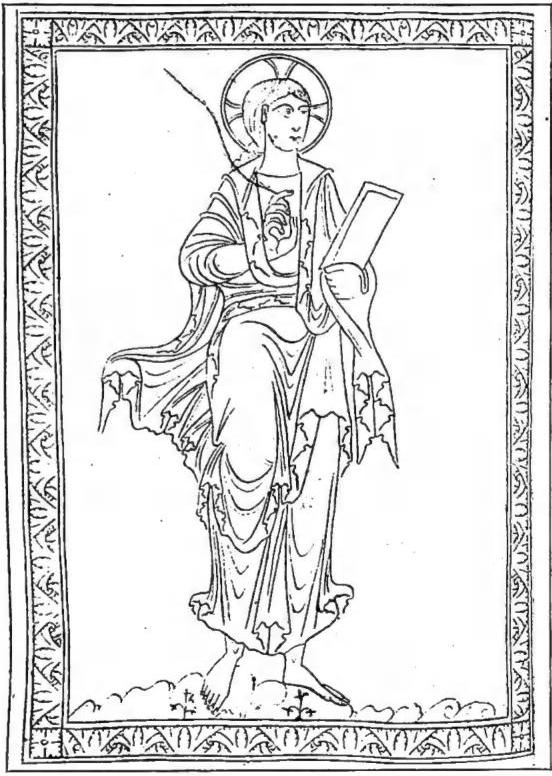
HOLY SPIRIT - Depiction of the H. S. under human guise. Drawing from the Pontifical of Sherburne or of s. Dunstano (end of the 10th century) - Paris, National Library, ms. lat. 943, f. 6v.
heilige Geist in den Luhasschriften, Stuttgart 1926; P. Gaechter, Zum Pneumabegriff des hl. Paulus, in Zeitschr. f. hath. Theol., 53 (1929), pp. 345-408; A. Schweitzer, Die Mystik des Apostels Paulus, Tübingen 1930, pp. 159-74, 263, 331-75; D. Bonhöffer, Sanctorum communio. Eine dogmatische Untersuchung zur Soziologie der Kirche, Berlin 1930, pp. 85-123; E. Fuchs, Christus und der Geist bei Paulus (Untersuchungen zum N. T., 23), Leipzig 1932; O. Moe, Vernunft und Geist im N. Test., in Zeitschr. f. system. Theol., 11 (1933-34), pp. 351-91; P. Van Imschoot, L'action de l'esprit de Jahwé dans l'A. Test., in Revue des sciences phil. et théol., 23 (1934), pp. 553-87; id., L'Esprit de Jahwé, source de vie dans l'A. Test., in Revue biblique, 44 (1935), pp. 481-501; id., L'Esprit de Jahwé et l'alliance nouvelle dans l'A. Test., in Ephem. theol. Lovan., 13 (1936), pp. 201-20; id., Sagesse et Esprit dans l'A. Test., in Revue biblique, 47 (1938), pp. 23-49; id., L'esprit de Jahwé, principe de vie morale dans l'A. Test., in Ephem. theol. Lovan., 16 (1939), pp. 457-67; J. Pascher, Der Glaube als Mitteilung des Pneumas nach Joh. 6, 61-65, in Theol. Quartalschrift, 117 (1936), pp. 301-21; J. Bonsirven, Chair, in DSp, fasc. VIII (1939), coll. 439-49; K. Prüm, Christentum als Neuheisterlebnis, Freiburg in Br. 1939, pp. 159-231; A.-J. Festugière, La Sainteté, Paris 1942, pp. 84-87; F. Puzo, Significado de la palabra πνεῦμα en t. Pablo, in Estudios bíblicos, 2 (1942), pp. 437-60; J. W. Martin, « Spirit », in the 2d chapter of I Cor., in Cath. Bibl. Quart., 5 (1943), pp. 381-95; T. Plassmann, Spirit and life, ibid., pp. 6-16; G. Verbeke, L'évolution de la doctrine du pneuma du stoïctime à St Augustin, Paris-Louvain 1945, pp. 387-409, 508-44; C. Oomen, Het bijbelgetuigenis over Christus den levengevenden geest, Brugge-Brussel 1946; J. Enciso, Manifestaciones naturales y sobre-naturales del Espíritu de Dios en el Antiguo Test., in Estudios bíblicos, 5 (1946), pp. 351-80; R. Koch, Der Gottesgeist und der Messias, in Biblica, 27 (1946), pp. 241-66, 376-403; id., Geist und Messias. Beitrage zur bibl. Theol. des A. T., Vienna 1950; F. Asensio, El espíritu de Dios en los apócrifos judíos precrístianos, 6 (1947), pp. 5-33; J. Dupont, Oussis. La connaissance religieuse dans les épîtres de St Paul, Louvain-Paris 1949, pp. 151-86; B. Schneider, Dominus autem Spiritus est (II Cor. 3, 17a), Rome 1951; L. Cerfaux, Le Christ dans la théologie de St Paul, Paris 1951, pp. 209-23, 241-42. Antonino Romeo