
ALPHABET. — It is the means of expressing the individual vocalic and consonantal elements of a word by means of determinate and constant signs.
1. ORIGIN
a) This art required a long evolution. The pictographic (ideographic) writings, which express words (ideas), precede II.| PHOENICIAN | HEBREW | SAMARITAN | ARAMAIC | SYRIAC | GREEK | ALPHABETIC WRITING | ||||
|---|---|---|---|---|---|---|---|---|---|---|
| ARCHAIC | MESHA | SQUARE | LAPID. | 8TH CENT. | ESTRANG ELO | ATHENS | RĀS | ŠAMRA | ||
| ʾ | Ⱬ ⱬ | ⱬ | Ɑ | Ɱ | Ɐ | Ɒ | ⱱ | Ⱳ | ʾa | ⱱ |
| b | Ⱳ | Ⱳ | ⱳ | ⱴ | Ⱶ | ⱶ | ⱷ | ⱸ | ʾe | ⱱ |
| g | ⱹ | ⱹ | ⱺ | ⱻ | ⱼ | ⱽ | Ȿ | Ɀ | ʾu | ⱱ |
| d | ⲇ | ⲇ | Ⲉ | ⲉ | Ⲋ | ⲋ | Ⲍ | ⲍ | b | ⱱ |
| h | Ⲉ | Ⲉ | ⲉ | ⲊⲊ | ⲋ | Ⲍⲍ | ⲍ | Ⲏ | g | ⱱ |
| w | Ⲏ | Ⲏ | ⲏ | ⲏⲏ | ⲏⲏ | ⲏⲏ | ⲏ | Ⲑ | d(z) | ⱱ |
| z | Ⲓ | Ⲓ | ⲓ | ⲓⲓ | ⲓ | ⲓⲓ | ⲓ | Ⲕ | h | ⱱ |
| h, ẖ | Ⲓ | Ⲓ | ⲓ | ⲓⲓ | ⲓ | Ⲍⲍ | ⲍ | Ⲕⲓ | w | ⱱ |
| ṯ | Ⲓ | Ⲓ | ⲓ | ⲓⲓ | ⲓ | ⲓ | ⲓ | Ⲕⲓ | z | ⱱ |
| y | ⲓ ⲓ | ⲓ | ⲓ | ⲓⲓ | ⲓ | ⲓⲓ | ⲓ | Ⲕⲓ | h | ⱱ |
| k | ⲓ ⲓ | ⲓ | ⲓ | ⲓⲓ | ⲓ | ⲓⲓ | ⲓ | Ⲕⲓ | ẖ | ⱱ |
| l | ⲓ ⲓ | ⲓ | ⲓ | ⲓⲓ | ⲓ | ⲓⲓ | ⲓ | Ⲕⲓ | ṯ | ⱱ |
| m | ⲓ ⲓ | ⲓ | ⲓ | ⲓⲓ | ⲓ | ⲓⲓ | ⲓ | Ⲕⲓ | y | ⱱ |
| n | ⲓ | ⲓ | ⲓ | ⲓⲓ | ⲓ | ⲓⲓ | ⲓ | Ⲕⲓ | k | ⱱ |
| s | ⲓ ⲓ | ⲓ | ⲓ | ⲓⲓ | ⲓ | ⲓⲓ | ⲓ | Ⲕⲓ | l | ⱱ |
| c | ⲓ | ⲓ | ⲓ | ⲓⲓ | ⲓ | ⲓⲓ | ⲓ | Ⲕⲓ | m | ⱱ |
| p(f) | ⲓ | ⲓ | ⲓ | ⲓⲓ | ⲓ | ⲓⲓ | ⲓ | Ⲕⲓ | n | ⱱ |
| ṣ | ⲓ ⲓ | ⲓ | ⲓ | ⲓⲓ | ⲓ | ⲓⲓ | ⲓ | Ⲕⲓ | s | ⱱ |
| q | ⲓ | ⲓ | ⲓ | ⲓⲓ | ⲓ | ⲓⲓ | ⲓ | Ⲕⲓ | ṣ | ⱱ |
| r | ⲓ | ⲓ | ⲓ | ⲓⲓ | ⲓ | ⲓⲓ | ⲓ | Ⲕⲓ | c | ⱱ |
| š(s) | ⲓ ⲓ | ⲓ | ⲓ | ⲓⲓ | ⲓ | ⲓⲓ | ⲓ | Ⲕⲓ | g | ⱱ |
| t | ⲓ + + | ⲓ | ⲓ | ⲓ | ⲓ | ⲓ | ⲓ | ⲓ | p(f) | ⱱ |
| ṣ | ⱱ | |||||||||
| ṣ̱ | ⱱ | |||||||||
| q | ⱱ | |||||||||
| r | ⱱ | |||||||||
| š | ⱱ | |||||||||
| š̱ | ⱱ | |||||||||
| ṯ | ⱱ |
(drawing, Esc. Catt.)
ALFABETO — Table of the archaic alphabetic signs of the Near East and ancient Greece, deriving from Phoenician, together with the cuneiform alphabetic script of Rās Šamra. (Columns 1, 8, and 10 contain the modern transcription).
(propr. B. Degenhart)
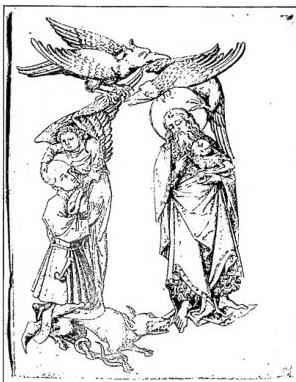
ALFABETO - Letter D of the a. Gothic with figures by the “Maestro ES.” German engraving (15th century) - Berlin, Kaiser Friedrichmuseum.
by means of appropriate images; then comes syllabic writing, which reserves one sign for each syllable (e.g. Mesopotamian cuneiform writing). Finally, an attempt was made to assign one sign to each sound (consonant or vowel). Since the number of sounds differs in different languages, the number of signs (“letters”) also varies between 20 and 30 (Hebrew has 22 letters, Greek 24, Ugaritic 29). This writing is called alphabetic after the first two letters of the Greek alphabet.
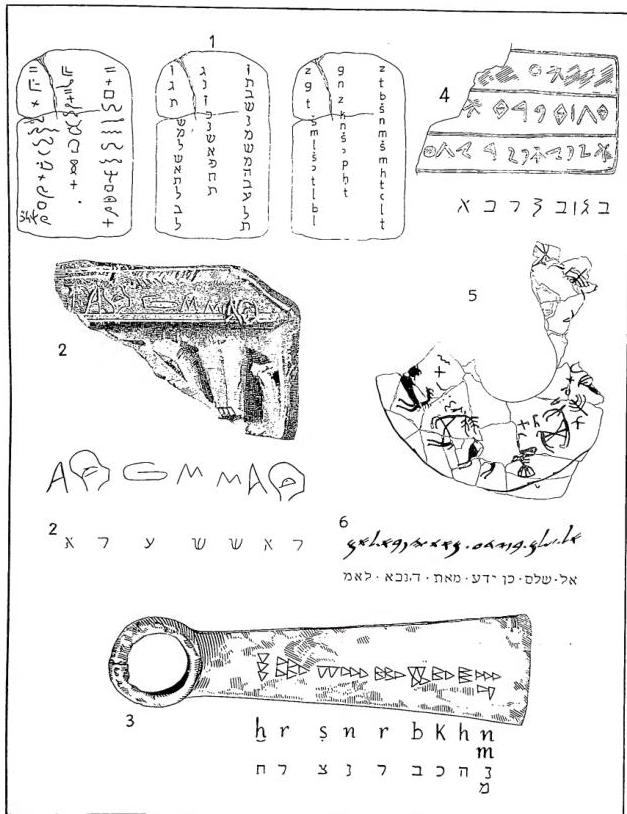
b) When the first alphabetic writing arose cannot yet be stated with certainty. It appears almost simultaneously in various regions around the Mediterranean. In the Sinai Peninsula, at Serâbit el-Hâdem, in the Egyptian mines, about thirty inscriptions have been found, executed in characters resembling in part Egyptian hieroglyphs and in part Semitic writing; it has been possible to establish that these are alphabetic signs (A. H. Gardiner and K. Sethe), which are called “Proto-Sinaitic.” Archaeologists have not yet reached agreement on the date of these inscriptions. Some assign them to the period of the Twelfth Dynasty (2000–1785), while others—with greater probability—to the time of the Eighteenth Dynasty (ca. 1500 B.C.). In Palestine, the oldest alphabetic writings have been discovered at Tell ed-Duweir = Lachis (an inscription on a dagger), at Tell Balâta = Sichem (two limestone fragments with several letters), and at Gezer (three letters probably belonging to a longer inscription). These inscriptions are assigned to the 17th–15th centuries B.C.; their interpretation has not yet been established with certainty, but they unquestionably constitute alphabetic writing used for practical purposes in everyday life. In Phoenicia, the oldest inscription discovered to date is the one found at Biblio at the foot of the acropolis, containing three lines, of
which the second is interpreted by almost everyone as b-g-b-l-r-b = “at Gebal (= Byblos), master.” Some assign it to the 16th century, others to the 15th. The date of the inscription of Šafatbaal (Šiptibaal), before the 15th century B.C., and that of the inscription of ’Abdô’, 18th–17th century B.C., proposed by Dunand, remain controversial. The famous inscription on the sarcophagus of Ahîrâm of Biblio, until recently regarded as the oldest in Phoenicia, is several centuries more recent, namely from the 13th century, or, according to recent authors, from the 12th or 11th century. The signs are already fairly cursive and presuppose a relatively long preceding period of use. The alphabet of Ugarit (Râs Šamra), discovered in 1929, is entirely distinctive: unlike all the other alphabets found to date, it is not written in linear characters but in “cuneiform” signs, similar to those of Assyro-Babylonian (syllabic) writing. Through various combinations of the “wedges,” approximately 30 different signs were formed, representing the consonants (and probably three vowels) of the Ugaritic language (related to ancient Hebrew). This alphabet probably arose somewhat before 1500 B.C.
This brief survey shows that in 1500 B.C. alphabetic writing was known and used in the regions later occupied by the Israelite people, or in areas close to them. It is therefore established that several centuries before Moses, alphabetic writing was known and practiced by the peoples with whom the Israelites had contact. On the other hand, there is so far no evidence that alphabetic writing was in use around the middle of the second millennium among other ancient peoples. The Greek alphabet (on which the Italic-Latin alphabet subsequently depended) derived from the Semitic alphabet at a more recent date, not yet precisely established (between the 11th and 8th centuries B.C.).
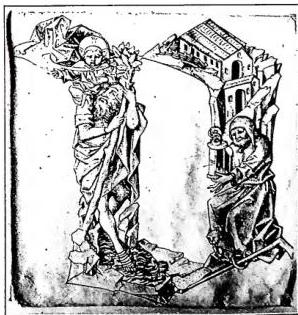
(propr. B. Degenhart) ALFABETO - Letter V of the Gothic alphabet with figures by the «Maestro ES». German engraving (15th century) - Berlin, Kaiser Friedrich Museum.
(propr. B. Degenhart)
2. ALPHABET IN MYSTICISM AND MAGIC
The alphabet, both as a whole and in its individual letters, soon acquired a symbolic and mystical significance, which at times ultimately degenerated into a magical one. The alphabet has a symbolic value as a whole in the formula A-Ω (v.)which refers to the divinity as the beginning and end of all things: a meaning repeated in the cross whose two arms bear respectively the letters of the Greek and Latin alphabets; this is the cross traced with ashes on the floor of a church on the day of its dedication: an ancient Roman rite for delimiting land intended for sacred use, performed by the augurs through the tracing of two perpendicular lines, the decumanus and the cardo; it was subsequently used by Roman land-surveyors for measuring land and adopted by the Christian rite of the dedication of churches to consecrate the area of ground devoted to worship.
The symbolic significance of the individual letters, in relation to their numerical (isopsephic) value, appears in the theological-mystical tradition of Judaism (v. below) and in Gnosticism, which made extensive and abusive use of II.
According to the Gnostic Marcus (Hippolytus 6, 45; Irenaeus 1, 14, 4), the 24 letters of the Greek alphabet represent Truth and contain the mystery of Christ’s descent to earth. Indeed, the 9 mute consonants signify Father and Truth; the 8 semivowels, Logos and Life; the 7 vowels, Man and Church. This imbalance of proportions among the three series of letters was remedied by Jesus, who descended from the first series (Father), reducing it by 1, and entered the third (Man), increasing it by 1.
According to the Gnostics likewise, the 7 Greek vowels (α, ε, η, ι, ο, υ, ω) musically symbolize the seven tones of the heptachord, capable of expressing, through continuous inarticulate sounds (ποππυσμοί), the sweetest harmonies in honour of the divinity.
They also represent the 7 planetary heavens and their succession from α to ω, confirming that the Most High is the beginning and end of all things and that the “heavens sing his glory.”
In this connection, the slab from the temple of Apollo at Miletus should be recalled. Within 7 ellipsoidal circles (two are missing) the 7 vowels are inscribed; while above there is an invocation to the archangels to protect the city of Miletus and its inhabitants. The 7 ellipses represent the 7 planetary heavens, as may be deduced from the symbolic signs at the head of each ellipse.
The passage from this mystical meaning to the magical one is easy for uneducated minds: it is precisely in the mysteriousness of the letters, in their juxtaposition, and in the unintelligibility of the language in which the words formed are written that they place the secret of their efficacy, as is found in the use of amulets with inscribed stones (v. ABRAXAS; AMULET; DEFIXION; MAGIC). Nicola Turchì
3. ALPHABET IN JEWISH MYSTICISM
The haggadists attributed a cosmic value to the letters: they played a major part in the creation of the world and in the Sinaitic revelation. The Kabbalists developed the system; they speak of celestial and terrestrial, masculine and feminine letters. Various correspondences are observed in the biblical text: for example, in the Psalter the word 'ašrē (“Blessed...”) occurs 22 times, in accordance with the 22 letters of the alphabet in which the Torāh is written; the alphabetical acrostic in Lamentations would indicate that the people had failed to fulfil all the precepts of the Law; “from alef to tau” is equivalent to “from alpha (v.) to omega,” hence the value attributed to 'eth in Gen. 1, 1.Through the numerical value of the letters, an attempt is made to establish the antiquity of the world. Relationships are established between words having the same number of letters or the same letters, even when their order of succession differs: for example, mē'ōdh (very much) and 'ādhām (Adam).
Cryptography. A cryptographic phenomenon is gematria (γραμματεία), based on the numerical value and permutability of consonants, in use in haggadic-midrasic exegesis and in Kabbalistic literature. In place of a given letter, the following letter in the alphabet is written (beth for alef), or the twelfth. The athbaš procedure consists in putting the last letter of the alphabet in place of the first, the penultimate in place of the second, and so on: in Jer. 51, 41 Īšākh=Babel (Babylon). Another permutation is tafraq, that is, in place of the last letter the penultimate, in place of the latter the antepenultimate, and so forth.
These procedures are expounded in The Letters of R. Aqiba and those of Ben Sira, Alphabetum Siracidis, both regarded as belonging to the eighth century A.D.
Mysticism. According to the Kabbalists, the letters are spiritual substances in which the outward form corresponds to the inner essence. The letters are connected with the ten sefirāth. Whenever a letter is pronounced or applied, its spiritual essence is awakened, bringing forth “holy forms” that unite with the celestial letters (Pythagorean influences?). The letters are the garments of the Torāh, woven in all the colors of light—white, red, green, and black. Prayer changes the letters into spiritual substances that rise toward heaven. The first letter is the source of all the others, which are divided into three groups: the first is the mystery of the line of grace, the second of mercy, and the third of justice. Only Adam knew, before original sin, the five final letters (m, n, s, p, kh). Abraham recognized them through inspiration, and their knowledge passed
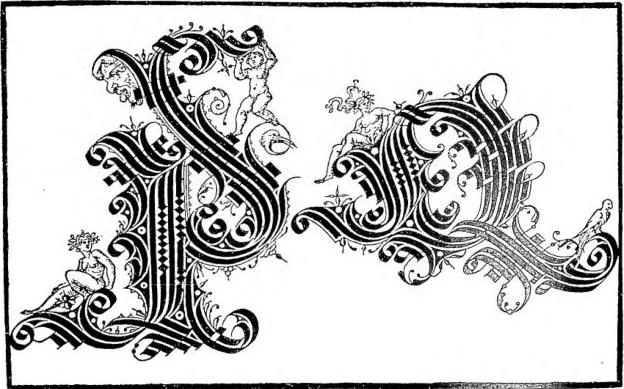
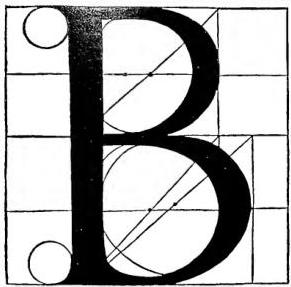
This letter B. is composed of two circles, and the lower one is the larger, measuring nine parts, that is, the five ninths of its height as diameter. For the upper one, four ninths should likewise be taken as the diameter, as proportionately represented above in the eye here shown.
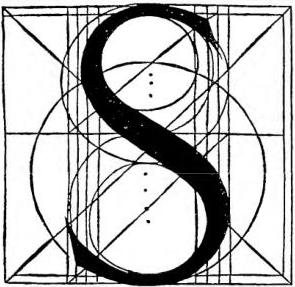
This letter S. is formed from eight circles, and its proportion is as appears here in the example: by means of its parallels, finding their centers, you will find that those below are larger than those above by one third of the ninth part of its square. The middle belly should be exactly one ninth of the height in thickness. The fillets should be one third of the thickness, ending the heads with due grace.
(phot. Enc. Catt.)
then to Isaac, Jacob, and Joseph; but it was subsequently obscured following the worship of the golden calf. Moses, Joshua, and the 70 Elders recognized them. They then shone forth in Palestine together with the other 22 letters of the a. in the mystical Song of Songs.
Every combination of letters (sérif) expresses a mystical idea; this theory is already found in Talmudic literature and subsequently recurs in the mystical Book of Creation and in Sabbatai Donnolo’s commentary on II. There is a sérif with which a man can also be created. The doctrine of the synthesis of letters assumes great importance in that concerning the divine names.
4. A. IN PEDAGOGY. - From a pedagogical and psychological standpoint, it is interesting to study the teaching methods devised for the instruction of the a. Leaving aside the less recent ones, handed down in the various Santa Croce and Abbecedari, only the current and most widely followed tendencies will be mentioned here, all of which originated in the psycho-pedagogical movement that took shape in the last century. According to the analytical or syncretic phonetic method (Mauro, Jacotot, Decroly, etc.), the teaching of the a. in its graphic and vocal expressions should not begin with individual signs and sounds, but rather with the word, a rational phonic fact of greater concreteness for the child, who must be placed immediately within the psychological reality of language. Only subsequently is the word broken down into syllables and letters, demonstrating the value of each character and phoneme. This method would be confirmed by a double series of experiments: 1st, that reading is not carried out syllable by syllable but in whole words; 2nd, that idiots, although unable to learn the value of individual letters, read complete words. The synthetic method (Lindner) proceeds inversely: it begins with the elements of words, that is, elementary sounds, letters, and syllables. In both systems, reading is initially mechanical, with the contribution of intelligence prevailing as automatism increases.
The Italian methods of Ferretti and Montessori are noteworthy, the one for its originality, the other for its practicality. G. Ferretti would have children relive the process through which humanity matured the invention of the a. (especially the need for alphabetic writing), passing through the progressive and simplifying stages of pictography and ideography, which in school practice would be summarized in drawing. M. Montessori, starting from Itard’s and Séguin’s principle of the natural transition from drawing to writing, combats as unnatural the teaching method that, through an infinite multiplication of strokes and curves, believed it was best preparing the mechanics of writing. She advocates the acquisition of motor skill through drawings, geometric at first and then alphabetic, made on raised figures and letters. Simultaneously with graphic activity, the child learns to pronounce the sounds corresponding to the alphabetic signs, initially isolated in syllabic units and immediately afterward in words. Cases containing cut-out letters serve to compose new words and thus, in this active approach, reading and writing, embryonically fused, are learned rapidly and effortlessly.
The variations and teaching innovations devised for learning the a. during this first half of the 20th century are too numerous to be mentioned here. Essential in each of them is the tendency toward greater practicality, leaving a wider margin for the cooperation of the young pupils.
ALFABETO (RITO): V. CHIESA, dedicazione della.