
HUGO, VICTOR-MARIE. – Poet, novelist, and playwright, born in Besançon on 26 February 1802, died in Paris on 22 May 1885. From his father Joseph Léopold Sigisbert (1773–1828), a republican officer who had distinguished himself in suppressing the Vendée revolt and in the struggle against the bands of Fra' Diavolo and Empecinado, and the author of works on art and military history, as well as of a novel, L'aventure tyrolienne, and from his mother Sophie Trébuchet, who held traditionalist and monarchist sympathies, he inherited a taste for poetry, which he shared with his elder brothers Abel (1798–1855) and Eugène (1800–1837), together with whom he expressed his enthusiasm for Châteaubriand and for the ideas and principles of the Restoration in the Conservateur littéraire (1819–21). Indeed, the inspiration of his first lyrics (1822) was monarchist and Catholic; they earned him a pension from Louis XVIII. New motifs helped to enrich it through the
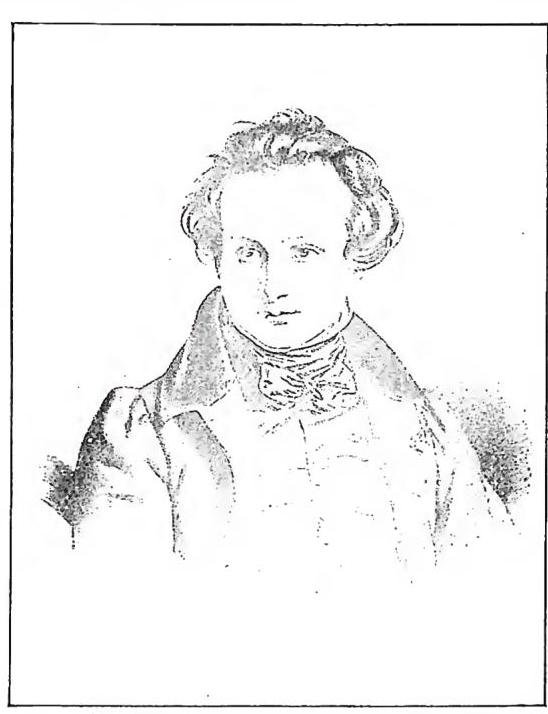
In 1827 the drama (never performed) Cromwell appeared, five acts that decisively established the Romantic aspiration to bring historical events to the stage, reaffirmed by an eloquent and celebrated preface: V. school. The following years were the happiest of his creative life; the profusion of images and colors characteristic of his finest lyric poetry was able to unfold in a perfect form, with a broad musical rhythm, in the Orientales (1829), taking its cue from the Hellenism then in vogue, while the Romantic passion for myths was being joined or supplanted by a love of works with a thesis, imbued with a demand for protest against social laws or conventions, in his work as novelist and dramatist. Thus Notre-Dame de Paris, a reconstruction of the follies and vices of a fantastic medieval Paris inspired almost tangibly by the architecture of the famous cathedral, was joined by two other novels that are nothing less than eloquent protests against capital punishment: Le dernier jour d'un condamné (1829) and Claude Gueux (1834). The dramas were even more popular, beginning with Marion Delorme, which fell victim to the censor’s prohibition precisely because of the thesis, or myth, of the redemption of the fallen woman that inspired it (1829); this was followed by Hernani (1830), Le roi s'amuse (1832), Lucrèce Borgia and Marie Tudor (1833), Angelo (1835), and Ruy Blas (1838); Notre-Dame de Paris too was adapted for the stage as an opera libretto, under the name of the novel’s protagonist, Esmeralda (1836). This theatrical series was brought to a close by the poem in three episodes, Les burgraves (1843), the fruit of impressions from a journey through Germany in 1838, like the collection of letters Le Rhin (1842).
From his original legitimism, his political position had evolved in an increasingly liberal direction, and his religious position toward a vague humanitarianism, making him in every respect an authentic “sounding echo” of his time (even a few Napoleonic undertones may be found in Rayons et les ombres, from 1840, the last of four collections of lyric poems—the others being Feuilles d'automne [1831], Chants du crépuscule [1835], and Les voix intérieures [1837]—grandiose also in their declamatory fervor: they are, moreover, the sentiments of those years, filled with a renewed enthusiasm for the glory of the Empire). The French Academy had admitted him in 1841; the Chamber of Peers in 1845. The February Revolution elected him, in 1848, as a deputy to the Constituent Assembly; his fiercely republican attitude made him an irreconcilable opponent of President Bonaparte, and the coup d’état of 2 December 1851 sent him into exile, first to Brussels and then to the Channel Islands, Jersey and Guernesey, where he ferociously denounced the new emperor in the pamphlet Napoléon le petit (1852), in Histoire d'un crime (published only in 1877), and in Châtiments (1853).
The silence into which he had withdrawn after the disappearance of his daughter Léopoldine in a tragic accident (1843) was definitively broken by exile: Les contemplations (1856) marked the culmination of his happiest creative period. There followed Chansons des rues et des bois (1865), the three series of short poems comprising Légende des siècles (1859, 1877, 1883), and a number of immensely successful novels, from Misérables (1862) to Quatre-vingt-treize (1873). In exile, V. H. imperiously reaffirmed his unshaken supremacy over the poetry and taste of the Second Empire, through an incomparable mastery of language, of the verbal instrument, and of the world of images and visions, as though the fantastic resources of the authors of visions and mysteries of the Middle Ages, and their capacity to bring an image, a dream, or a symbol to life, were revived and multiplied in him. His poetic work from 1850 to 1859 (including most of Chansons des rues et des bois) truly represented the most mature and almost unique fruit, amid the disappearance or weakening of the other great voices of French letters, of nineteenth-century Romanticism; it imposed a new, pantheistic and mythical style upon the years that followed.
It was in this same apogee of his finest poetic qualities that H. must have found the stimulus, and perhaps the pedestal, for the mission of thinker, politician, and social and moral reformer toward which his earliest dramatic and narrative work had already shown him to be moving. Without doubt, the commitment and radicalizing theses of his novels rightly constituted its liveliest and most fruitful starting point, as well as its easiest source of popularity; and likewise “le combat du jour et de la nuit” (as a line composed in his final years puts it), questions concerning God and matter, suggested images of grandeur to his lyric poetry. But the function thus assumed as the tutelary bard of European democracy, in both his republican and anticlerical fervor (consecrated by his return to his homeland after the fall of the Empire and by his election as senator in 1877), ultimately brought into relief the growing heaviness and exhaustion of his art, within a closed circle of motifs and forms, despite its extraordinary fertility of resources as it moved from the affections of Art d'être grand-père (1877) to the polemics of Année terrible (1872), Pape (1878), Pieté suprême (1879), Ane (1880), Religion et religions (1880), Quatre vents de l'esprit (1881), and the drama Torquemada (1882). Just as perhaps the very immense and immediate success of his work encouraged, in our own time, the tendency to limit its poetic value—which nevertheless, from a broader perspective, remains immense and dominant in the French literature of the modern age.
The following works by H. are on the Index: Notre-Dame de Paris (Decree of 28 July 1834) and Les misérables (Decree of 20 June 1864).
biographie des auteurs modernes de langue française, IX, ibid. 1949, pp. 1-307. Enzo Bottasso