
CLADDINGS. - The practice of covering masonry structures with marble or stucco was already widespread in classical antiquity and was immediately adopted by Christianity.
There is evidence of marble claddings in Christian places of worship as early as the 3rd century (the cubiculum of the popes in the catacombs of S. Callisto); later, with the triumph of the Church, marble, specially worked or, more frequently, taken from other monuments, was often used as cladding in the interior of sacred buildings, whereas on the exterior it was confined to the decoration of individual architectural elements.
(phot. Alinari)
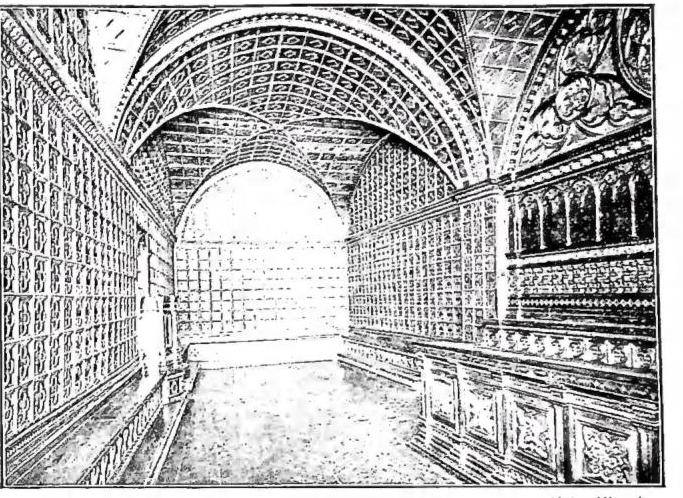
RIVESTIMENTI - Interior of the Sala della Mercanzia with wooden cladding (14th century). Perugia.
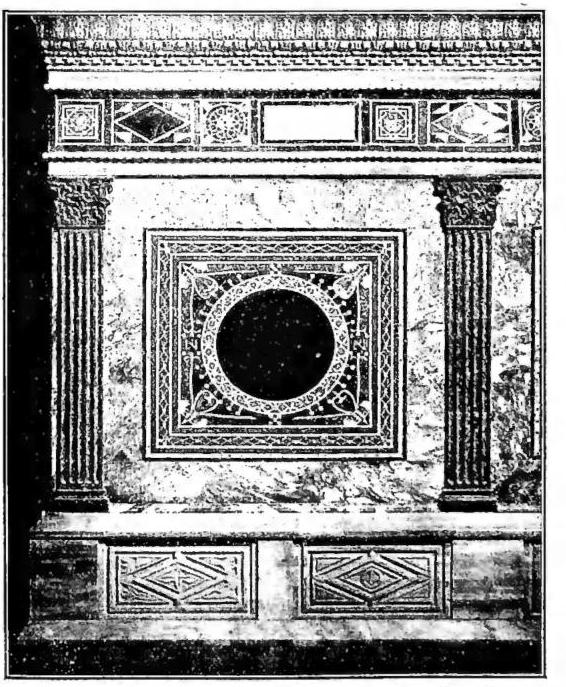
architectural compartments and ornaments, but also complex figural compositions; the foremost example is the civil basilica of Giunio Basso (317), known through the drawings of G. da Sangallo and whose ornamental fragments remain in the Museo Capitolino. This technique was used in religious buildings of the second half of the 4th century (the Basilica Ursiana in Ravenna and the early Basilica Ambrosiana in Milano), insofar as may be inferred from descriptions and the few surviving remains, reducing the ornaments to simple symbolic representations; finally, in the 5th century, it was reduced to geometric motifs, exploiting the polychromy of the materials (S. Sabina in Roma). The tendency toward decorative abstraction became more pronounced in Byzantine architecture (S. Vitale in Ravenna, the cathedral of Parenzo); subsequently, while in Italy this technique gave way to painted decoration, it developed and was perfected in the East, attaining its highest expression in S. Sofia in Costantinopoli.
In Romanesque architecture, following the model of S. Giovanni in Firenze, marble cladding was limited to only two colours, with the intention of enhancing spatial relationships, sometimes feigning architectural motifs: the most notable example is in the basilica of S. Miniato al Monte, where the decoration marks out the spatial rhythm of the façade. In Sicilia too, marble cladding, though associated with terracotta, helps to emphasize the architectural lines (bell tower of the Martorana, cathedral of Monreale). In Gothic architecture, on the other hand, marble cladding generally has no relation to the structural organism (side of the cathedral of Perugia, S. Maria di Collemaggio at L'Aquila, S. Maria Novella in Firenze).
(fot. Alinari)
RIVESTIMENTI - Cladding in marble, mother-of-pearl, and enamel in the apse of the church of S. Vitale in Ravenna (6th century). Reconstruction of 1900–1904, carried out on the basis of original remains and documents.
della Vittoria, Gesù e Maria in Rome, Corpus Domini and S. Lorenzo in Turin; S. Filippo Neri in Naples).
The conception of the chapel as an architectural organism in its own right made it possible to restrict marble cladding to one or a few areas of the church: the first examples date from the beginning of the sixteenth century (the Chigi chapel in S. Maria del Popolo in Rome), and in the following century attained their greatest decorative richness in the chapel of the Princes adjoining S. Lorenzo in Florence, entirely clad in rare marbles, hard stones, gems, and gilded bronzes, with effects of great magnificence but of mediocre taste; more elegant is the chapel of the Monte di Pietà in Rome, sumptuously clad in precious marbles, alabasters, and Sicilian jasper. A typical expression of the late Baroque is seen in the Cybo chapel in S. Maria del Popolo in Rome, where polychromy imparts a character of severity, whereas in the chapel of the S. Sindone in the cathedral of Turin an even more solemn effect derives from the use of black marble alone in the wall cladding. The preference given to stucco in the eighteenth century limited the use of marble cladding in central and northern Italy; while in the south of the peninsula and in Sicily its very intensive use continued until the end of the century. The last great application of marble in church cladding is found in the nave of the Gesù in Rome, dating from the beginning of the nineteenth century. In the same century, however, it was adopted for the completion of façades that had remained unfinished, using marbles whose colours harmonized with the rest of the building. Thus, for the cathedral of Florence, Carrara marble, Prato green, and Maremma red were used; for that of Grosseto, alternating bands of white and Gualdana red marble; and for S. Croce in Florence, Carrara marble alone.
In our century, marble cladding is generally restricted to individual chapels, such as that of the Sacramento in S. Carlo al Corso in Rome, remade for the priestly jubilee of Pio XI, and the other, still more recent, in S. Andrea delle Fratte, also in Rome; an example of the extension of marble cladding to the entire interior of a church is found, again in Rome, in the S.ma Addolorata.
The use of wood as wall cladding is quite rare: a characteristic example is the hall of the Collegio della Mercanzia in Perugia, decorated with geometric motifs. Sometimes, however, the cladding extends only over limited sections of wall, especially above the choir (SS. Severino e Sossio in Naples, cathedral of Pisa). Even rarer as wall cladding is the use of leather, of Oriental derivation, occasionally employed in the seventeenth century in rooms of secular buildings and entirely excluded from religious ones. - Vedi tav. LVI.