
REFECTORY. – An area of convents and monasteries intended for communal meals.
It is ordinarily a large rectangular hall accessible from the cloister and generally arranged with its longer side parallel to the latter, except in Cistercian monasteries, where a perpendicular arrangement is frequent (Clairvaux, Fossanova). Certain large abbeys, such as Montecassino, possessed two refectories, one reserved for the monks and the other, larger, also for visitors. In proportion to the size of the convents, the dimensions of the refectories were at times likewise considerable (that of the convent of S. Francesco at Assisi measures 58 × 11 m). The architecture
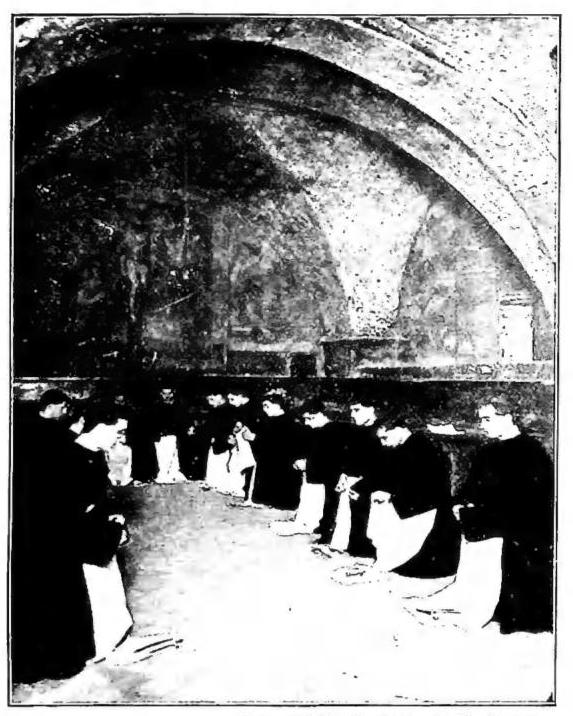
Beginning in the fourteenth century, the walls of refectories were covered with frescoes (S. Chiara in Naples, Novacella near Bressanone, Pomposa), a practice that became general in the Renaissance (convent of S. Marco in Florence, Certosa di Pavia, Monte Oliveto near Siena, and S. Maria delle Grazie in Milan, famous above all for the Cena painted by Leonardo, a theme preferred in many other refectories, as more suited to the setting). Among seventeenth-century refectories, that of the Filippini in Rome is noteworthy, the work—like the rest of the building—of Borromin