
CRISTINA, queen of SVEZIA. — Daughter of Gustavo Adolfo and Maria Eleonora of Brandenburg, born in Stockholm on 8 December 1626, died in Rome on 19 April 1689. Instructed in politics by the grand chancellor Axel Oxenstierna, at sixteen she was already keeping herself informed about public affairs, displaying, in addition to a remarkable and impetuous independence of character, a particular tendency to confront every situation with exaggerated confidence in her own abilities.
In 1642 she also took part in the regency council. An indefatigable reader, endowed with great intelligence and eager for knowledge, she applied herself with genuine success to the study of political science, history, and theology. On 8 December 1644, at the age of eighteen, she assumed the effective direction of the govern-
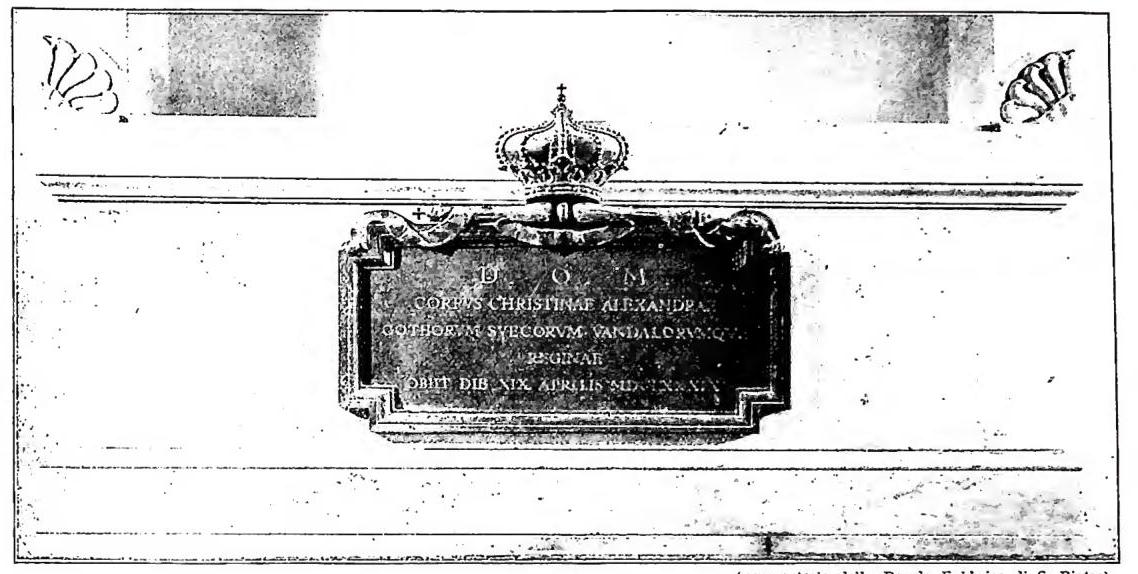
For some years, partly through the influence of Descartes, the queen’s Lutheran faith had undergone an evolution toward Catholicism. She asked, without obtaining consent, to reign as a Catholic and to postpone the ceremony of abjuration to a later date. She then decided to abdicate in favour of her cousin Carlo Gustavo (6 June 1654) and went to Brussels, where she performed her first acts of Catholic faith; she then decided to travel to Rome, arriving there in September 1655, and was received at the Vatican by Alessandro VII. Previously, at Innsbruck, the official ceremony of abjuration had taken place, and the corresponding notification had been sent to all the European courts. In 1656 she went to France, where Mazzarino received with considerable reserve the proposal for her accession to the throne of Naples; during a second journey to Paris, she risked irreparably compromising herself with the French court by having Monaldeschi executed illegally in her palace (November 1657), since he had allegedly revealed to the Spaniards the plan for Naples. She attempted to return to the Swedish throne upon the death of Carlo Gustavo (1660), but she was clearly advised to abandon this plan, which was deemed impracticable, and was even forbidden to remain in her homeland, where she had gone. The years she spent once more in Italy marked for C. a long period of brilliant activity. When difficulties arose with Innocenzo XI, who was displeased by the former queen’s somewhat eccentric attitudes, and every hope of ascending the throne of Naples had faded, C. turned to Poland and expressed the intention of succeeding the deceased king Giovanni Casimiro, but received a categorical refusal. She then renounced all political activity and devoted herself exclusively to her preferred studies and learned conversations with her friends, foremost among them the cardinal Azzolino (or Azzolini), to whom she left all her possessions. In her salons the first nucleus of the Arcadia was formed, which came to life after her death but received from her its first impulses and necessary encouragement.
C. was also in contact with Molinos, who did not, however, become her spiritual director. In the notes that C. appended to the propositions of Molinos condemned by the Holy Office (which she probably received in copy from Cardinal Azzolino), she does not appear completely convinced of the guilt of the Spanish quietist; nevertheless, she cannot fail to acknowledge that the “mystical death” as presented by Molinos is a “chimera,” and that, in Catholic mystical theology, it is an “absurdity” not to strive, in the contemplative stage, toward the love of God and the hope of salvation. C. does not, however, show much favour toward vocal prayer, and is hostile to Ignatian asceticism: according to her, “in spiritual exercises nothing is practised more than vanity and self-interest: as for the rest, one sleeps” (cf. G. Bandini, article cited). This writing, and in general all her mystical and moral works, shed light, albeit indirectly, on a moment in the broader religious history of seventeenth-century Europe.
Mario Zazzetta-Massimo Petrocchi