Machine translation of the 1948–1954 Italian original. The original text is authoritative.
LE CARDONNEL, LOUIS. - French poet, b. at Valence (Drôme) on 25 Feb. 1862, d. at Avignone on 28 May 1936. In his youth he actively participated in the Symbolist experience, following the movement of Nous autres (1882) and contributing to Ermitage and the Mercure de France.
Having come to Italy, he completed his religious education and, ordained a priest (1896) in Rome, devoted himself to a series of journeys in France and Italy, attested by the literary and artistic recollections collected in Du Rhône à l'Arno (1920). In 1905 he withdrew to Assisi. The previous year he had published the principal collection of his verses (Poèmes), in which, detaching himself from Symbolism, he associated himself with the canonical and Platonic tradition, concluding his confident search for truth with an “itinerary to God.” The subsequent volumes of poetry (Carmina sacra, 1912; De l'une à l'autre aurore, 1924) document his continuous journey in faith. In 1929 his complete works were published in Paris.
(phot. National Photographic Cabinet)
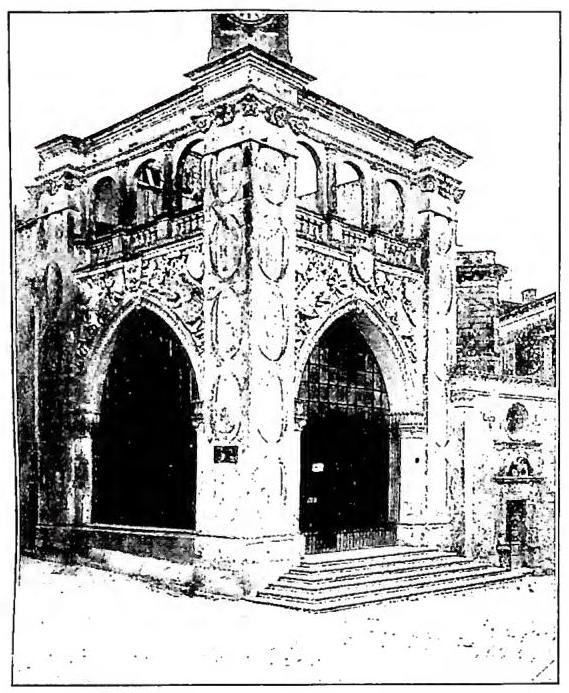
LECCE, DIOCESE of - Little church known as “of the Venetians” (16th cent., with later alterations) - Lecce.
BIBL.: P. J. Richard, Le poète Le C., Avignone 1925; J. Willichu, L. Le C., Monaco 1932; R. Christofour, L. Le C., humaniste chrétien et poète mystique, in Mercure de France, 240 (1932), pp. 562-69; E. Baumann, E. Ripert, etc., Hommage à L. Le C., in Le correspondant, 3 (1936), pp. 3-70; M. Coulon, L. Le C. poète et prêtre, Uzès 1937; M. Savigny-Vesco, Du Quartier latin au sacerdoce. Lettres de L. Le C. à M. et M. me Alidor Delvant, in Etudes, 3 (1937), pp. 162-76; R. Christofour, L. Le C. pèlerin de l'invisible, Parigi 1938; N. Richard, L. Le C., ibid. 1946 (with extensive bibliography).
Cite this article
“LE CARDONNEL, LOUIS.” Enciclopedia Cattolica, vol. VII (1951), p. 617. Azione Romana digital edition, https://azioneromana.com/article/le-cardonnel-louis.