
MADERNO, CARLO. - Architect, b. at Capolago (Canton Ticino) in 1559, d. at Rome on 30 January 1629. Nephew of D. and G. Fontana, he collaborated with them on various works. After D. Fontana's departure from Rome he continued some of the constructions the latter had left unfinished, among them the Palazzo of Cardinal Rusticucci at Borgo Nuovo, now demolished.
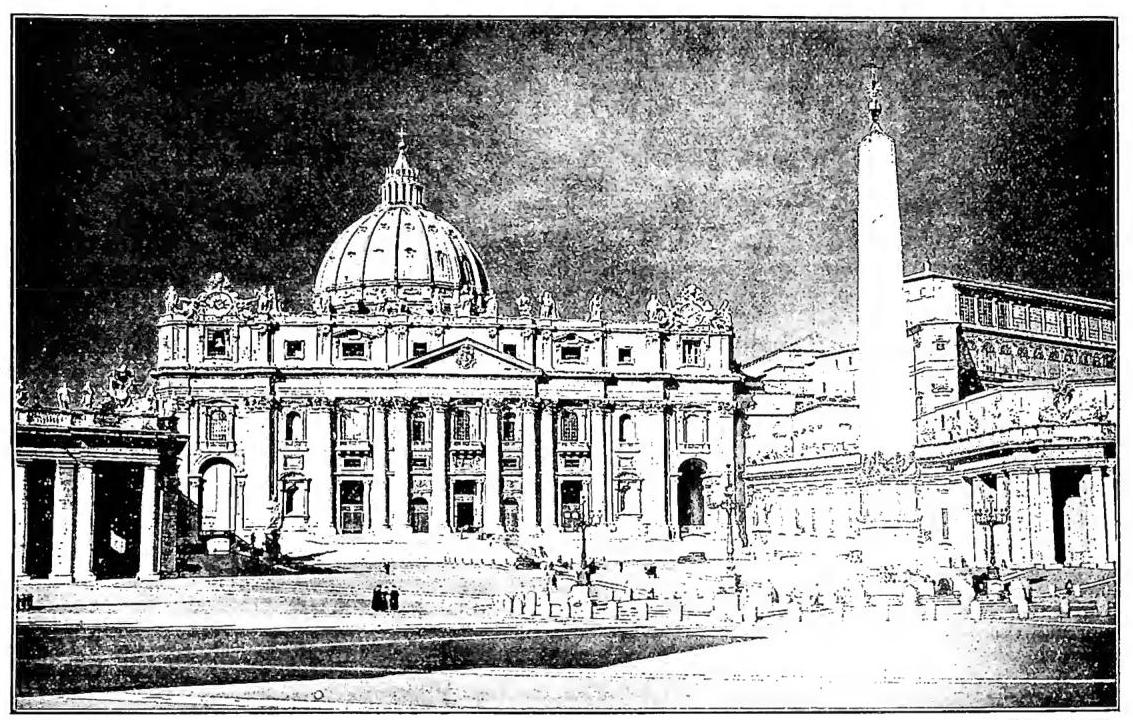
For the same cardinal he began in 1595 the rebuilding of the ancient church of S. Susanna, important for the evolution of the Roman Baroque. In fact the facade (completed in 1603) is not only conceived as the dominant element in the architectural organization of a piazza, but takes on a new plastic force through the adoption of almost completely projecting columns; original too is the balustrade entablature along the pediment, which heightens the sense of picturesqueness and movement. Besides the rich interior of S. Maria della Vittoria (1608-20), the M. is also responsible for the continuation of S. Andrea della Valle (1608-22), which develops the model of the church of the Gesù; for this latter church he also left a design for the facade, later modified in execution by C. Rainaldi (v.). But his most famous work is the facade of the Vatican Basilica, unjustly criticized by the immediately succeeding generations, whereas today its Michelangelesque conception is recognized, in the adoption of the single order and in the sense of grand plasticity. The transformation of the plan, from Greek cross to Latin cross, was, as is well known, imposed not only by liturgical reasons but also by the tradition that required that the ground already occupied by the primitive Constantinian Basilica not be left uncovered; the excessive horizontal development of the facade too must not be imputed to the M., but to the impossibility, for practical reasons, of executing the two bell towers which, in the architect's project (taken up again some decades later by Bernini), would have introduced a vertical note of balance.
No less vast was the M.'s activity in civil architecture: besides works in the Quirinale and Vatican Palaces, he is responsible for the continuation of the Palazzo Aldobrandini (later Chigi) at Piazza Colonna; the other Palazzo for the same family opposite S. Luigi de' Francesi; that for Monsignor Varesi on Via Giulia; and the Palazzo Mattei di Giove (1598-1613), which, through the contrast between the severity of the facades and the decorative elegance of the courtyard, constitutes one of the most significant expressions of the period of transition between the Counter-Reformation and the Baroque. It seems that he wished to adopt more open forms in the Palazzo Barberini, left however at its beginnings at his death, and completed with other characteristics by Borromini (v.) and by Bernini (v.).
Finally, among his minor works, mention should be made of the fountain in Piazza S. Pietro, to the right of the obelisk (later imitated by Bernini in the symmetrical one); the other of the Acqua Paola on the Janiculum, completed in collaboration with G. Fontana, and the one in Piazza S. Maria Maggiore, beside the column which he himself erected, taking it from the Basilica of Maxentius and on which he placed the statue of the Virgin. - See pl. CXX.
BIBL.: sources