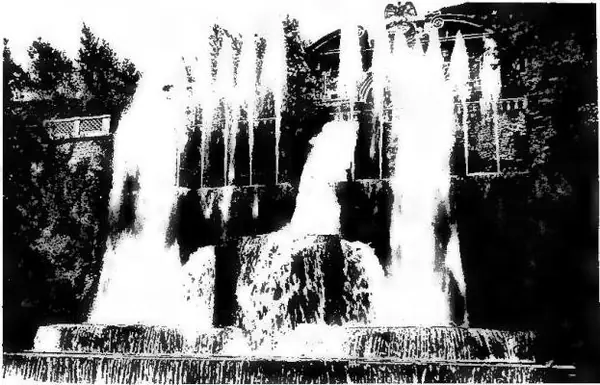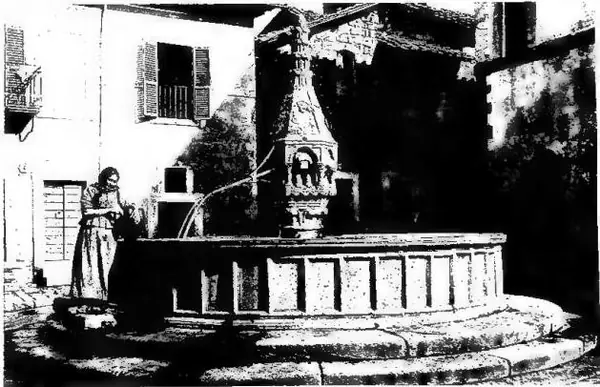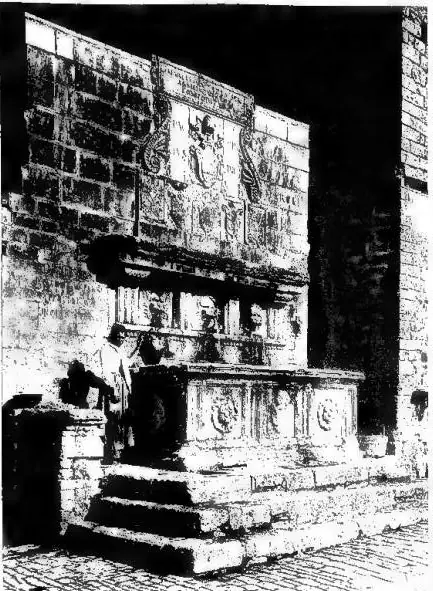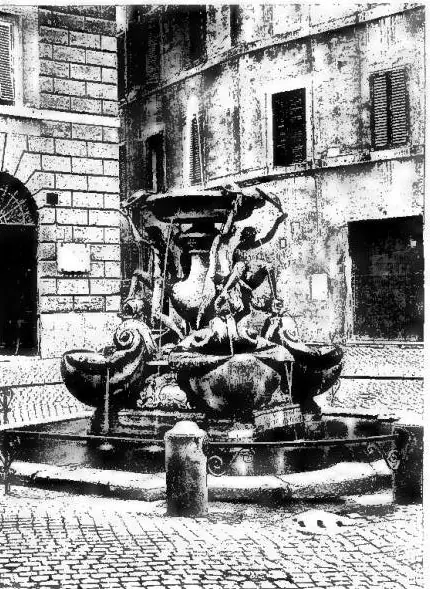
FOUNTAIN. - By fountain is meant an architectural-sculptural structure, of varying size, suited to receiving water and distributing it, for utilitarian or decorative purposes.
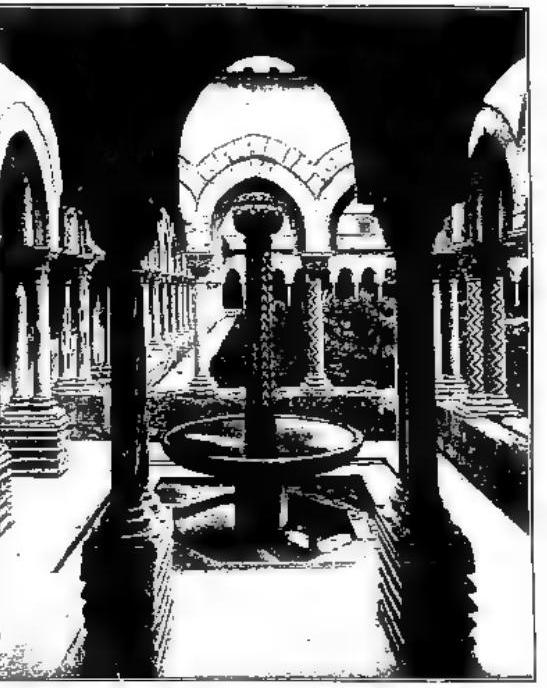
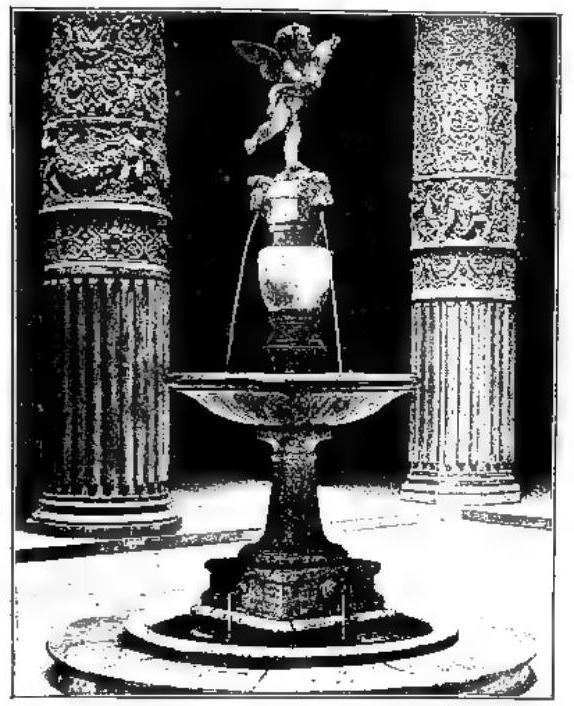
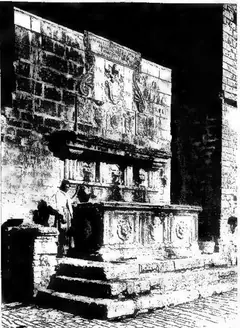
According to Doerpfeld, the first rudimentary architectural forms foreshadowing the Greek fountain date to the time of Mycenae, consisting of a spring received within a polygonal construction, similar to that of the tholos. Different from these Greek fountains of the aforementioned type (which find an example in the Burinna spring of Coe) are those depicted on Greek vases of the 7th-6th century B.C. (consisting of a lion protome pouring water into a basin), those in the form of a pillar, and those, later, in which the multiple spring is surrounded on three sides by a kind of portico with columns adorned with marble basins. In the Hellenistic East the portico is replaced by a broad projecting front with columns of various orders, often richly decorated, connected by slender transennae with friezes, and crowned by entablatures. Thus the fountain becomes an architectural construction particular, to which the name of nymphaeum is attributed. Famous among all the nymphaea of the East is that of Antioch, most beautiful for its precious marbles and paintings. It represents the type of the public fountain up to the Hellenistic period, in which the first luxurious private fountains placed in atria or gardens appear. The so-called distributing fountain, due to the Etruscans (Marzabotto), consists of a basin divided into two tanks of different levels: while the higher one, uncovered, serves as a reservoir, the lower one, covered, receives water from two conduits and expels it from two others. Of this type is the Italic public fountain, which, in comparison with the Greek one, almost subterranean, presents the character of an open-air construction. In Rome this character is maintained in all fountains of the monumental type, among which is that of Septimius Severus, the Septimius, with its monumental seven-story facade. At Pompeii the nymphaeum sometimes has a particular form: a small pedimented apse receives a statuette that pours water, through little cascades, into the basin below. In the early Middle Ages, after the destruction of the aqueducts, the fountains were replaced by wells. Only in the atria of the great basilicas do the so-called cantari remain, to fulfill particular liturgical functions. Intended to bring spring water to the population, the Sienese fountains of the 13th century are built in the lowest areas of the city, where the water, through reservoirs, gushes from numerous jets. Among the isolated fountains, composed of a structure rising at the center of a basin, are to be remembered: the "Fonte grande" (1269) of Viterbo, the "Fonte maggiore" of Perugia, the work of Nicola Pisano, and that of the cathedral of Monreale. Among the Gothic ones, the fountain of Nuremberg is famous; among the Renaissance ones: that of the Palazzo Vecchio in Florence and those of the garden of Villa d'Este at Tivoli; among the seventeenth-century ones, that of Piazza Navona in Rome, the work of Gian Lorenzo Bernini; among the eighteenth-century ones, the "Fountain of Trevi" (where a rare harmony is achieved between the architecture of the background, the groups of figures, the rocks and the multiple jets of water). In the second fifty years of the eighteenth century, developing precisely the theme of the "Fountain of Trevi," fountains tend to imitate, in their effect, waterfalls; often, as at Caserta, statues, allegorical figures and animals appear among the water displays. Among the achievements of our century, besides the fountain in Piazza dell'Esedra in Rome and that of Bari, with its very high jet, one should number, as an indication of the new possibilities offered by technology, the projects and models of fountains presented in 1931, 1935 and 1948 at the Expositions of Paris. - See plates XCV-XCVI.