
FONTANA. – By f. is meant an architectural-sculptural structure, of varying size, designed to receive and distribute water for utilitarian or decorative purposes.
According to Doerpfeld, in the time of Mycenae there appeared the first rudimentary architectural forms anticipating the Greek f., consisting of a spring enclosed in a polygonal structure resembling that of the tholos. Different from these Greek f. of the aforementioned type (an example of which is found in the Burinna fountain at Coe) are those depicted on Greek vases of the seventh–sixth centuries B.C. (consisting of a leonine protome pouring water into a basin), those in the form of pillars, and those of a later period, in which the multiple fountain is surrounded on three sides by a kind of portico with columns, embellished with marble basins. In the Hellenistic East, the portico was replaced by a broad projecting structure with columns of various orders, often richly decorated, connected by slender screens with friezes and crowned by entablatures. Thus the f. becomes an architectural structure
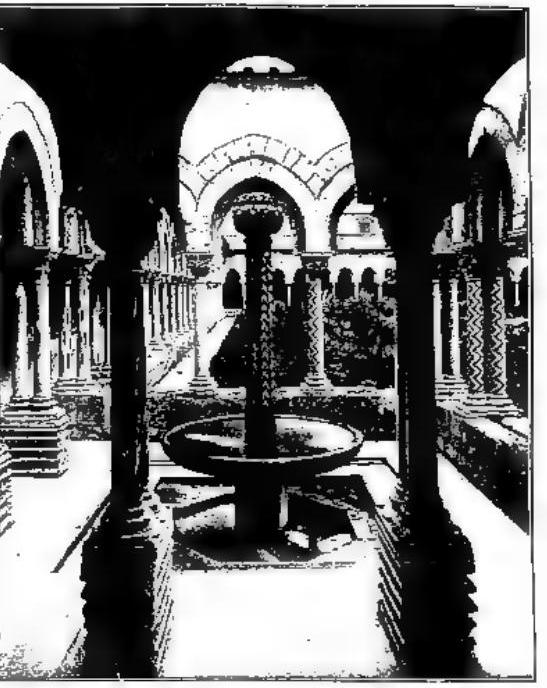
(phot. Alinardi)
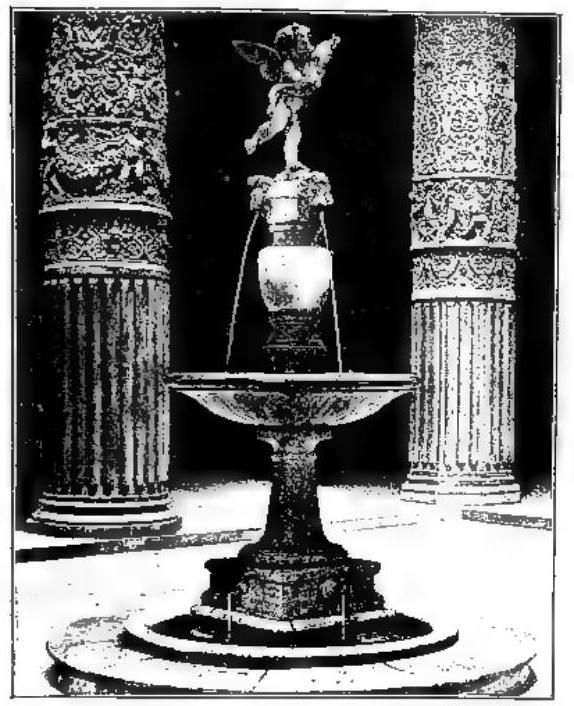
FONTANA - The fountain in the courtyard of the Palazzo Vecchio, the work of Francesco del Tadda (1565); the putto is by Verrocchio (1476), formerly in the villa at Careggi—Florence.
and animals appear among the play of the waters. Among the creations of our century, in addition to the fountain in Piazza dell'Esedra in Rome and that of Bari, with its exceptionally high jet, mention should be made, as an indication of the new possibilities offered by technology, of the designs and models of fountains presented in 1931, 1935, and 1948 at the Paris Exhibitions. - Vedi tavv. XCV-XCVI.
Pietro Gazzola
FONTANA. – Name of numerous artists, especially architects, born in or originating from Ticino, between the 16th and 18th centuries; the most notable are the following:
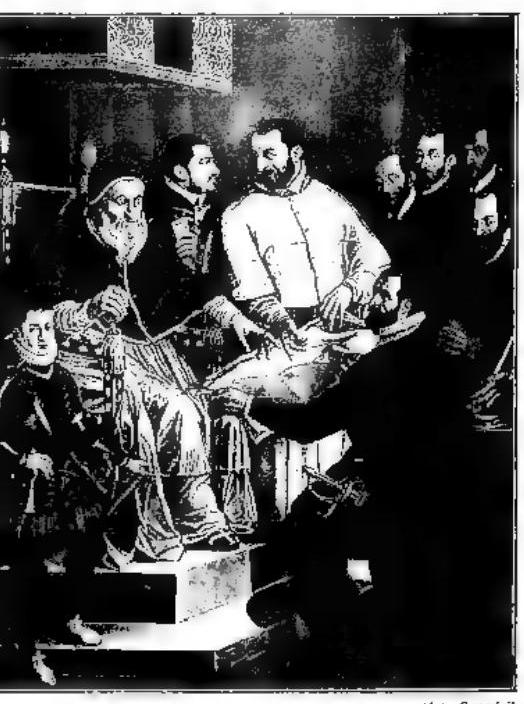
DOMENICO, born at Melide in 1543, died at Naples in 1604, linked his name to the transformation of Rome undertaken by Sixtus V through the laying out of the straight roads radiating from S. Maria Maggiore toward the other basilicas, and their connection by means of other great streets; this vast conception, left unfinished by the death of the Pontiff, anticipated modern urban-planning principles. In the obelisks erected at the ends of the streets, the aesthetic function is combined with spiritual significance through the superimposition of the Cross upon pagan symbols. In these works F. also demonstrated great technical expertise, and his transportation of the Vatican obelisk, of which he left an account, became famous.
In his immensely extensive activity, which also included the vaulting of the dome of S. Porta (v.), the figure of the architect is combined with that of the entrepreneur (Villa Montalto, Chapel of the Nativity Scene in S. Maria Maggiore, Lateran Palace, Vatican Library).
After leaving Rome following the death of the Pope, F. went to Naples, where he carried out other great works, both in urban planning
(the widening of Via S. Lucia and Via Chiaia, the square in front of the Castle) and in construction (Royal Palace, Customs House), showing himself to be a skilled builder rather than a brilliant architect. It should be remembered that, during excavations for the diversion canal of the Sarno, he was the first to come upon the ruins of Pompeii, though without identifying them.
GIOVANNI, brother of the preceding, born at Melide in 1540, died at Rome in August 1614. Particularly skilled in hydraulics, he brought the Acqua Felice to Rome during the pontificate of Sixtus V, and subsequently the Acqua Paola, partially restoring the ancient Alexandrian and Trajanic aqueducts. He provided the designs for the displays of these waters, at S. Bernardo and on the Janiculum (the latter together with Maderno), and for the smaller fountain at the end of Via Giulia, now reconstructed on the right bank of the Tiber at the head of Ponte Sisto. He also devised the water displays for the Aldobrandini and Borghese villas (now Torlonia) at Frascati. Other works of his are the bridges of Acquapendenta over the Paglia and of Borghetto over the Tiber (destroyed in the Second World War).
His activity as an architect was limited: he is responsible for the oldest part of Palazzo Barberini, executed for Cardinal Alessandro Sforza; the beginning of Palazzo Giustiniani; and the palace of Torrenova with its adjoining church on Via Casilina, for Cardinal Scipione Borghese.
CARLO, born at Mendrisio in 1638, died at Rome in 1714, was initially Bernini’s collaborator at Ariccia and in Palazzo Chigi (now Odescalchi) in Piazza SS. Apostoli. The first work he completed independently was the elegant little church of S. Rita da Cascia at the foot of the Campidoglio (demolished in 1928 and reconstructed on Via del Mare).
(photograph Sonesini)