
GALILEI, GALILEO. – Born on 15 February 1564 at Pisa to Vincenzo, a Florentine, and Giulia degli Ammannati of Pescia; in childhood he was with the Vallombrosan monks; he subsequently enrolled at Pisa in the Faculty of Arts and, around the age of twenty, devoted himself with particular study to mathematics. The milieu at Pisa was Peripatetic par excellence, but this did not deter the young scholar from proceeding independently, basing himself on the study of Archimedes and on experience. In 1587 he was in Rome, where he entered into relations with Fr. Cristoforo Klau (Clavius), professor of mathematics at the Collegio Romano (d. 1612), with whom he subsequently always maintained excellent relations. In 1588 he unsuccessfully attempted to be appointed to teach mathematics at the University of Bologna; in July 1589, instead, he obtained the chair at Pisa; and, not having been reappointed there, he moved to Padua, to which he was appointed by decree of the Senate of Venice on 26 September 1592. The years at Padua were truly decisive for G.’s scientific career and an incentive to intense activity. In addition to giving the public lectures required of him, he gave private lessons and ran a boarding establishment for students; he organized a workshop for precision instruments: compasses, dividers, quadrants, set squares, etc., and later also lenses and telescopes; he made friends among the Venetian nobility and had illustrious pupils, among them Gian Francesco Sagredo, the monk Benedetto Castelli, and the canon Paolo Aproino. During these years, from a relationship with a certain Marina Andrea Gamba, he had Virginia (later Sister Maria Celeste), Livia (later Sister Angelica), and Vincenzo Andrea, whom he would subsequently take with him to Florence. With the specific aim of making science popular, he began his career as a writer by employing the vernacular, in the use of which he always achieved remarkable clarity, precision, and brevity, keeping well clear of unnecessary citations and all rhetorical emphasis, thereby making himself a steadfast
(photo by Carlo)
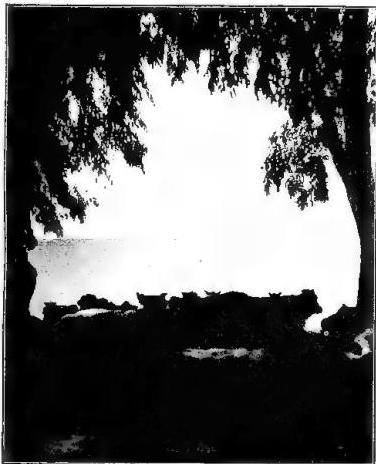
GALILEA - Midday on the shores of Lake Tiberias.
Belonging to this first period are a Treatise on the Sphere, a Treatise on Fortification, some practical manuscripts On Mechanics, and a booklet on the Compasses of Proportion (1606), which described an instrument he had constructed to accelerate calculations. In 1597 he was already a convinced Copernican and was corresponding on the subject with Kepler, but he could not publicly profess it; above all, he was intent on refining his scientific method, in the constant application of which G. may be called the father of modern science. From the outset he proposed to follow the method taught by mathematicians, namely “to make what is said depend on what has been said, without ever assuming as true what has to be explained”; whereas, according to the methods then in use, “those who learn never know things from their causes, but merely believe them on faith, that is, because Aristotle has said them. And if what Aristotle has said should be true, there are few who investigate it; it is enough for them to be considered learned because they have a greater number of Aristotelian texts at hand” (Opere, national edition, I, p. 285). The rational interpretation of phenomena, together with the investigation of their mutual dependencies by means, wherever possible, of mathematical deductions, finds in G. its first conscious and complete expression: “I truly esteem the book of philosophy (understood in the broadest sense as natural philosophy) to be that which perpetually lies open before our eyes; but because it is written in characters different from those of our alphabet, it cannot be read by everyone: and the characters of this book are triangles, squares, circles, spheres, pyramids, and other mathematical figures supremely suited to such reading” (ibid., XVIII, p. 293). Here, on the one hand, G. reveals in mathematics his preference for geometry; on the other, he insists upon direct experience, which may indeed be assisted by the speculations of the ancients, provided that they do not conflict with what direct experience teaches. In this sense of an experimental method, G. would be an incomparable teacher to famous disciples, and this new school would completely renew the study of nature.
From the outset G.’s investigations were directed toward different fields. As early as 1602 he was occupied with magnets, which he manufactured, increasing their power of attraction; at the same time he studied the phenomena of heat, upon which his disciple Sagredo worked; nor were hydraulic problems foreign to him. But problems relating to motion and gravity were those that particularly occupied his activity throughout his scientific life. Indeed, he was already working on them at Pisa, where he also observed the isochronism of the small oscillations of the pendulum and began to compile his notebooks “da motu gravium,” while engaging in the struggle against the Aristotelians who adhered to the master’s erroneous conclusions; at Padua he was already concerned with “the marvellous problem of the penossa,” the fall of projectiles—subjects that would later provide him with material for broader developments. Astronomical problems were also connected with those of motion, but G. did not make them an object of study until a second period; nor did he leave a scientific treatment of the comet of October 1604, which he nevertheless observed.
The second period began in 1609, which carried G. into a broader field of activity and fame. The general report that a spectacle-maker in the Netherlands had constructed, with lenses, an instrument through which distant things could be seen close at hand induced G. to build one in his workshop (August 1609), and he immediately demonstrated it in Venice; he subsequently built many of them, and for a long time no one equaled him in perfection. It is known that he later adapted this telescope for viewing minute objects, but this did not greatly interest its inventor, who instead turned his instrument toward the heavens. This was in January 1610, and he immediately observed the lunar spots, the immense multitude of fixed stars, especially in the Milky Way, and their difference from the planets, as well as the existence of Jupiter’s satellites. He announced this to the world in the Siderens nuncius, published in Venice in March, written precisely in Latin so as to make it accessible throughout Europe. The Nuncius overturned all the cosmological conceptions then in vogue and completely disrupted the astrology called judicial, which was still flourishing; it therefore encountered open disbelief in the scientific world from the outset: the truthfulness of the telescope and the accuracy and interpretation of the observations were doubted. Certainly, few could obtain a good telescope with which to repeat the observations; others, out of preconceived opposition, did not wish to use one, as did Cesare Cremonino, G.’s colleague at Padua. In Germany, on the other hand, Kepler supported G., especially once he was able to use a good telescope, as did Father Clavius and Father Tommaso Campanella.
The fame that G. had by now acquired among the truly learned moved Grand Duke Cosimo II to summon him back to Tuscany; on 10 June 1610 he appointed him first mathematician of the University of Pisa and grand-ducal mathematical philosopher, without any teaching obligation. G. accepted, and on 12 September he was in
Florence, where he also moved his laboratory. Here he continued his observations of the singular configuration of Saturn, begun at Padua (25 July), and in September–October 1610 he became convinced that Venus had phases analogous to those of the moon, a sign that this planet revolved around the sun, from which it received its light. The Ptolemaic system was thus completely refuted, but the Peripatetics did not appear to notice II.
In February 1611 he traveled to Rome, where he also had the opportunity to discuss the sunspots that he had been the first to observe; he was warmly received by Clavius and the Jesuits of the Roman College. Federico Cesi, Marquis of Monticelli, enrolled him in his Accademia dei Lincei, and G. considered himself greatly honored by this; he also received an honorable welcome in Roman ecclesiastical circles, which wished to assure themselves of his discoveries. In May 1612, at the grand duke’s invitation, he published in Florence his conclusions on floating bodies, following the doctrines of Archimedes and provoking a lively controversy with the irreducible Peripatetics. They received another blow from him through the three letters which, in the second half of that—
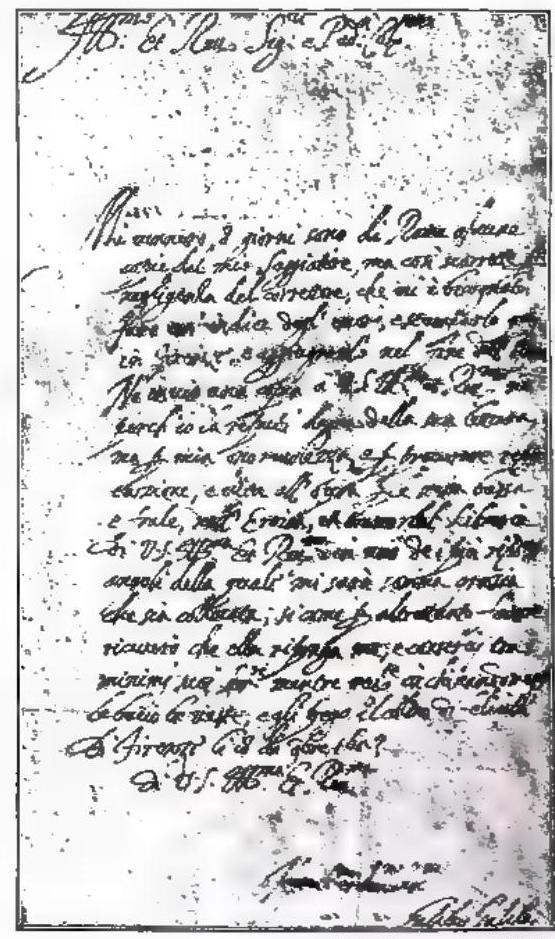
GALILEI, GALILEO – Autograph letter to Cardinal Federico Borromeo from Florence, 18 October 1627, accompanying a copy of the Saggiatore intended for the Biblioteca Ambrosiana. Milan, Biblioteca Ambrosiana.
in that year he wrote to Marco Welser of Augsburg, communicating his further observations on sunspots in refutation of the letters that Father Scheiner, a Jesuit, had sent on the same subject. They were printed in 1613 in Rome under the auspices of the Lincei.
In the following years controversy arose concerning the acceptability of the heliocentric doctrine in relation to the Faith. G. disseminated this theory in oral discussions and correspondence; but, with a few exceptions, he found «against himself the universal opinion imbibed, one might say, ab orbe condito». To some, even learned men, Tycho-Brahe’s system seemed sufficient to reconcile the new discoveries with religious tradition. It was, moreover, a widespread custom to introduce the authority of Scripture and the Fathers into discussions, even purely philosophical ones, and the same was done in the heliocentric question, in order to condemn it as contrary to the Faith and heretical. In December 1613 Father Castelli a-
On 7 February 1615, Fr. Niccolò Lorini, a Dominican, had sent from Florence to Cardinal Paolo Sfondrati, prefect of the Congregation of the Index, a copy of G.’s letter to Fr. Castelli, as containing “many propositions that are either suspect or rash.” Since the letter was not printed, the cardinal forwarded it to Cardinal Mellini, secretary of the Holy Office, where it was immediately examined. On 20 March, Fr. Tommaso Caccini, also a Dominican, formally denounced G. to the Holy Office, and a judicial inquiry was consequently begun in Florence. Realizing that the Florentine enmities would not fail to have repercussions in Rome, G. decided to go there without delay. He hoped to win over the most learned figures in the Urbe,
and paid no heed to his friends’ warning that “the Peripatetics were extremely powerful there.” Many of the distinguished persons who, even within the Curia, supported him did not look favorably upon his openly presenting himself as a convinced advocate of Copernican doctrines; although they appreciated his studies and discoveries, they did not intend to follow him along that path. In the fervor of his convictions, G. failed to appreciate how difficult it was to dismantle a philosophical edifice taught as incontrovertible in all ecclesiastical and secular schools, and how hard it must have seemed to those teachers to renounce doctrines that they had taught and held with complete conviction for many years. Having left Florence with the grand duke’s permission, G. arrived in Rome on 11 December 1618, as the guest of the grand-ducal envoy on the Pincio, and immediately set to work disputing his theories with the most distinguished figures, even with Fr. Caccini, committing his arguments to writing as well and consequently arousing the hostility of the followers of the old systems, who promptly turned the matter into one of religious orthodoxy. All this necessarily led to the conclusion that the relationship between Copernican theory and Christian tradition had to be clarified, and that the discussion had thus to be officially transferred from the personal sphere to the strictly doctrinal one. It was therefore easy for G.’s adversaries to persuade the Holy Office of the need for a decision that would remove all uncertainty. The Holy Office referred the examination to a commission of eleven theologians, who on 24 February 1616 replied as follows to the two questions put to them: 1) “That the sun is at the center of the world and immobile in local motion is an absurd and false proposition in philosophy and formally heretical, because it is expressly contrary to Sacred Scripture”; 2) “That the earth is not the center of the world and is not immobile, but moves with diurnal motion in accordance with its own nature, is likewise an absurd and false proposition in philosophy and, considered theologically, is at least erroneous in Faith.” This response by the theologians was ratified the following day by the cardinals of the Inquisition, in the presence of the Pope; but it was not officially published as an act of the Sacred Congregation and remained an internal rule, representing the conclusion reached by learned and qualified men in the matter.
As for G., who had publicly compromised himself through his discussions, it was decided to proceed with regard to him in a lenient manner, and Cardinal Bellarmine was entrusted with the task of officially admonishing him to desist from advocating such theories, with imprisonment threatened in the event of disobedience. On 26 February the cardinal fulfilled this task in the presence of the commissioner of the Holy Office and several witnesses. G. promised to obey, undertaking “in no way to hold, teach, or defend, orally or in writing,” heliocentric doctrines. For its part, on 5 March the Sacred Congregation of the Index prohibited Fr. Foscarini’s book, together with all other works, not specifically listed, that supported the same doctrines; it also decreed that in new printings of Copernicus’s work a few phrases should be corrected so that it would appear that he had proposed the heliocentric system merely as an astronomical hypothesis. Since the rumor was spreading that G.
had been compelled to make a formal recantation, he took care to obtain from Cardinal Bellarmine, on 26 May, a certificate of the communication made to him concerning Copernican theory. Thus ended what was improperly called G.’s first trial. At the beginning of June he returned to Florence, more determined than ever to work, in the best and most prudent manner, toward the triumph of his doctrines, demonstrating for the time being the untenability of the opposing doctrines.
The year 1618 was the year of the comets: three appeared, the last of which (November–January 1619) aroused particular interest among astronomers and the public. Discussion centered above all on their nature: that is, whether they were true planets or meteors. Judgment from G. was awaited, but he was ill and unable to make direct observations. It was instead Fr. Grazio Grassi, astronomer at the Roman College, who printed a public disputation, De tribus cometi, and G. undertook an examination of this publication, presenting his friend Mario Guiducci as the speaker in a discourse delivered at the Florentine Academy. Rather than establishing a doctrine, the reading was intended to demonstrate the untenability of the
theories of Grassi and other astronomers, including Tycho-Brahe, lamenting that, instead of direct observations, people reasoned solely on the basis of preconceived theories. Fr. Grassi replied under the guise of a supposed disciple defending his teacher’s doctrine and, under the name of Lonario Sarsi Sigensano, published in Perugia Libro astronomico ac philosophico (1619), in refutation of Guiducci. G.’s friends agreed that a reply ought to be made, and in October 1623 he published Il Saggiatore, in which, in 52 chapters, he examined all of Sarsi’s assertions. A polemical work, not a properly systematic treatise, in which the author was careful not to present himself as a defender of Copernican theory, although he suggested its superiority here and there, it destroys Sarsi’s assertions and his objections to Guiducci’s discourse, and observes that in scientific research one must have recourse, more than to the opinions of authors, to direct observation of phenomena and to mathematics; for this reason he avoided adducing Sacred Scripture, as was unfortunately then customary. The book, addressed to the young Roman patrician Virginio Cesarini and dedicated to the new Pope Urban VIII, enjoyed wide circulation, provoking a counter-reply from Fr. Sarsi. Trusting in the benevolence that Urban VIII had shown him years earlier, G. undertook a new journey to Rome in the spring of 1624 and was promised ecclesiastical benefices; but as regards the acceptance of his ideas he encountered nothing but disappointments. Thus, almost by way of excuse, while refuting his adversaries, he wrote that by this he did not intend to support Copernican doctrines, but to make heretics understand that, although he could not accept them, the arguments on which they were based were not unknown.
Meanwhile, a new piece of evidence in favor of heliocentrism presented itself to G.’s investigation: that of the ebb and flow of the sea. He wanted nothing to do with the influence of the stars, almost as a reaction against what was one of the chief principles of astrology at that time; he therefore thought that the influence of the sun and moon had nothing to do with the cause of the tides. According to him, they were due to the
rotation of the earth. He wished to place this new supposed argument within a broader treatment that would examine the two principal cosmological systems: the Ptolemaic and the Copernican. He began work on it in the autumn of 1624, but only in October 1629 did he devote himself to it with the intention of carrying the work through to completion. It was conceived as a dialogue divided into four days, with three interlocutors: Filippo Salvati, who presents the Copernican case, while repeatedly professing to be reasoning as about a scientific hypothesis that the Faith does not accept; Gian Francesco Sagredo, who plays the part of the listener, learned but uninitiated,
who repeats the arguments, elaborating on them; and the third, Simplicio, the traditionalist, neither ignorant nor foolish, always attached to the doctors and the books, without contact with nature or experiment, who, not without caricatural features, defends prevailing ideas. They debate the nature of the heavens, the earth’s daily motion and its motion around the sun, the ebb and flow of the sea, and the fall of heavy bodies.
The work was to be printed in Rome, and the task was to be undertaken by Prince Federico Cesi, head of the Accademia dei Lincei. For this reason, in May 1630 G. went to Rome and established contact with Fr. Niccolò Riccardi, Master of the Sacred Palace, in order to obtain his license for printing.
The book was widely circulated from February 1632 and also reached Rome, where its contents were displeasing, and in July an attempt was made to prevent its circulation there. The Pope wished the matter to be pursued to the end and entrusted it without further delay to the Holy Office; a commission was in fact appointed to examine II. It soon became the common conviction that, appearances notwithstanding, the author was defending Copernican theory as true. It was noted that the preface sent by Fr. Riccardi from Rome was printed in a different type, almost as though it were extraneous to the rest, and that authors venerated in the Church were being mistreated. When it was proposed that the book be corrected, the Pope replied that it would be necessary to redo the entire book from the beginning. The decisions were not long in coming. On 23 September 1632 Urban VIII ordered the Inquisitor of Florence to summon G. in the legally prescribed form to appear before the Roman Inquisition by October. G.’s delays, which he attributed to his poor state of health, were regarded as evasions; threats were resorted to, the original manuscript was demanded, and all printed copies were withdrawn. Since the Pope had no intention of yielding, the grand duke too urged G. to obey. He left
Florence on 20 January 1633, arrived in Rome on 12 February, and presented himself before the tribunal. He was permitted to reside with the Tuscan ambassador, Nicolini, at the Pincio, on condition that he live in seclusion. Only on 12 April was he compelled to enter the palace of the Holy Office, where he was assigned the only three rooms available, without being locked in, with permission to go down into the courtyard, keep a servant, and receive his meals from the embassy. The interrogation began immediately. G. had hoped to be allowed to defend his theories, but this was not the practice of the tribunal, for which they had already been classified as such since 1616. Indeed, the first question put by the commissioner, Fr. Vincenzo Macolano, concerned the injunction then given to him by Cardinal Bellarmine. G. admitted that he was the author of the Dialogo, adding that he had «in detto libro né tenuta, né difesa l'opinione della mobilità della terra e della stabilità del sole». G. attempted to base his defense on this denial, whereas, as the commissioner rightly observed, the contrary «apparisce manifestamente nel libro da lui composto». To spare him harsher measures, the commissioner obtained permission to deal with him extra-judicially; and on 20 April he induced him to admit that in his book he had gone too far in favor of Copernican doctrines. In the second interrogation, on 30 April, he admitted that «gli argomenti portati per la parte falsa (copernicana) ch'egli intendeva di confutare, fossero in tal guisa pronunciati che per la loro efficacia fossero più potenti a stringere che facili ad esser sciolti», and declared himself ready to write in the opposite sense and, for that purpose, to add one or two days to his dialogue. After this second interrogation, G. was immediately permitted once more, on grounds of health, to remain «loco carcerio» in the palace of the ambassador Nicolini, while remaining at all times at the disposal of the Holy Office.
At the third appearance before the Holy Office, on 10 May, concerning the precept imposed upon him in 1616, G. insisted on asserting «di non avere scientemente e volontariamente traspedito ai comandamenti fattigli» at that time, and with regard to the Dialogue he did no more than refer to what he had said in the first interrogation. Perhaps he hoped to avoid a formal recantation, but it was clear that his assertions were untrue. Thereupon, on 16 June, the Pope communicated his decisions: G. was henceforth to be questioned without fail about what he really believed (super intentionem), with the threat also of torture; and if he persisted, he was to make his recantation and be condemned to imprisonment at the discretion of the Congregation, with an injunction never again to discuss the Copernican doctrine in any way, under penalty of being treated as a «relapsò»; the Dialogue was to be prohibited and the sentence made public by transmitting it to the nuncios and inquisitors in the various countries, and especially to Florence. The interrogation «super intentionem» took place before the commissary father on 21 June, and G. again maintained that before 1616 he had been indifferent between the two great systems, but that thereafter he had no longer defended the Copernican system. When threatened with torture, he replied that he was there to render obedience, again insisting on his denial concerning the Copernican system. The threat was merely a procedural element, nor could it, according to the rule, have been inflicted upon him, an old and sick man; indeed, «fu rimandato al luogo suo», and on the following day, in the convent of Minerva, before the cardinals and prelates of the Congregation, the sentence was read to him. In it, although it was held that G. had not fully told the truth, it was acknowledged that in the rigorous examination he had answered as a Catholic; in any case, he had rendered himself «vehementer suspectum de hacessi», incurring the relevant censures and penalties; from these he was absolved after his recantation; the Dialogue was prohibited and its author condemned to imprisonment in the Holy Office at the discretion of the Congregation, with the obligation of reciting the seven penitential psalms once a week for three years. G. made his recantation according to the prescribed formula, accepting the obligations imposed upon him. Such was G.’s trial, in which, without reopening the doctrinal decision of 1616 concerning the religious unacceptability of the Copernican system, G. was judged and condemned for his continued adherence to it, demonstrated above all by the Dialogue on the Two Chief World Systems. From then on he was a prisoner of the Holy Office; yet the Palace of the Orator on the Pincian was assigned to him as his prison. On 30 June he was granted permission to stay in Siena with its archbishop, Ascanio Piccolomini; then, on 1 December, he received permission to withdraw to his villa at Gioiello near S. Matteo d’Arcei, which he had purchased on 27 September 1631, and there he remained, as a prisoner, until his death. In fact, every attempt to obtain a full pardon for him was fruitless: Urban VIII would hear nothing of II. G.’s final years were troubled by tiresome illnesses, during which he found the consolation of his daughter, Sister Maria Celeste, who died on 2 April 1634; in December 1637 he became completely blind. The prohibition against printing all his works grieved him particularly. Nevertheless, he never interrupted his studies, especially those on «motion and resistances», as he himself wrote on 12 July 1636, and he formed from them a volume printed by the Elzevirs at Leiden in 1638, which was immediately also sold in Rome: Discorsi e dimostrazioni matematiche intorno a due nuove scienze attenenti alla meccanica et i movimenti locali. The work consists of four dialogues with the same interlocutors as the Massimi sistemi, of which it is in a sense a continuation, maintaining a tone that is no longer polemical but serene and calm. Taking up again his youthful writings De noisi, he laid the foundations of dynamics and, opposing Aristotle with the law of inertia, provided the first rational basis for the Copernican system and the secure foundation for Newton’s principle of universal gravitation. But G. was still pursuing further developments of his doctrines, which his pupil Vincenzo Viviani, using the notes he had collected, later set down in two further days added to the Scienze nuove.
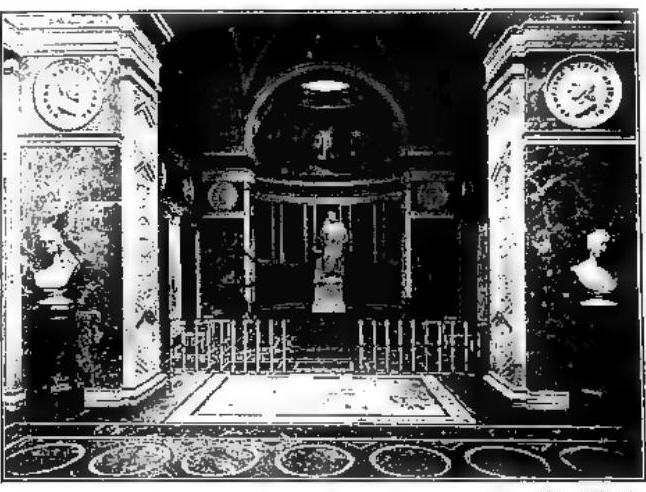
And since the States General of the Netherlands had announced a competition to solve the problem of determining longitude during navigation, G. re-examined the hypothesis that this might be achieved by observing the eclipses of Jupiter’s satellites with the aid of a good telescope and a clock. On this matter he had maintained a long correspondence with Spain after 1616, without success; and this time also (1636–40), owing to technical difficulties, he reached no other result than receiving a gold necklace as a gift (1638), which he refused in order not to arouse new suspicions. He continued until the end to examine his favored problems, and his last letters concerned the libration and lunar brightness, until he piously ended his life in the arms of his son Vincenzo, of the Viviani family, and of Evangelista Torricelli, who had been his disciple during the final months, on 8 January 1642. He was buried in Florence, in S. Croce. - Vedi tav. CXXVII.
On the third centenary of G.’s death. Essays and lectures, in the publications of the Catholic University, Milano 1942.