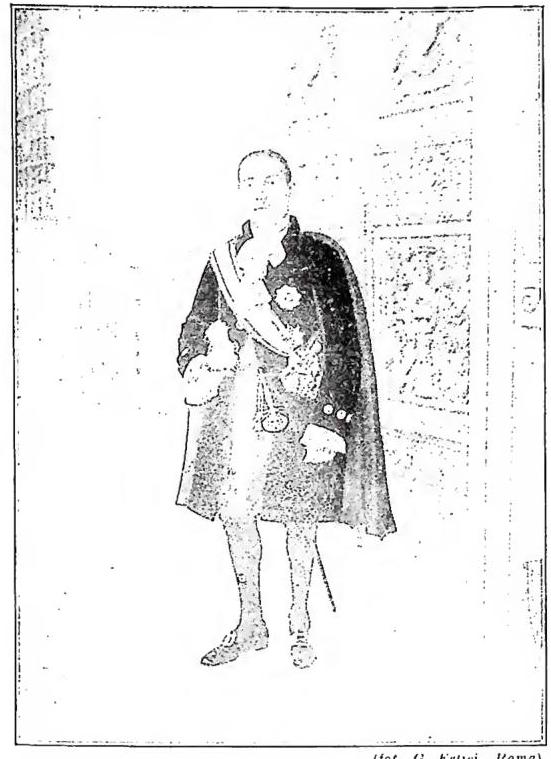
ASSISTANT TO THE PONTIFICAL THRONE. — This is a high honorific title, instituted in the 16th century, which is conferred upon ecclesiastical and lay dignitaries and carries the privilege of occupying a distinguished place near the Pope’s throne during pontifical functions, immediately after the cardinals. Patriarchs, archbishops, and bishops who are assistant to the pontifical throne form a college (with their own secretary) which, in pontifical chapels, follows immediately after the college of cardinals: at the present time (1948), there are 8 patriarchs, 70 archbishops, and 105 bishops among the ecclesiastical assistants.
Lay assistants to the pontifical throne, by right, are the Prince Colonna and the Prince Orsini, who alternate in this role.
ASSISTANT TO THE PONTIFICAL THRONE – SOCIAL ASSISTANCE
The functions of the assistant to the pontifical throne have undergone various attenuations according to the needs of the moment. In Italy, for example, after 1931, the assistant to the pontifical throne, together with the president (male or female), formed the presidency, and thus had a deliberative role on any matter. The Statutes of 1946 restored to the assistant to the pontifical throne the exclusive function described above, in order to grant laypeople greater autonomy and responsibility in matters not explicitly reserved to the assistant to the pontifical throne or in which he does not have a kind of veto power.
Pontifical documents have always emphasized the decisive importance of the work of the assistant to the pontifical throne, carried out within Catholic Action, down to the incisive formula given by Pius XI: “Catholic Action is what the assistants to the pontifical throne make it.”