
CASTELGANDOLFO. – The small town that overlooks Lake Albano from above the volcanic crater in which it lies now has 3,500 inhabitants, chiefly farmers. It has very ancient origins, since on the very site where the Apostolic Palace now stands there rose the Arx albana, the sacred center of Albalonga, founded, according to legend, by Ascanius, son of Aeneas; it was in turn the cradle of Rome and later its rival.
Although destroyed, the Arx albana still preserved its sanctuaries in the imperial era, when mention is made of the Salti arcis albanae and of the Vestal Virgins who guarded the fire of Vesta albana. This place was chosen by Domitian for his residence, including during the winter. The Alban estate of the Caesars occupied an immense area, since it also included the lake, extending for a total of approximately 14 km.; it belonged to the imperial domain and was assigned by Constantine as an endowment, according to the Lib. Pont., to the basilica of S. Giovanni Battista, the cathedral of Albano, which he had founded.
The papal villa now stands on the ruins of what was the principal nucleus of the Albanum Domiziani. There are preserved there, besides a few fragments of columns, statues, and marble friezes, part of the cryptoporticus: a magnificent nave measuring 300 m. in length, with a coffered vault and painted walls, intended to shelter the emperor’s promenade from bad weather.
The earliest record of the present name of C. dates to 1218, in a document in which the Gandolfi (apparently a family of Genoese origin) appear as lords of the place. The Gandolfi were soon succeeded in its dominion by the Savelli, who were dispossessed by Eugenio IV and recovered it under Nicolò V. They lost it again, as guilty of rebellion, under Alessandro VI, only to regain it in 1503 and finally surrender it, owing to financial difficulties, to the Apostolic Camera in 1596.
Card. Maffeo Barberini, who used to spend his holidays in this town, having become pope (1623) under the name of Urbano VIII, ordered the fortress to be enlarged and renovated by Carlo Maderno, and inaugurated it in 1626, staying there for another eleven years, in spring and autumn. His example was followed by Alessandro VII, who had the parish church of S. Tommaso di Villanova built according to a design by Bernini; it is adorned with a painting by Pietro da Cortona on the high altar and another, depicting the Annunciazione, by Maratta.
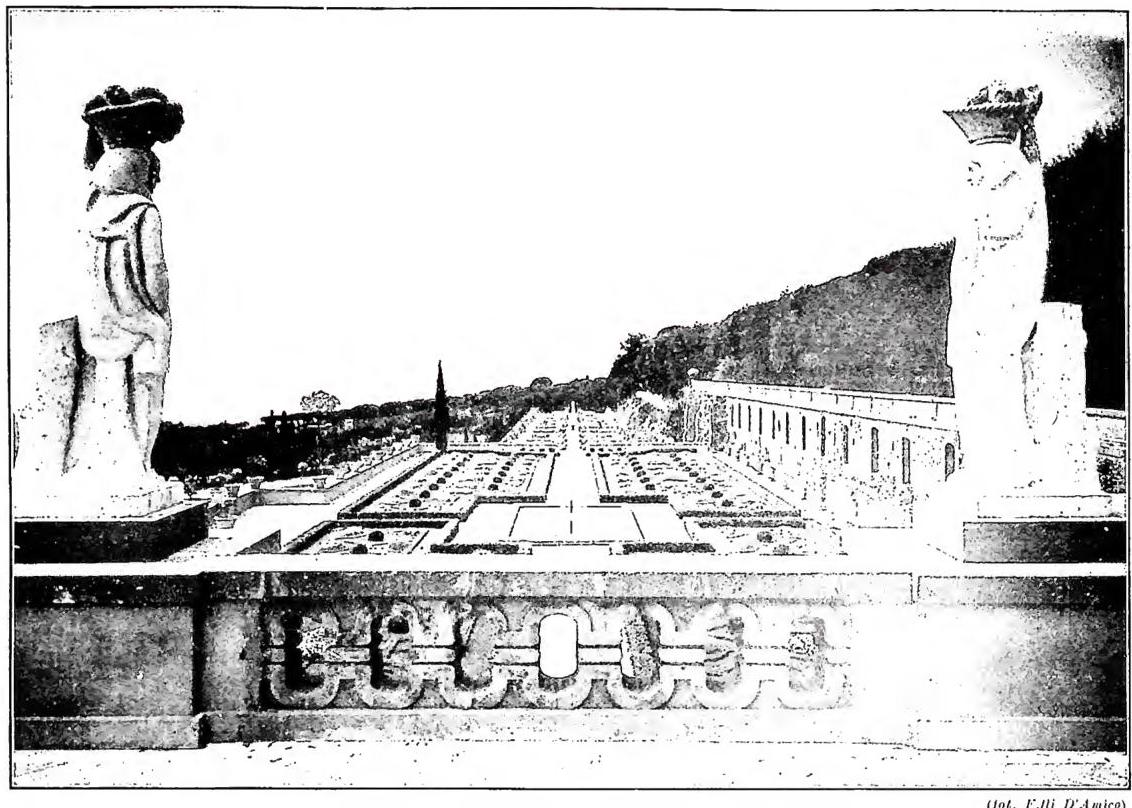
CASTELGANDOLFO - Terraces and gardens of the papal villa.
(Int. F. di D'Amico)
For eleven years out of the fifteen of his pontificate (1831–1846), Gregory XVI spent his holidays here. During his long pontificate, Pius IX vacationed at C. nine times, at irregular intervals, and for relatively short periods; his last stay was in May 1869. After 1870 the villa remained permanently closed, although under the Law of Guarantees it was included among the properties that the Italian State granted for the use of the Supreme Pontiff, with the same immunities established for the other apostolic palaces. This continued until, with the Lateran Treaty of 1929, its full ownership was recognized as belonging to the Holy See, together with the addition of the Barberini villa, making possible the Pope’s return to his summer residence. It was not until 1934, however, on 2 August, that Pius XI entered the old Apostolic Palace.
Thus, after sixty-five years, the series of papal summer stays at C. began again. The Pope returned there, however, no longer as a sovereign but as the guest of another State—in his own home, to be sure, and protected by the privilege of extraterritoriality, but “forming part of the kingdom of Italy,” according to the wording of the treaty; and his stay was in practice to remain within the boundaries of the residence. The latter was therefore enlarged by the addition of the Barberini villa, intended to give greater space to the former cramped papal property, to which it was connected by a covered bridge.
Several sculptures discovered during the renovation work adorn the gardens; among them, noteworthy is an equestrian statue perhaps representing Domitian, whose head was later replaced. In the former Barberini palace, by contrast, there were placed a porphyry torso of athletic stature, a perfect copy of a work by Polykleitos, and a small, remarkably faithful copy of the Ciniscus, another masterpiece by the same master. A copy of Myron’s Marsyas was taken to the Vatican Museum. Among the works of art preserved in the Apostolic Palace is a Descent from the Cross, a large high relief in the Swiss Hall and, in the adjoining rooms, a painting by Wicar representing the Ratification of the Concordat of 1807, a gift from Napoleon to Pius VII, and a Madonna by Dolci. Near the Consistory Hall is the Chapel of Urban VIII; in the private apartment there is also the Polish chapel, decorated by Rosen, where a copy of the Madonna of Czestochotca is displayed, presented to Pius XI by the episcopate of Poland.
The Pontifical Palace also received the astronomical observatory transferred from the Vatican, equipped with new instruments and an ultra-modern astrophysics laboratory.
Pius XI remained at C. during his first summer stay for more than two months, progressively lengthening his residence in subsequent years. Pius XII, who had already transferred to C. in the summer of 1939 and stayed there for more than three months, emphasized the simplicity of this residence, to which he customarily moved without an entourage and with only the strictly necessary staff. This sense of austerity also accords with the memory of the recent events of war through which the papal villa had passed.
In January 1943, after the landing at Anzio, the Pope, who had not returned to the villa since his first visit, received there the populations of C., Albano, and the surrounding countryside, who sought refuge and protection under the mounting threats of war. In the first weeks of February, the refugees numbered more than 12,000; at that time aerial bombardments also descended upon the pontifical residence, causing more than 500 deaths and thousands of injuries. In addition to sheltering the refugees, throughout that period and immediately after the war the villa served as a providential relief station for the populations located behind the Anzio battlefront, who had been left without assistance or supplies and gravely afflicted by bombardments and forced evacuations.
Once the battle for the capture of Rome had ended, restoration work on the serious damage suffered by the villa began as soon as possible. It was not until the summer of 1946, however, that the Pope, who since 1939 had left the Vatican only to rush to the aid of Rome’s neighborhoods devastated by bombardment, returned there; he did likewise in the following two years, staying from the beginning of August until the end of November.