
LATERAN PACTS. — These are the agreements concluded between the Holy See and the Italian State on 11 February 1929, Roman Question (v.) was resolved.
The settlement of the dispute, which for approximately eighty years had divided Church and State in Italy and had disturbed and saddened consciences, followed a period of preparation which, considering only the postwar years, went back in its less immediate phase to the Cerretti–Orlando conversations (May 1919) and found its basis in the negotiations initiated by the Mussolini cabinet after it came to power.
The desire for an agreement, generously expressed Pius XI (v.) at the very moment of his accession to the papal throne, with the blessing from the external loggia of St Peter’s, and confirmed in the encyclical Ubi arcano, had in fact been answered on the part of the Italian government by the drafting of a Project for the Reform of Ecclesiastical Legislation (March–December 1925); this project, prepared by a commission chaired by the Italian undersecretary for Justice and including, though without an official mandate, several ecclesiastics, was intended to settle the complex problem of ecclesiastical property, in implementation of art. 18 of the Law of Guarantees (v. the commission’s report and bills in A. Giannini, Concordati postbellici, II, Milan 1936, pp. 455–92).
However, in his chirograph of 18 February 1926, addressed to the cardinal secretary of State (AAS 18 [1926], p. 84 ff.), Pius XI proclaimed that in such matters one could not “recognize in others any right or power to legislate, except following the appropriate negotiations and legitimate agreements with [the] Holy See.” Following this declaration, the Italian government shelved the project and, somewhat later (14 May 1926), the Keeper of the Seals Rocco announced to the Chamber of
Deputies that studies on the matter would be resumed on “broader bases.”
These were to be the negotiations between the representative of the Holy See, attorney Professor Francesco Pacelli (v.), and the representative of the Italian government, State Councillor Domenico Barone, who died before the conclusion of the agreements; negotiations which, having begun privately on 6 August 1926, became unofficial on 4 October of the same year. On 24 October the Holy See made known its detailed proposals, which also included a draft convention regulating the juridical condition of the Church in Italy, that is, the future Concordat. Pacelli and Barone signed a draft of the Treaty on 24 November and prepared two drafts of the Concordat for February 1927.
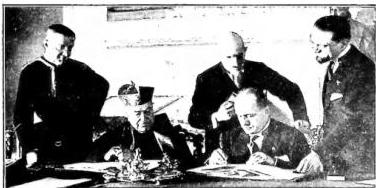
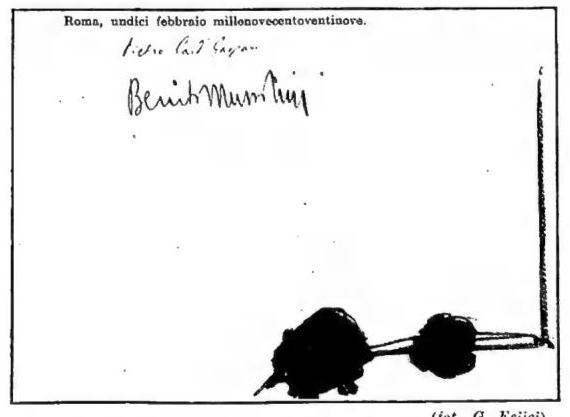
The continuation of the discussions was hindered by various events, including those relating to the establishment of Fascist youth organizations, which culminated in the forced dissolution by the Holy See of the young explorers (cf. chirograph of 27 January 1927, AAS 19 [1927], p. 41 ff.); and only in November 1928, after a great many sessions, when the documents had by then been prepared in their definitive form, were the plenipotentiaries appointed, namely the cardinal secretary of State and the Italian Prime Minister. On 7 February 1929, the cardinal secretary of State announced to the diplomatic corps accredited to the Holy See that the agreements would shortly be signed; this took place in the Lateran Palace on the 11th of the same month. The ratifications were exchanged on 7 June, on which day Law no. 810 of 27 May 1929 entered into force, making the agreements executable in Italy.
The L. P. (v. the text in AAS, 21 [1929], p. 209 ff) consist: I. of a treaty in 27 articles, with four annexes (1, plan of the territory of the Vatican City State [v.]; 2, list of properties enjoying extraterritorial privileges and exempt from expropriation and taxation; 3, list of properties exempt from expropriation and taxation; 4, financial convention); II. of a concordat in 45 articles concerning the status of religion and of the Catholic Church in Italy.
By the Treaty it was intended “to eliminate every reason for disagreement... existing by bringing about a settlement... which, by stably assuring the Holy See a situation in fact and in law that guarantees it absolute independence for the fulfillment of its high mission in the world, will enable the Holy See itself to recognize the ‘Roman question’ as definitively and irrevocably settled,” etc.; while, on the other hand, “since, in order to assure the Holy See absolute and visible independence, it is necessary to guarantee it an indisputable sovereignty even in the international sphere,” there was recognized “the necessity of constituting the Vatican City, recognizing over it the Holy See’s full ownership and exclusive and absolute sovereign power and jurisdiction” (preamble). With this latter declaration solemn confirmation was given to the principle always affirmed, before and after 1870, by the supreme pontiffs: that the free exercise of the Holy See’s mission, including its spiritual mission, was inconceivable without at least a minimal territorial base.
To attain this purpose, since the establishment of the Vatican City State alone was insufficient, a special juridical status was also created within the Italian legal order for the central organs
Italian, and that there shall be no authority other than that of the Holy See.”
Under Art. 8, “Italy, considering the person of the Supreme Pontiff sacred and inviolable, declares an attack against him and incitement to commit one punishable by the same penalties established for an attack against and incitement to attack the person of the King” (now the President of the Republic, Arts. 276–77 of the Penal Code). Moreover, “public offences and insults committed in Italian territory against the person of the Supreme Pontiff through speeches, acts, or writings shall be punished as offences and insults against the person of the King” (now the President of the Republic, Art. 278 of the Penal Code).
The particular legal situation of the bodies, persons, and things connected with the supreme direction of the Church is outlined in its essential features in Arts. 9, 10, and 11 of the Treaty. These establish (Art. 9) that “all persons having a permanent residence in Vatican City shall be subject to the sovereignty of the Holy See”; that (Art. 10) “the dignitaries of the Church and the persons belonging to the Pontifical Household, who shall be indicated in a list to be agreed upon between the High Contracting Parties, even when they are not citizens of the Vatican, shall always and in every case, with respect to Italy, be exempt from military service, jury service, and every form of personal service (while equal treatment is provided for other career officials of the Holy See)”; and that (Art. 11) “the central bodies of the Catholic Church shall be exempt from all interference by the Italian State (except for the provisions of Italian laws concerning acquisitions by juridical persons), as well as from compulsory conversion with regard to immovable property.”
Under Art. 12, “Italy recognizes the Holy See’s right of active and passive legation according to the general rules of international law”; while Art. 19 establishes that “the diplomats and envoys of the Holy See, the diplomats and envoys of foreign governments accredited to the Holy See, and the dignitaries of the Church coming from abroad and traveling to Vatican City ... shall ... be able to reach it through Italian territory” (cf. LEGAZIONE, diritto di; CORPO DIPLOMATICO; CORRIERI DIPLOMATICI; AGENTE DIPLOMATICO).
Arts. 13–16 recognize the ownership, immunity, and exemption from expropriation and taxation of certain immovable properties belonging to the Holy See. For its part, in accordance with the provisions of Art. 18, the latter shall maintain “open to scholars and visitors ... the treasures of art and science existing in Vatican City and in the Lateran Palace.”
Although this follows implicitly both from the preamble and from the content of the Treaty, the final paragraph of Art. 26 (cf. also Art. 45, paragraph 2, of the Concordat) expressly declares Law no. 214 of 13 May 1871 (the law of guarantees [v.]) and “any other provision contrary to the ... Treaty” abrogated.
The Concordat accompanying the Treaty regulates “the conditions of religion and the Church in Italy.”
While referring the examination of these conditions to another entry (ITALIA, IV), it should be noted here that they are based on the following fundamental principles: 1) Italy’s guarantee of the “free exercise of spiritual power,” of the “free and public exercise of worship, as well as of ... jurisdiction in ecclesiastical matters in accordance with the provisions of the ... Concordat” (Art. 1); 2) the establishment of forms of special favor for ecclesiastical persons and bodies (Arts. 3–4, 6–8, 29 h, paragraph 1, 30, paragraph 3); 3) the relevance, in Italian law, of norms and relationships belonging to the Church’s legal order, especially with regard to marriage (v. II) and education. Taken together, all these provisions contribute to directing the Italian legal order, if not in a strictly confessional sense, toward considering the position of the Catholic religion and Church as endowed with particular prestige.
Some observations are necessary concerning the nature of the documents and their value. First of all, they constitute a solution founded on a bilateral agreement, in conformity with what the Holy See had always demanded; and in this respect they stand opposed to the discipline unilaterally established by the law of guarantees. It should also be noted, however, that this solution was reached independently of the intervention of any other subject of international law; and this ran counter to the projects repeatedly advanced that envisaged the participation of other states in concluding the agreement, precisely in order to ensure greater stability for II.
A problem of major importance concerns
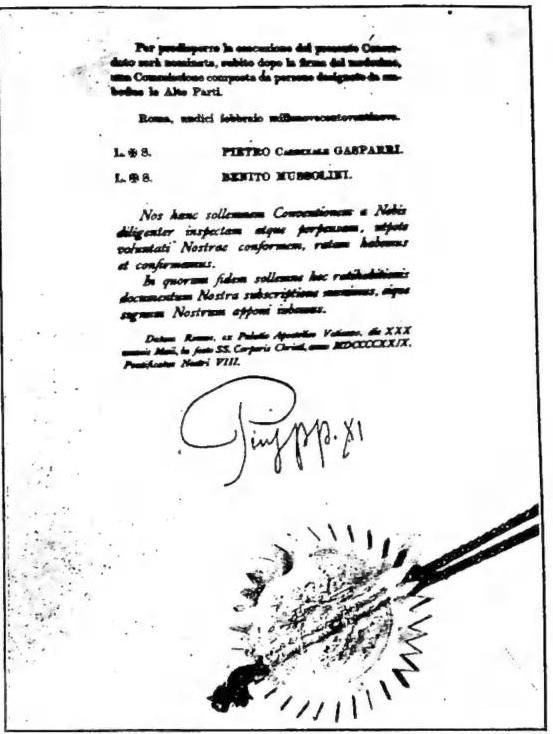
(phot. G. Felici) PATTI LATERANENSI - Signature of Pius XI and seal appended to the instrument of ratification of the P. L. (30 May 1929).
Without giving weight to manifestations preceding the conclusion of the P. L., and limiting the examination to these and to official declarations contemporary with or subsequent to them, one may observe first of all that the preamble itself of the Treaty states that “the Holy See proposed that the Treaty... should be accompanied, as a necessary complement, by a concordat, etc.” Article 26 of the Treaty itself then speaks of “the AGREEMENTS which are today signed.” The connection between the two protocols is also demonstrated by the speeches of Pope Pius XI of 11 and 13 February 1929, and especially by the papal chirograph of 30 May of the same year (AAS, 21 [1929], pp. 297 ff.), in which it is affirmed that “Treaty and Concordat, according to their letter and spirit, as well as according to the explicit oral and written understandings, are each the necessary complement of the other and each inseparable and indivisible from the other. It follows that simul stabunt or simul cadent” (loc. cit., p. 305). On the Italian side, these solemn declarations are matched by those contained in the report of the Head of Government and the Minister of Justice on the bill for the implementation of the agreements, according to which “the Concordat is the logical and necessary development” (of the Treaty); and also “the Concordat supplements and completes the Treaty.”
In addition to the aforementioned law of 27 May 1929, no. 810, by which the P. L. were made effective in Italy, further provisions were issued to implement the provisions of the agreements; among these, the most important, all concerning matters covered by the Concordat, are: law of 27 May 1929, no. 847, on recognition for civil purposes of marriage celebrated before ministers of Catholic worship; law of 27 May 1929, no. 848, on ecclesiastical entities and civil administrations of assets intended for religious purposes; and the related regulation, approved by R. D. of 2 December 1929, no. 2262, and amended by R. D. of 26 September 1935, no. 2032.