
BARTOLI, DANIELLO. — Born in Ferrara on 12 February 1608, died in Rome, at the Gesù, on 13 January 1685. Not yet sixteen, on 10 December 1623 he entered the Society of Jesus; although extremely frail in constitution, he was sharp of intellect and gentle in disposition, and the Jesuits came to regard him as one of their most distinguished members, both for his apostolic virtues and for his exquisite skill in treating history and Italian prose. As soon as he was received into the novitiate at Novellara, he longed, as he wrote in one of his letters dated 5 February 1627, to devote himself “to the labours of the Indies and to the desired end of divine glory in martyrdom.” Thus for thirteen years, once or more each year, he implored the superior general Vitelleschi to send him to propagate the faith; he wrote that he wished to go “where there might be greater dangers and greater opportunity to suffer and die in hardship or to be killed, since there, by divine grace, he felt himself more strongly encouraged to go.” Having completed his philosophical and theological studies at Parma and been ordained a priest at Bologna in 1636, instead of the longed-for Indies he was given Italy as the field of his apostolate.
At first he taught philosophy, but only for a very short time, at Parma; then, when the need arose for an able preacher of Lenten sermons, he was made to leave the chair for the pulpit. For thirteen years he continued preaching Lenten and Advent sermons, once and sometimes more than once, in Ferrara, Genoa, Lucca, Florence, Rome, Naples, Messina, Palermo, and Malta, earning a reputation as an excellent orator and producing abundant spiritual fruit among his listeners, until in 1649 the new superior general Vincenzo Carafa appointed him historian of the Order. Thus, at the age of forty-two, leaving the pulpit, where Paolo Segneri was about to succeed him, he undertook the apostolate of the pen with the certainty of the happiest success. For even if the Saggio di poesie morali, published at Bologna in 1642 under the name of Giov. Battista Bartoli, was not his, L'uomo di lettere, published in 1645 to turn young people away from reading novels, provided sound grounds for supposing that his lively speech, listened to with such acclaim from the pulpit, would be no less welcome and fruitful when read in books.
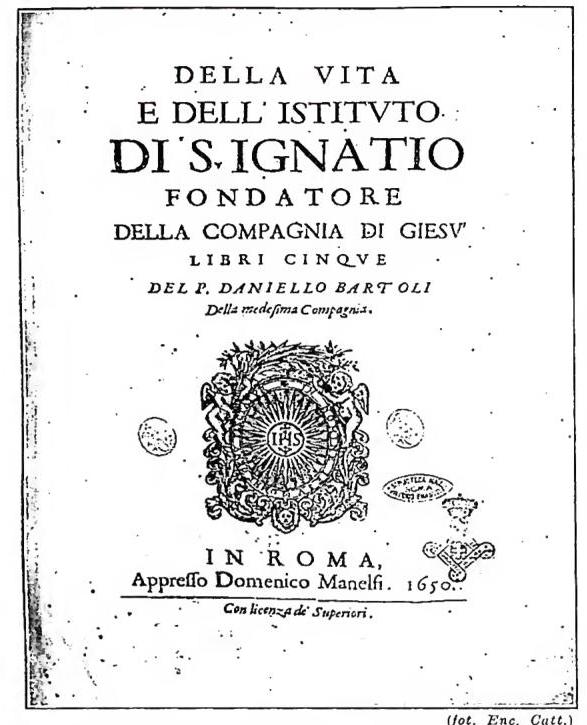
The Society, whose universal history he was preparing to write, then had a century and a decade of life behind it—enough time to offer the historian abundant and varied material. To arrange it with order and clarity, he tells us, he chose to adopt the very common division into the four parts of the world, subdivided into the regions where the Order had laboured most extensively for the salvation of souls. He began it with a majestic vestibule or, as he called it, “the foundation of the whole work”: the five books Della vita e dell'istituto di s. Ignazio fondatore della Compagnia di Gesù, published in Rome by Manelfi in 1650. These were followed, in the years 1653, 1660, 1663, 1667, and 1673, by five other folio volumes, like the first: three on Asia (India, Japan, China), and two on Europe (England, Italy). It is thus clear that the Historia universale, as he had announced it, remained largely unfinished, despite the fact that for thirty-five years, except for the three-year period when he was rector of the Collegio Romano (1671–73), he was constantly engaged with his pen. It is true that during this long period he also treated a considerable number of subjects, even within the same historical field.
Such were the five works—not so much biographies as histories of the lives of distinguished fellow members—namely: of Fr.
His long and copious work in the historical field did not exhaust the B.’s exuberant intellectual vein.
He also drew useful subjects from philosophy, asceticism, physics, and philology, which he knew how to treat with nobility of sentiment, penetrating reflection, close argumentation, and a marvelous variety of elegant phrases and turns of expression, almost always far removed from the eccentricities of the bombastic Seicento. He published no fewer than twelve volumes in the disciplines mentioned; among the principal ones may be recalled: La povertà contenta (1650), L'uomo al punto (1667), Dell'ultimo e beato fine dell'uomo (1670); Delle due eternità (1675); Delle grandezze di Cristo (1675); Dei simboli trasportati al morale (1677); all of them reprinted several times up to 1850. In these works he adapted for reading a considerable part of the Lenten sermons lost in the shipwreck that took place off the coast of Capri in 1649, when he was traveling to preach in Palermo.
After his death, the B. experienced a fate that, if not unique, was certainly rare. For more than a century and a half, until the second half of the nineteenth century, he was unanimously exalted to the skies; one may recall the epithet “terrible” given him by Giordani, together with the praises bestowed upon him by Monti, Leopardi, Galesni Napione, Gargallo, Tommaseo, and other contemporaries of theirs.
Yet, once the kingdom of Italy had been proclaimed, perhaps because of political passions, the judgment passed from one extreme to the other. For De Sanctis, Settembrini, and a whole group of critics of Italian literature, with the exception of Carducci and a few others, the B. was—as De Sanctis defined him—“a rhetorician and abstract moralist of the Seicento,” and Bonghi did not hesitate to call him “a null writer, lacking in thought, life, and truth, heaped-up, confused, without coherence or order, with an affected and artificial style, and a language rich indeed, but mixed and haphazardly assembled without discernment” (Lettere critiche, Naples 1884, p. 157).
This concerns his style and language; with regard, however, to the historical value of his works themselves, they would be nothing other than histories—as people now say—romanticized in the manner of Amedeo Thierry’s Recits de l'histoire romaine du Ve siècle. Now, this judgment can be accepted only by one who has never compared Bartolian pages with the sources from which the author derived them. Anyone who, before making an assertion, undertakes such a necessary comparison will have to become convinced that the B. was not only an excellent prose writer, but also a historian in the strict sense of the word—that is, that he faithfully presented what the critically examined sources attested to him. But let us be clear: he narrated and described as an artist, because God had made him such.
Accordingly, Antonio Belloni rightly observed (B. [Collezione scrittori italiani], Turin 1931, p. 7): “the representations, descriptions, and narratives of the B. are to be judged as one judges portraits executed by talented painters, who, while rendering on canvas as faithfully as they can the features of the person posing before them, at the same time idealize them in order to reveal that person’s soul, character, hidden thoughts, and the secret movements of the mind and heart.” It therefore seems that twentieth-century criticism is now reversing its judgment concerning the Ferrarese, acknowledging in him the inevitable imperfections present in every human work, but ultimately experiencing this great writer of the Seicento as Giacomo Leopardi experienced him when he wrote: “Ovid describes, Virgil paints, Dante (and, proportionately, our B. in prose), to speak precisely, not only paints masterfully in two strokes and creates a figure with a single brushstroke, not only paints without describing (as Virgil and Homer also do), but carves and sculpts before the reader’s eyes his own ideas, concepts, images, and sentiments” (Zibaldone, IV, 289).
BISL: For the biography, the fullest account is found in vol. I of the Operette morali, spirituali e scientifiche, Venice 1716; the same account in abridged form, but with some additions, in A. Patrignani-G. Boero, Menologio, I, Rome 1859, pp. 247–51. For the list of published works and manuscripts V. SOMMERVOGEL, CHARLES, I, cols. 965–85. On the B. as historian V. the extensive bibliography compiled by P. P. Trompeo, s. V. in Enc. Ital., VI, p. 248. Pietro Tacchi Venturi