LEOPARDI, GIACOMO. - Poet, born at Recanati on 29 June 1798 to Marchioness Adelaide Antici and Count Monaldo (q.v.), died at Naples on 14 June 1837. His tutors until the age of fifteen were his father, the Spanish Jesuit Giuseppe Maria De Torres, and Sebastiano Sanchini, but above all the books in his father’s library, which contained more than 16,000 volumes: in those rooms he spent “the best part” of himself and his youthful dream of becoming a distinguished philologist, translating from Homer, Hesiod, Isocrates, Epictetus, Virgil, Horace, Fronto, Eusebius, essays which he sent from time to time, with prefaces and notes, to Lo Spettatore, L’Antologia, and Il Nuovo Ricoglitore.
(photo Enit)
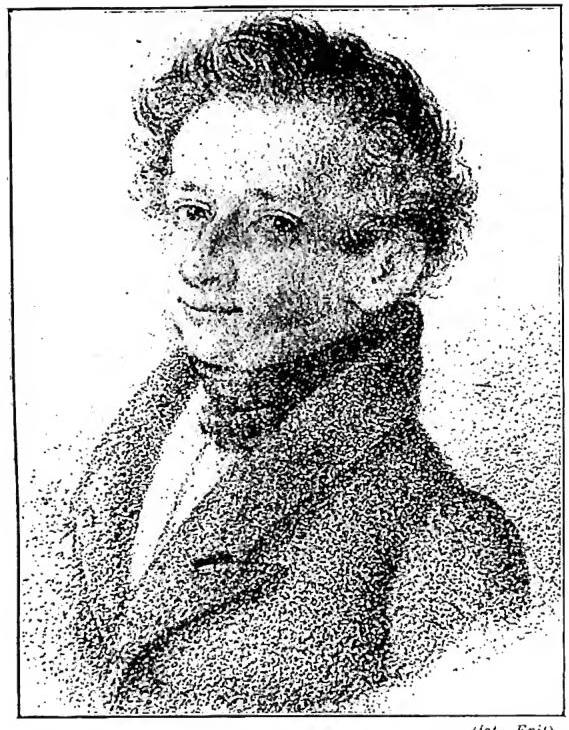
LEOPARDI, GIACOMO - Portrait painted by Lolli (1826).
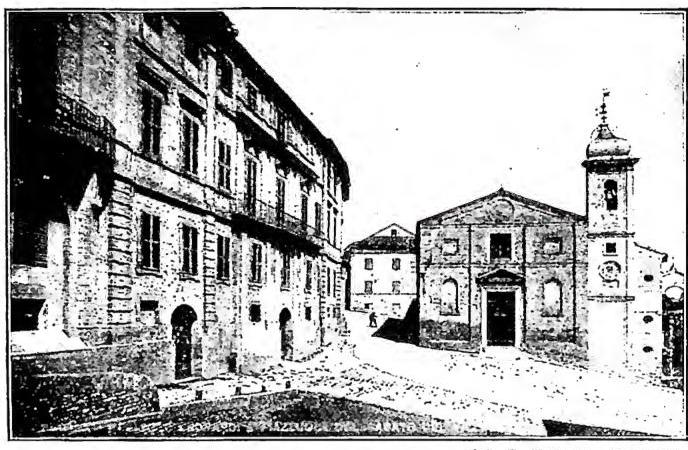
Recanati, Casa Leopardi.
After a stay in Florence from 1830 to 1833;
he finally embraced the idea of associating with Ranieri
by moving to Naples, where, despite care and rest
in the Vesuvian area, his « daily and incurable physical
sufferings » grew worse. Death overtook him in this city.
Notable but not decisive, apart from his friendship with Giordani, were his contacts with the men of his time: Mai, Niebuhr, Vieusseux, Capponi, Colletta, Manzoni, Gioberti. He had no political fortune: acclaimed deputy in 1831 for the Assembly of the United Provinces, he had barely time to refuse when the Austrians were already in Bologna. Apart from Bunsen’s offer of the Dante chair at Bonn or Berlin, rare were the recognitions of his fame among contemporaries: in Italy he was offered in 1829 the chair of natural sciences at Parma and was granted only an honorable mention by the Accademia della Crusca for the Operette morali (the five-year prize had been awarded to Carlo Botta). In the time of pleasant delusions, with « seven years of mad and most desperate study » he ruined his body forever: the hunchback from rickets, the extreme weakness of his sight, which made him definitively abandon philology by sending his manuscripts to De Sinner, reduced him in his last year (cataract of the right eye and hydropericarditis arrived) to « a trunk that feels and suffers ».
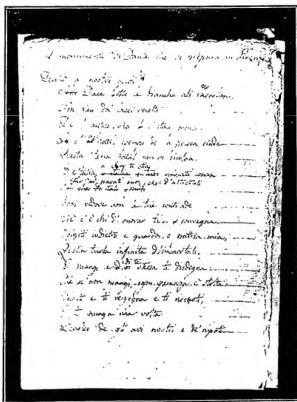
LEOPARDI, GIACOMO - Autograph of the canzone "Sul monumento di Dante che si prepara in Firenze" - Recanati, Casa Leopardi.
(photo: Vatican Library)
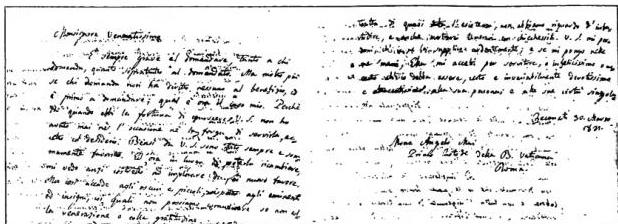
LEOPARDI, GIACOMO - Letter to Angelo Mai (30 March 1821) in which he asks to be appointed «Professor of Latin Language» at the Vatican Library - Vatican Library, cod. lat. 12895.
cosmic shudder (Song of a Wandering Shepherd in Asia) and still the conviction that nature, an indifferent spectator of man’s tragedy (The Broom), is the only enemy to be fought. To annihilate then the « proud fables » of an earlier time, in the Operette morali (1st ed., Milan 1837) Leopardi re-examined the themes already suffered in the Canti (1st ed., Florence 1831), and in dialogues of exquisite literary craft he reasoned about the errors of men, of customs and peoples, the vanity of glory (Il Parini), of love (Di Torquato Tasso e del suo genio familiare), of philosophy (Detti memorabili di Filippo Ottonieri), of nature and death (Dialogo della natura e di un islandese, Dialogo di Federico Ruysch e delle sue mummie), driving the characters, in whom his voice as supreme poet is present, to define the mortal sickness inherent in all things (Cantico del gallo silvestre). Because life’s weariness finds no reason in its hopes, man, according to Leopardi, falls into the most sublime human sentiment: boredom, that is, death in life: « the inability to be satisfied by any earthly thing nor by the earth itself ».
Leopardi’s pessimism cannot be overcome by the idea of love that must bind human companionship in struggle against destiny in mutual solidarity — it is the positive idea of The Broom that Pascoli wished to continue — yet the secret fascination of the Leopardi world lies in the fact that this pessimism, as De Sanctis keenly perceived, « produces the opposite effect to that which it proposes. He does not believe in progress and yet makes you desire it; he does not believe in freedom and yet makes you love II. He calls love, glory, and virtue illusions and yet kindles in your breast an unquenchable desire for them ».
All this lives in the lyric poetry of greatest perfection that Italy has had after Dante and Petrarch, in a miraculous succession of images, in a chaste and sober language worthy of the ancient Greeks, in a measured richness of words rediscovered in their values and heightened with wonder and power — a discovery that seems to be recognized not only in the great idylls (L’infinito, Le ricordanze, A Silvia, Il sabato del villaggio) but in the entire vast and equally rich and memorable zone of the other Canti, those of the elegiac, patriotic, classical moment, those of impassioned philosophical or Lucretian lyric, according to Carducci’s classification.
The prose writer of the Operette morali, the Pensieri, the Zibaldone, and the Epistolario stands in the line of an Attic simplicity open to profoundly human visions always tinged with a vague imagining.
Del cristianesimo the L. believed that « it agreed in many things with his system of nature »; in the Nuovi Credenti he declared himself a defender of Job and Solomon, and in cursing fate, he substituted for the name of God « unworthy fate », « ugly power », « Arimane », and wished to dedicate a hymn to this maleficent power. But if we turn to the other hymn sketched to the Redeemer or to Mary or to the dialogue between Ranieri and the L. cited by Brofferio (I miei tempi, III, Milano 1864, pp. 81-83), in which the poet reacts to the argument of the repugnance of faith to reason (« why was the reason of Leibniz, of Newton, of Columbus not repugnant like ours? »), we must conclude that his denial was not final but wavering and tormented by doubts. Certainly in the L. « that desire for extreme purity in love was not something learned from the classics; it came from Christian education; he had sufficient knowledge of his own religion and sufficient clarity of thought to recognize that only this could reconcile nature and religion, or, in his own language, provide a rational foundation for the thirst for sacrifice peculiar to young and noble hearts. This places the L. far above 19th-century rationalism and positivism, and although he no longer adhered to a positive faith, the impression of the divine remained indelibly in his soul: he could not become frankly atheistic » (G. A. Levi). In the L. the longing for the faith of others and for his own childhood faith was certainly very strong, and erudition, poetry, and thought were in him continually directed toward the deepest questions of human existence. This spiritual anxiety of the seeker (« and the eternal comes to mind... ») makes credible the account of his religious and Christian death. The Operette morali were placed on the Index « donec corrigantur » (decr. 19 Apr. 1850).