**MARTINI, Arturo** – Sculptor, b. Treviso 11 Aug. 1899, d. Milan 22 Mar. 1947. After studying under the sculptor Carlini in Treviso and Urbano Nono in Venice, he went to Munich to study with Adolf von Hildebrand. In 1921 he took part in the *Valori Plastici* movement and, four years later, held his first solo exhibition in Milan.
At the 1st Roman Quadriennale in 1931 he won the national sculpture prize, and received further wide recognition in Italy and abroad at the 18th International Biennale in Venice (1932). In 1929 he accepted a teaching post at the Higher Institute for the Arts at the Royal Villa in Monza, and in his final years (1942) the sculpture chair at the Accademia di Belle Arti in Venice. Having moved beyond naturalism, M. represents, after Medardo Rosso, the most notable and vital voice of early 20th-century Italian art. His experiments and achievements in a new, bold, yet traditional, popular yet artistic language are evident in *The Happy Bride* (1929), *The Shepherd* (1930), *The She-Wolf* (1931), *The Convalescent* (1932), *Tobiolo* (1934), *Woman Swimming Underwater* (1941), and *Titus Livius* (1942). In his sculptures one sometimes finds an elemental idea, at other times a character studied to the point of almost clumsy yet psychologically true humour, or again the analytical study of formal beauty, often a violent predominance of material, or a distant dream of prehistoric ages—always, however, a personal and elegiac musical rhythm. On Christian art and his own work M. wrote: “Christ represents for us the greatest and most expressive figure. The total vision of being is established with the Incarnation; with Christ, expression is born for us, that is, the antithesis of Greek Olympianism.”
“As a Christian I feel that my world begins with the Nativity: on that day the most vague and mysterious tale was born. In Christianity I represent the liveliest part of myself. Before religious themes, artists become characters within the sacred world.”
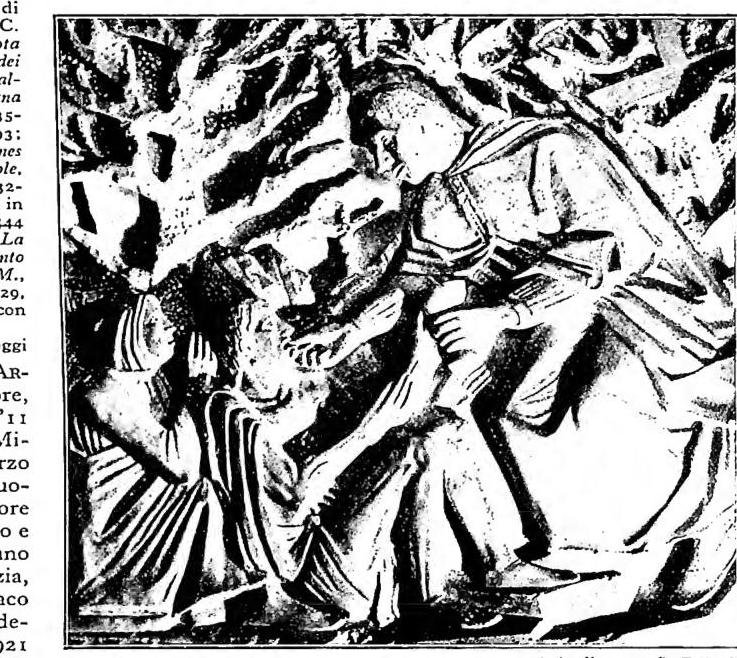
Among his works of sacred subject are to be noted: in ceramics, *Judith*, *The Flight into Egypt*, *St Sebastian*; in terracotta, *The Way of the Cross*, *The Deposition*, *Adam and Eve*, *The Expulsion from the Earthly Paradise*; in wood, *St James the Apostle* for the church of the same name in Vago Veronese; in bronze, *Tobiolo* and *The Sacred Heart* for the church of Christ the King in Rome. Within a formal solidity and a fullness of spiritual life, M. modelled the great allegorical bas-reliefs: *Corporate Justice* for the Palace of Justice in Milan, and for the Milanese Arengario, *The Edict of Constantine*, *St Ambrose*, *St Charles Communicating the Plague Victims*, *The Sforzas and the Viscontis*. In *The Prodigal Son* (1926, Acqui, Ottolenghi Hospice)—perhaps his masterpiece—he wished to place an autobiographical accent; in *The Founding of the Ospedale del Perdono in Milan* (1939, ibid., Ospedale Maggiore) he defined the character of his plastic narratives.
**
---
**FRANCESCO DI GIORGIO MARTINI** – Painter, sculptor, architect, military engineer, b. Siena 1439, d. 1500 (most documents refer to him simply as Francesco di Giorgio).
He began his artistic career before the age of twenty-five in painting, and his earliest works, e.g., *The Stories of Joseph and Susanna* in the Pinacoteca of Siena, reveal his debt to Vecchietta. In 1464 he is found engaged in a sculpture commission. By 1469 he was already active in hydraulic works for the city of Siena, without neglecting painting and illumination, drawing elements also from Girolamo da Cremona (*Madonna of the Earthquakes*, *Annunciation* in the Pinacoteca of Siena). He then entered into partnership with Nereccio (*Stories of St Benedict* in the Uffizi, various *Madonnas*), but dissolved it in 1475. In the works completed during this period, relationships with the Florentine world (Lippi, Baldovinetti, Pollaiolo, Botticelli) are also noted, though only partially assimilated, as seen in the *Coronation of the Virgin* (1472) in the Pinacoteca of Siena, the *Siege of Bethulia* executed in 1473 from his design in the floor of Siena Cathedral, and the two *Nativity* scenes now in the Pinacoteca (1475) and in the church of S. Domenico (c. 1489), also in Siena. In 1477 Francesco was already in Urbino, and it is likely that shortly after 1472 he worked on the part of the Ducal Palace raised by Luciano Laurana. There the decorative sculpture (friezes, corbels) and the inlaid doors (the one with the *Liberal Arts* and *Triumphs*, prior to 1474, was certainly executed from his designs) were being completed.
Thus, very probably with the task of providing models to the decorators, he found himself in contact with a highly complex milieu in which Venetian-Lombard and Florentine experiences (active in Urbino with Ambrogio Barocci, Francesco di Simone Ferrucci, Domenico Rosselli and others) were not divorced from the teachings of Piero della Francesca and Laurana. Yet Francesco di Giorgio’s interest in architecture must have been aroused before his arrival in Urbino, perhaps during the trip to Rome he made in 1464 with Vecchietta.
Certainly, in the designs of his early codices the artist already reveals himself as a student of Roman structures, and from that time he must have formed, following the example of Vecchietta, his personality as an architect. Nevertheless, there is no building that can be assigned to him with certainty before his stay in Urbino. Here, however, his earliest works can be recognized in the convent of the Zoccolanti (adjacent to the later church of S. Bernardino), and in the works of the Ducal Palace, following with great freedom the designs left by Luciano Laurana (a quadrangular tower superimposed on the western façade of the Palace, a loggia on the piano nobile overlooking the courtyard of the Pasquino, the roofing of the halls on the piano nobile of the Castellare, and the arrangement of the hanging garden). After these early works, F. di G. M. continued to work also as a painter (miniatures in the codex Urbinate latino 508 in the Vatican Library) and as a sculptor (relief with the Deposition in the church of the Carmine in Venice). To the same creative period belong the Flagellation in the National Gallery of Perugia and the Discord in the Victoria and Albert Museum in London (terracotta) and in the Chigi-Saracini collection in Siena (stucco). Works from almost the same period in the field of military architecture were the fortresses of Sassocorvaro, S. Leo, Serra S. Abbondio, Tavoleto, Cagli, and Mondolfo, all in the Marches.
After the death of Federico da Montefeltro (1482), F. di G. alternated his residence between Urbino, Siena, Milan, and Naples. In Siena he was appointed engineer of the Republic in 1485 and capomaestro of the Duomo from 1498 until his death, and he designed the new choir of the Cathedral and placed there the angels and cherubim candle-holders: the former carved by his own hand, the latter executed, perhaps from his designs, by Cozzarelli. In Milan he was summoned in 1490 to advise on the stability of the Duomo in relation to the construction of the tiburio. In Naples he worked as a military architect in the service of Alfonso of Calabria, and in 1495 he successfully detonated the first mine. In Urbino he attended, from 1482 and at various times, the construction of two churches commissioned by the testamentary disposition of Duke Federico: the Duomo and S. Bernardino. The former was destroyed in the 18th century, but from the surviving reliefs it is clear that its forms recall the design elaborated by the architect for the church of S. Maria del Calcinio near Cortona (1484). S. Bernardino, on the other hand, is a rather late construction (though it has been suggested that an initial design may have been given by the artist when, as a young man, he built the adjacent convent). However, the definitive elaboration of this design could not have taken place without a meeting with Bramante, from whom certain aspects present in S. Bernardino derive. Still in Urbino, during the time of Guidobaldo, the Sienese built the stables of the Ducal Palace, which occupied a grand building now half-destroyed, the convent of S. Chiara, and the rear part of the Palace. Finally, mention should be made of the Palazzo della Signoria in Jesi, part of the Palazzo degli Anziani in Ancona, and part of the Ducal Palace in Gubbio.
His architectural experiences form the basis of his Trattato d’architettura (of which the best codex is in the Biblioteca Nazionale in Florence, with minor versions in Turin, Siena, and the Vatican) and deeply differentiate its content from the precepts of Vitruvius, whom F. di G. follows in organizing the subject.
V. XVI.