Machine translation of the 1948–1954 Italian original. The original text is authoritative.
ROSALIA (RUSOLIA), saint. — Patroness of Palermo since the 17th century, the “little saint,” as she is called by the people, lived as a hermit in the second half of the 12th century in caves of the Quisquina range and of Monte Pellegrino near the city; local historians have her dying at a young age in 1160.
Before the 17th century there is only scant information about her cult, which spread extraordinarily after the discovery of the body (15 July 1624) and the cessation of the plague that was raging in the city of Palermo (July 1625) and on the island (June 1626) through the intercession of the Saint. The information concerning the life of St. R. dates from after that time and has no historical value. The inscription found, 40 days after the discovery of the body, in the cave of the Quisquina range, presumed to be the Saint’s autograph, declares her to have been the daughter of Duke Sinibaldo, who lived in the time of Roger II (d. 1154). Urban VIII had inserted
43. — CATHOLIC ENCYCLOPEDIA. — X.
(Enit photograph)
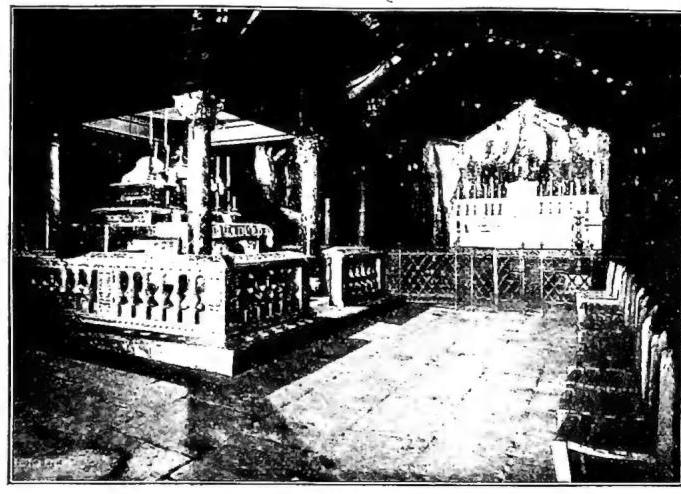
ROSALIA, saint — Interior of the shrine of St. R. on Monte Pellegrino — Palermo.
in the Roman Martyrology (1630) the date of the discovery of the body (15 July) and that of her presumed death (4 September). The caves inhabited by R. were transformed into richly adorned chapels (17th–18th centuries), and her body rests in a sumptuous chapel of Palermo Cathedral, enclosed in a richly decorated reliquary chest, executed by various artists in 1631. Sicilian emigrants have spread her cult throughout all the regions of the world they have frequented.
BIBL.: R. Pirzi, Notitiae Sicilensium Ecclesiarum, Palermo 1630, pp. 198–201; Acta S.S. Septambria, II, Antwerp 1748, pp. 278–414 (a study accompanied by numerous illustrations by Fr. J. Stillingh); D. M. Spàracio, «La Santuzza cui diede nome i fiori», ossia 1, R., Foligno 1924; 2nd ed. Palermo 1924 (cf. Anal. balland., 43 [1925], p. 457); Martyr. Romanum, pp. 290, 380. A. Pietro Frutza
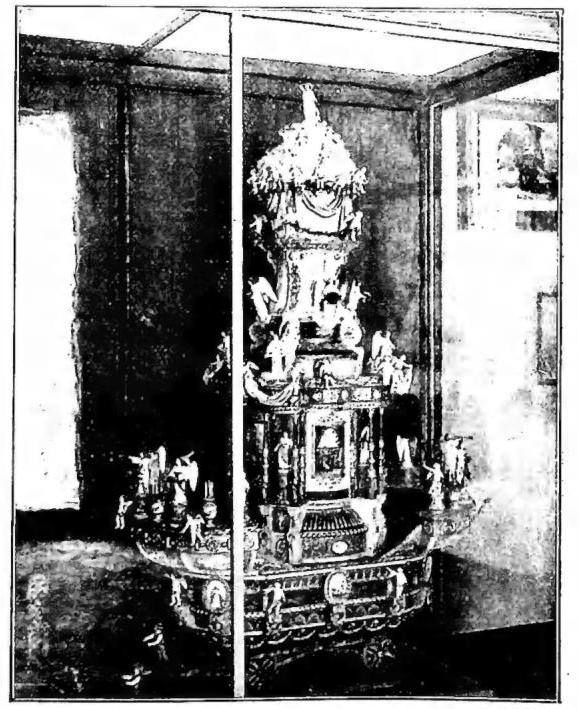
FOLKLORE. – An image, before which even Goethe knelt (Journey to Italy, letter of 6 April 1787), venerated in the chapel of St. R. on Monte Pellegrino and variously reproduced in popular prints, represents the Saint lying as if in ecstasy within the recess of a grotto, dressed in the penitential habit and illuminated by a shaft of light from above; beside her are a skull, a book, and a bowl, symbols of the eremitical life, while a little angel stands at her side holding lily branches, and at the entrance to the cave a young hunter appears. This, the legend explains, is the hunter Vincenzo Bonello, who discovers the Saint’s relics. In memory of this discovery and of the translation that is said to have brought a terrible plague to an end in 1625, a solemn festival is held in Palermo in mid-July. In past centuries it was enthusiastically described by Italian and foreign writers as one of the most characteristic manifestations of Sicily and of Italy as a whole; today little remains of it except the memory and the saying “Mi cunti li cincu jorna di lu Fistinu.” Drawn by long lines of oxen or mules (up to 24 pairs!), the triumphal float travelled through the city’s principal streets. Built in the form of a ship according to a design renewed each year (the designs are preserved in the National Museum of Palermo), it was sumptuously illuminated and decorated with garlands of flowers and embellished with representations of the legend; at its summit shone the statue of the “santuzza,” suspended upon a cloud, her head crowned with roses and rising higher than the roofs of the houses. The country people called this mighty structure “la muntagnedda d’oru”; every 50–60 paces it stopped for the singing of the frottola, an ever-new hymn in honour of St. R. Other elements that gave the festive rite life and a scenic character were the “beneficiata” in Piazza Marina, a lottery offering prizes of money, cloth, and paintings depicting Palermo and St. R.; the race of the Berbers, that is, of horses, sometimes riderless and sometimes mounted by boys aged 12–14, covered with elder leaves, for which the prize was a gilded wooden eagle; the procession with the silver urn containing the Saint’s relics, carried, by ancient privilege, by bricklayers and preceded by the biers of the other saints, to the sound of many drums; and the fireworks and splendid illumination of the Cassaro, the Marina, and the Cathedral. The Saint is also celebrated on 4 September, the day of her liturgical commemoration, with a pilgrimage to the grotto, attended by all the faithful of the province and, with particular devotion, by the Albanians of the Piana. The people of Palermo prefer to make the pilgrimage in May, when it takes on the character of a spring rite. Of the three principal motifs of the legend—birth, childhood, and withdrawal into solitude; temptations; and the deliverance of Palermo from the plague—taken up poetically by the people, the contrast between the penitent virgin and the tempting demon is the most recurrent and vivid in the popular songs. These are composed in narrative metres (Sicilian stories in ottave of hendecasyllables; Fullone also composed an epic poem on St. R.) and in lyric metres (quatrains or sestets of octosyllables), the latter form being widespread also in Calabria, Lucania, Apulia, Campania, Abruzzo, and the Marches. Even more extensive
are the geographical boundaries of the cult, which has spread to Spain (the “Fiesta del Cuadro” of 15 July at Torredembarra is famous), France, Belgium, Germany, Poland, Hungary, Portugal, Malta, and even Africa and South America: St. R. is invoked everywhere against the plague.
From a critical-comparative point of view, it is useful to note that certain manifestations of the cult of St. R. are connected with that of St. Rosa (v.): besides the common feast day of 4 September, noteworthy are the similarity of the two structures, the frequent substitution in popular songs of the name Rosa for that of R., and, with regard to the legend, the common motif of the discovery of the bones and deliverance from the plague.
(photo Enit) ROSALIA, santa – Reproduction of the float of St. R. – Palermo, Pitrè Ethnographic Museum.(from F. M. William, Die Geschichte u. die Gebratscheile des Rosenkranzes, Vienna 1958, pp. 58–59)
ROSARIO - Madonna del R. Silografia che orna l'Unser Lieben Frauen Psalter, Augusta, Zeisselmaier 1495.
BIBL.: G. Pitrè, Canti popolari sicil., Palermo 1871, pp. 314-329; id., Spettacoli e feste, ivi 1881, pp. 365-77; id., Feste patronali, ivi 1900, pp. 1-48; M. Pitrè, Le feste di s. R. in Palermo e dell'Assunta in Messina, ivi 1900; B. Rubino-G. Cocchiara, Usi e costumi, novelle e poesie del pop. sic., ivi 1924, pp. 116-18; G. Naselli, Guida del Monte Pellegrino colla storia del monte, di s. R. e del santuario, ivi s. a. [1924?], p. 41 sgg.; R. Corso, I carri sacri in Italia, in Folklore ital., 10 (luglio-dic. 1935), pp. 139-40; R. Rovira y Oliver, S. R., 4 ed., Tarragona 1935; P. Toschi, La poesia pop. religiosa in Italia, Firenze 1935; M. Savarese Savoca, in Lares, 10 (1939, 1), pp. 54-55; P. Toschi, S. R., in Ecclesia, 5 (1946, IX), pp. 438-40. Giovanni Bronzini
Cite this article
“ROSALIA (RUSOLIA), SANTA.” Enciclopedia Cattolica, vol. X (1953), p. 803. Azione Romana digital edition, https://azioneromana.com/article/rosalia-rusolia-santa.