
RUBINO, ANTONIO. – Jesuit, missionary, born at Strambino (diocese of Ivrea) on 1 March 1578, died on 22 March 1643 at Nagasaki (Japan).
He entered the Order in 1586 and departed for India in 1602, where, ordained a priest in 1605, he was assigned the kingdom of Bisnagar as his field of work. He remained in India until 1638 and, always devoted to teaching, catechesis, preaching, and important missions, accomplished immense good there. Nor did he neglect his tireless scientific activity; several letters to Fr. Clavio and Griemberger, professors at the Collegio Romano, a brief description of the whole world, and a description of the kingdom of Bisnagar attest to his expertise in cosmography and cartography, while his interest in Galileo’s discoveries, revealed by the same letters, shows him to have been a skilled student of the mathematical sciences; and the Catena evangelica, in 7 large volumes, shows him to have been an expert exegete.
(phot. Enc. Catt.)
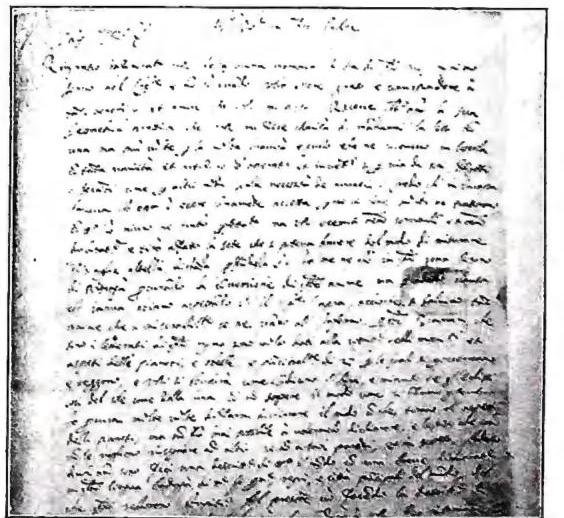
RUBINO, ANTONIO — Part of the letter of Fr. R. to Fr. Cristoforo Clavio (25 October 1609) from Chandrepi (India), in which he expresses his thanks for the sending of the volume on practical geometry, informs him that the Brahmanii are engaged in astronomy but are jealous of their knowledge, and adds that he is preparing a description of the kingdom of Bisonia, and asks for the astrolabe — Rome, Archive of the Gregorian University, Miscellanea No. 529, fol. 37.
Through his immediate application to the study of the Chinese and Japanese languages and books, he was soon able to engage in disputation with the bonzes. By the Method of Doctrine he intended to justify the conduct of his missionaries in China, clearly setting forth the practice followed in evangelization, in order to refute the objections of religious from other Orders and of some Jesuits themselves (v. RITO, QUESTIONE del). The work, written in Portuguese, was not printed until many years after the author’s death, having been translated into Italian by another missionary, Fr. G. F. Marini (Lyons 1665). In 1686 it was placed on the Index, where it still remains. In 1643, he and his companions, all disguised as Chinese, embarked for Japan and landed on 12 August on the island of Satauma; but, discovered by the persecutors’ spies, they were seized, taken to Nagasaki, and after a harsh imprisonment condemned, it seems, to the pit execution.
The work Difesa del giudizio formato dalla Santa Sede Apostolica. Torino 1760 (?) was attributed to R. by his Jansenist and Enlightenment adversaries. Concerning Chinese rites and ceremonies, it contains iconoclastic judgments against the use of the Crucifix in churches and on altars. The calumny collapses of itself, because by the date of Clement VI’s decree on Chinese rites (1704), to which the work refers, and still more by the date of its promulgation in Peking through Cardinal de Tournon (1707), R. had already passed from this life. The author was instead a doctor of the Sorbonne (cf. anon., La verità difesa col disvelarsi nella sincera esposizione dei fatti, Firenze 1761).
BIBLI: Sommervogel, VII, 285-80; G. Saroglia, Vita del p. A. R. da Strambino, Trento 1894; [E. Rosa], Breve mem. della vita del V. p. G. A. R. della C. di Gesù, martire del Giappone, Torino 1898; P. Tacchi Venturi, Alcune lettere del p. A. R., ivi 1901. Margherita Letizia Fontanesi