
RITI, QUESTION OF THE. - The question of the rites concerns those acts of veneration toward Confucius, ancestors, and the imperial family, practiced in China and Japan, as well as certain customs and traditions in India. The adaptation of Catholics to these rites gave rise to lengthy discussions known as the question of the Chinese rites (I), Japanese rites (II), and Malabar rites (III).
I. CHINESE RITES
After many futile attempts by the Portuguese and Spanish to initiate missions in China, the Jesuits Ruggieri and Ricci succeeded in 1583 in establishing the first station in Shihing, Guangdong Province. In 1601, Ricci was then able to take up permanent residence in Beijing, the capital of the Empire. From the outset, Ricci sought to adapt to Chinese customs and practices not only in external matters such as attire—dressing first as a Buddhist monk, then from 1594 as a scholar—but also in the terminology of sacred names and in the rites toward Confucius and ancestors.The first major difficulty was the translation of Christian terms into Chinese, particularly "God," "Spirit," and "Soul." Ricci believed that the Chinese terms T'ien-Chu (Lord of Heaven), Shang-Ti (Supreme Lord), or T'ien (Heaven) sufficiently conveyed the Christian meaning of "God," just as T'ien-Cheng did for "Spirit" and Ling-hua for "Soul." This terminology was approved at a conference of Jesuit missionaries in Macao in 1600, and in two subsequent conferences convened by Fr. Valignano (v.) in 1603 and 1605, adaptation to Chinese customs in honor of Confucius and ancestors was also approved.
Regarding the name of God, opposition soon arose among the Jesuits themselves, led by Fr. Longobardi against the terms T'ien and Shang-Ti. After Ricci’s death in 1610, Longobardi, having become superior of the Chinese mission, was tasked by Visitor Francesco Pasio with re-examining the question of God’s names. All missionaries and some Christian scholars provided their opinions, which were not uniform. After a new examination in 1612 or 1613, the use of the word Shang-Ti was prohibited, though uniformity among the missionaries was not achieved. Debates for and against the terms Shang-Ti and T'ien continued, particularly in Kiating in 1629. In 1629, Visitor Palmeiro again prohibited the use of T'ien and Shang-Ti, but the Jesuit General, Muzio Vitelleschi, revoked the order. Opposition also arose against the name T'ien-Chu, and some missionaries, including Longobardi, proposed using the Latin word Deus. Ultimately, however, the name T'ien-Chu prevailed.
More serious difficulties arose after the Dominicans (1631) and Spanish Franciscans (1633) arrived in the Chinese mission, particularly regarding the rites in honor of Confucius and ancestors. These were ceremonies performed in small temples dedicated to Confucius by government officials and scholars, as well as customs and rites for venerating ancestors during funerals, at tombs, or at home before ancestral tablets. Ricci and the Jesuits considered these ceremonies as purely civil manifestations of courtesy and gratitude toward Confucius and ancestors, appealing to ancient Chinese writings and the opinions of contemporary scholars—likely all Neo-Confucians—who attributed no religious significance to these rites. The Dominicans and Franciscans, however, viewed these ceremonies as superstitious practices, basing their stance on the people’s behavior during these rites, and prohibited their Christians from participating.
Without attempting a thorough critical examination of the rites and ceremonies in question, we will briefly outline the events of this lengthy dispute.
In 1635, some Jesuits, Franciscans, and Dominicans held a meeting in Prochow on missionary methods, where the ceremonies in honor of Confucius and ancestors were discussed. In Tingtu, Dominicans and Franciscans then initiated two informational processes regarding the dispute with the Jesuits. The records were sent to Manila and contained 15 doubts submitted to the Archbishop of Manila, Hernando Guerrero, who forwarded them to Rome. The Historia de la provincia del S. Rosario de la Orden de Predicadores by Fr. Diego Aduarte (Manila, 1640) made the dispute public. From Manila, Fr. Morales O.P., expelled from China, was sent to Rome, where he arrived in February 1643 and presented 17 doubts about the missionary method in China. For their examination, the Holy Office appointed seven qualifiers, who issued a decision published by Propaganda with a decree on September 12, 1645. The responses to articles 6 through 13, concerning Christians’ participation in ceremonies honoring the spirits of Confucius and ancestors, were negative. Compliance with these decisions was made obligatory for all missionaries in China. However, the Jesuits in China disagreed with the Roman decisions and sent Fr. Martino de Martinis to Rome, who arrived in 1654 to present four doubts to the Holy Office, the third and fourth of which concerned the ceremonies in honor of Confucius and ancestors. These ceremonies were presented as acts of pure courtesy, and the Holy Office permitted them to Christians on March 13, 1656. The controversy did not end, however, as the question immediately arose whether the 1656 decree had abrogated that of 1645. With another decree, the Holy Office decided on November 13, 1669, that both decrees were to be observed « iuxta quaesita, circumstantias et omnia in dictis dubia expressa ».
Meanwhile, in 1665, Christianity had been prohibited in China, and nearly all missionaries—except for some Jesuits remaining at the imperial court and a few who managed to hide in the provinces—were transported to Canton in 1666, where they were held prisoner in the Jesuit residence. There were 21 Jesuits, 3 Dominicans, and 1 Franciscan, who held several conferences in 1667 and 1668. Forty-two decisions were made, the 41st of which concerned the ceremonies in honor of Confucius and ancestors, based on the Holy Office’s 1656 decision. The Acta Cantonensis were signed by the Jesuits and Dominicans, but not by the Franciscan Antonio Caballero. Even the Dominican Fernandez Navarrete, after lengthy correspondence with the Jesuits, withdrew his signature. He escaped from the Canton prison and arrived in Rome in 1672, where he presented 119 doubts to Propaganda, 21 concerning the ceremonies in honor of Confucius and 25 on the veneration of ancestors. Propaganda appointed some consultants to examine Navarrete’s doubts but issued no new decree, so the decrees of 1645 and 1656 remained in force. Missionaries, having returned to their missions in 1671, followed a dual practice in the places where they could work. Between 1676 and 1679, Navarrete published the two volumes of Tratados históricos, políticos, éticos y religiosos de la Monarchia de China, and in the second volume, he discussed the question of the rites. The Spanish Inquisition, however, immediately confiscated this second volume.
With the arrival of missionaries from the Paris Seminary in China in 1684, the question of the rites was revived. In 1687, Charles Maigrot was appointed Vicar Apostolic of Fujian. To achieve the necessary unity in the practice of missionaries from various institutes, he issued a Mandate on March 26, 1693, in which, in seven articles, he condemned the terms T'ien and Shang-Ti and prohibited the ancestral ceremonies, declaring them superstitious. Maigrot sent Nicolas Charmot to Rome as his procurator, who presented the Mandate to Innocent XII. The Pope appointed a special congregation of four cardinals, who formulated the « quaesita et rationes dubitandi » to serve as the basis for the votes of the consultants and cardinals and the decision of the Holy Office. The trusted expert for the « quaesito facti » was the Chinese missionary Gianfrancesco de Nicolais da Leonessa O.F.M., who was in Rome. The questions corresponded to the seven points of Maigrot’s Mandate. The qualifiers appointed were: Fr. G.M. Gabrielli, Nicolao Serrano O.E.S.A., Filippo di S. Nicola O.C.D., and Carlo Francesco Varese O.F.M. Fr. Ga-
The question of rites (q. dei r.) concerns those acts of veneration toward God, Confucius, and ancestors that had been the subject of prolonged debate among missionaries in China. After careful reflection, these rites were deemed inseparable from superstition and thus prohibited for Christians. However, the decree of November 20, 1704, issued under Innocent XII and later confirmed by Clement XI, established the following norms:
Since it is impossible to adequately translate and express the Latin word Deus in Chinese terms, the word T'ien-Chu (Lord of Heaven), long used by missionaries in China and by Christians, was to be adopted. The terms T'ien (Heaven) and Shang-Ti (Supreme Lord) were abolished. For the future, tablets inscribed with the Chinese King-T'ien (Venerate Heaven), whether to be hung or already displayed in churches, were prohibited. Christians were also forbidden from attending or participating in the solemn offerings or sacrifices made twice a year to Confucius and deceased ancestors, as these were tainted with superstition. Similarly, they were barred from the ceremonies performed in Confucian temples during the full moons of each month by magistrates and scholars before assuming office. The same rites and offerings were prohibited for Christians in private homes before ancestral tablets, during funerals, or at burial sites, whether performed alone or in the company of pagans. These rites, having been judged inseparable from superstition after mature consideration, could not be practiced by Christians even if they prefaced them with a public protest declaring their actions to be of a civil or political, rather than religious, significance. However, mere physical and occasional presence at such ceremonies was not condemned, especially to avoid hatred or enmity, and preferably after a prior declaration of faith, always avoiding any risk of perversion. The decree categorically mandated the removal from private homes of all types of ancestral tablets indicating the throne, seat of the spirit, name of the soul, and the like. The only tolerance expressly permitted by the decree was a tablet bearing solely the name of the deceased, accompanied by a declaration from Christians regarding their reverence for the dead and filial piety, in a manner that would convince pagans that such a tablet differed in meaning from theirs. Other practices that were purely civil and political were not forbidden, but their determination was left exclusively to the authority of the apostolic commissioner or visitor, bishops, and apostolic vicars. Meanwhile, these authorities were obliged to introduce in their respective missions those pious practices and religious rites that the Catholic Church prescribes for its faithful in honor and suffrage of the dead.
Meanwhile, the discussion on rites gained unusual publicity through numerous writings (cf. Streit, Bibl., V and VII). The Sorbonne also took part in the debate, censuring 29 propositions, of which 21 were taken from the Quaesita sent by Charmot to the Archbishop of Paris, Monsignor de Noailles. Additionally, it censured five propositions drawn from the works of the Jesuits Le Comte and Le Gobien. The decision of November 20, 1704, remained secret until it was published in Nanjing on January 25, 1707, by the apostolic legate Carlo Tommaso Maillard de Tournon.
In China, on November 30, 1700, the Jesuits presented a memorandum to Emperor K'ang-Hsi, who in 1692 had granted freedom to preach the Gospel in his realm. In this memorandum, the ceremonies in honor of Confucius and ancestors were declared political and civil acts of courtesy, and the Emperor fully approved II. The document was sent to Rome and, in 1701, printed together with the opinions of other mandarins and scholars.
When the apostolic legate De Tournon arrived in Beijing in 1705, K'ang-Hsi initially received him well. However, upon realizing De Tournon's opposition to the memorandum's content, the Emperor issued a decree in 1706 requiring all missionaries to obtain the Piao—a permit from the Emperor to preach the Gospel in China—which was granted only to those missionaries who promised to observe Chinese rites. On January 25, 1707, the pontifical decree of 1704 was published in Nanjing, and subsequently, De Tournon was taken to Canton and then to Macao, where he was detained under Portuguese custody. He was later created a cardinal by Clement XI and died in Macao in 1710.
Against the publication of the pontifical decree, the majority of Jesuits and some other missionaries who had accepted the Piao appealed to the Pope. Emperor K'ang-Hsi himself sent the Jesuits Provana and Arso as his legates to Rome to seek the revocation of the 1704 decree. Missionaries who refused the Piao were banished from China, including the apostolic vicar Maigrot. Clement XI rejected all protests and, on September 25, 1710, confirmed the decisions of 1704 and De Tournon's decree of 1707. At the same time, he prohibited any publication on the question of rites "sine expressa et speciali licentia a Sanctitate Sua obtinenda." To put an end to all subterfuge and pretexts for delaying strict observance of the decree, Clement XI issued the constitution Ex illa die on March 19, 1715, solemnly confirming the decisions of the earlier decrees and imposing an oath of observance on all missionaries. The Constitution was published in China in 1716; all missionaries took the prescribed oath, but especially the Jesuits at the imperial court refrained from any missionary activity until Father General Michelangelo Tamburini ordered its resumption on April 9, 1718. Many Christians did not submit and continued to observe the rites. In 1717, Emperor K'ang-Hsi signed the verdict of the Rites Tribunal of Beijing, which exiled all missionaries, prohibited the Christian religion, and compelled all Christians to apostasy. This sentence was not executed during K'ang-Hsi's lifetime, but it set the stage for future persecutions.
To enforce the constitution Ex illa die of 1715 in China, Clement XI appointed a new legate, Mezzabarba (v.), on September 18, 1719. He arrived in China in 1720 and, on November 7, 1721, published eight permissions of the following tenor:
RITI, QUESTIONE DEI (continuazione)
- Streit, Bibliotheca Missionum, V e VII, Friburgo in Br. 1929-1931;
- H. Bernard-Maître, La première confrontation de l'Europe et de la Chine: les missions jésuites du XVIIe siècle, Parigi 1961;
- J. Dehergne, Répertoire des Jésuites de Chine de 1552 à 1800, Roma 1973;
- G. Gheddo, La questione dei riti cinesi, Milano 1967;
- L. Pfister, Notices biographiques et bibliographiques sur les Jésuites de l'ancienne mission de Chine, Shanghai 1932-1934;
- A. Launay, Histoire des missions de l'Inde, Parigi 1908;
- J. Brucker, La question des rites chinois, in Études, 1912;
- P. Tacchi Venturi, Storia della Compagnia di Gesù in Italia, Roma 1950-1951.
A. ROSSI
1. Chinese Christians are permitted to keep in private homes tablets of the deceased bearing only their names, provided that a proper declaration is added to the side of the tablet, any superstitious elements in its composition are omitted, and all scandal is avoided. 2. All civil ceremonies of the Chinese nation toward the deceased that are not superstitious or suspect are permitted. 3. That civil cult of Confucius and the use of his tablets, purged of superstitious letters and inscriptions, are permitted, with the addition of a proper declaration. Before his tablet, it is permitted to light candles, burn incense, and prepare food. 4. For the use and expenses of funerals, it is permitted to offer candles and incense, provided that a proper declaration is added to the card. 5. The reverence of genuflection and prostration before the corrected tablet, as well as before the coffin of the deceased, is permitted. 6. Where the corrected tablet is present, with the proper declaration and all superstition omitted, it is permitted to prepare tables with sweets, fruit, meat, and usual foods around or before the coffin, for reasons of a certain propriety and respect toward the deceased. 7. During the Chinese New Year, as well as at other times, the so-called Ko-t'ou reverence before the corrected tablet is permitted. 8. Before the tablets, duly corrected and with due precautions, it is permitted to light and burn incense, as well as around the tomb, before which food may be prepared with the due precautions as mentioned above. Mezzabarba imposed the most prudent use of these permissions, under penalty of excommunication for anyone who translated them into Chinese or published them.
Yet even this attempt to establish harmony among the missionaries failed. The Jesuits, especially those in Beijing, made extensive use of the permissions, while others, particularly the Franciscans, scrupulously observed the constitution Ex illa die; indeed, Monsignor Francesco Saraceni da Conca, Apostolic Vicar of Shansi-Shensi, went further, prohibiting in a pastoral letter of 1730 « as superstitious all tablets of the dead, even those corrected ». Only the simple image of the deceased was permitted, but without incense, candles, or flowers, and even less adoration. The preparation of tables with food and drink around the tomb or before the image was also forbidden. Thus, what Ex illa die and Mezzabarba had conceded was prohibited. This pastoral letter provoked a reaction in Beijing. In two pastoral letters dated July 11 and December 23, 1733, the Bishop of Beijing, Francisco da Purificação, O.E.S.A., ordered all missionaries under penalty of suspension « ut observant et observant praecipent constitutionem Ex illa die iuxta permissiones ». With a brief of September 25, 1735, Clement XII revoked and annulled the two pastoral letters of the Bishop of Beijing. The question of the permissions was submitted to a new examination by the Holy Office. This examination, for which some missionaries from China and some Chinese students were summoned, lasted until 1742. On July 11, 1742, Benedict XIV published the constitution Ex quo singulari, pronouncing the definitive sentence. He declared that Mezzabarba’s permissions had never been approved by the Holy See, that they were indeed contrary to its decisions, disapproved them, annulled them, and condemned their use by missionaries. He reconfirmed the prohibitions established in the constitution Ex illa die of Clement XI and prescribed a new oath formula for missionaries.
In this way, the question of Chinese rites was definitively decided by Rome. In later times, various questions regarding one or another ceremony were discussed; first and foremost, the Ko-t'ou, that is, the prostration before the corpse, the coffin, or the tablet of ancestors, was the subject of doubts. It is true that it had been formally prohibited by the constitution Ex quo singulari with the condemnation of Mezzabarba’s permissions, but according to the opinion of many missionaries, the Ko-t'ou was a purely civil ceremony. In 1753, Propaganda issued an instruction in response to various doubts raised by the Apostolic Vicar of Eastern Tonkin, again condemning Mezzabarba’s permissions, especially those concerning funerals. In 1757 and 1773, the Holy Office published a decree to condemn even the simple Ko-t'ou before the coffin. In 1769, Propaganda ordered the Bishop of Nanjing to follow the instruction of 1753. In 1777, the Holy Office issued a universal decree again prohibiting the Ko-t'ou in all its forms as superstitious.
In 1932, the new state of Manchukuo was established in Manchuria under Japanese protection, and the Japanese promoted the cult of Confucius, requiring all citizens to participate. Monsignor Agostino Gaspais, Apostolic Vicar of Kirin (Northern Manchuria), informed the Cardinal Prefect of Propaganda of the difficulties arising for Catholics from this new situation. He was told that the Ordinaries of Manchuria should study the question to provide Propaganda with the elements for practical directives. On February 27, 1935, Monsignor Gaspais asked the Government Directorate of Cults of Manchukuo whether the honors rendered to Confucius in schools and small temples were considered a religious cult or « a purely civil homage to a great man and a philosopher, due to the value of his doctrines and their importance for the moral formation of the nation ». The government’s response was that the ceremonies had no religious character but intended only to honor his doctrine, the basis of morality and government, so that all citizens were obliged to participate. Based on this official declaration, the episcopate of Manchuria held a meeting in Hsinking on March 12, 1935, and compiled a lengthy questionnaire on how, in concrete cases, Christians could participate in the ceremonies in honor of Confucius. The questions and answers addressed: the honor rendered to images of Confucius in schools; the group visits of students, soldiers, and employees to pagodas; financial contributions for the construction and restoration of pagodas for Confucius or other temples; and attendance at pagan funerals. In a letter dated May 28, 1935, to Monsignor Gaspais, Propaganda gave the following response: « Due to the particular importance of the matter, this Sacred Congregation, after carefully studying and having the question studied, deemed it opportune to refer it to the Holy Father. In the audience of the 16th of this month, His Holiness, having taken cognizance of Your Excellency’s report and the written opinion of His Excellency Monsignor Celso Costantini, expressed the following thought: 1) that the Ordinaries of Manchukuo, to avoid any possible reason for scandal, should make known, with the necessary prudence suggested by the circumstances, the letter in which the Directorate of Cults of Manchukuo recently assured Your Excellency that the ceremonies in honor of Confucius have absolutely no religious character; 2) that the same Ordinaries should regulate themselves, in giving their norms to the faithful, according to such an official declaration; 3) that priests, after taking the prescribed oath on the Chinese rites, should adhere to the instructions of the Ordinaries, avoiding questions and controversies. This Congregation believes, for its part, that the Ordinaries, in giving their norms to the faithful, may conform to the decisions they took jointly in their meeting in Hsin-King. These seemed prudent and well-considered » (Sylloge de Prop. Fide, n. 192, pp. 479-82; V. under r. giapponesi, art. by P. D'Elia).
As for Manchukuo, so too for China, in an instruction of Propaganda dated December 8, 1939, the question of rites received a new regulation.
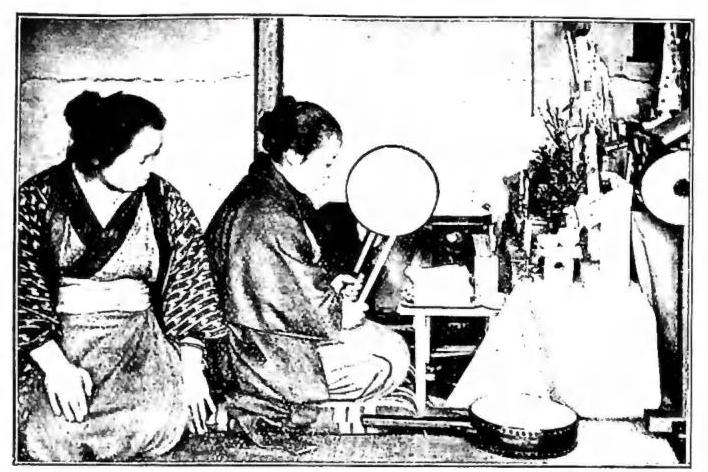
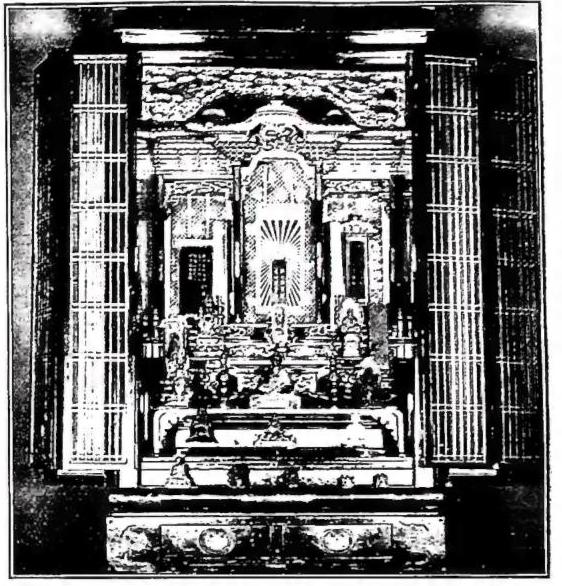
RITI, QUESTIONE dei - Family prayer before the ancestral altar, which holds a privileged place in the home, with flowers and candles; the worshippers beat a kind of small drum with a stick - Tokyo.
1) Since the Chinese government has repeatedly and explicitly declared that all are free to profess whatever religion they prefer, and that it has no intention of issuing laws or ordinances on religious matters; and that, therefore, the ceremonies performed or ordered by public authorities in honor of Confucius are not carried out with the intent of rendering religious worship, but solely for the purpose of promoting and expressing due honor to so eminent a figure and the proper respect for the traditions of the ancestors: it is licit for Catholics to participate in acts of honor performed before the image or tablet of Confucius, in Confucian monuments, and in schools. 2) It is therefore not to be considered illicit that in Catholic schools, especially if the authorities command it, the image of Confucius or even the tablet bearing his name be displayed; nor that one bow the head in greeting. Should scandal ever be feared, the just intention of Catholics should be declared. 3) It is to be tolerated that Catholic magistrates and students, if commanded to be present at public ceremonies, even if these appear to have a semblance of superstition, attend them, provided, however, that in accordance with can. 1258, they participate passively and associate themselves only with that homage which can reasonably be considered purely civil; declaring, as above, their intention when it appears necessary to avoid false interpretations of their acts. 4) Bowing of the head and other manifestations of civil respect before the deceased or their images, and even before those tablets of the deceased where only the name is written, are to be considered licit and appropriate. Furthermore, the Eminent Fathers, considering: that the oath on the Chinese rites, ordered by Benedict XIV with the constitution Ex quo singulari of July 11, 1742, for all priests "in the Chinese Empire and in the adjacent kingdoms and provinces, both bordering and nearby," does not entirely align with the recent norms given by this Sacred Congregation; and that, moreover, this oath has become, as a disciplinary measure, absolutely superfluous in modern times, since it is known that the ancient controversies over the Chinese rites have now ceased, and, in any case, missionaries and other priests have no need of the constraint of an oath to render prompt and filial obedience to the Holy See: judged that this oath should no longer be required, wherever it was in use, in China or elsewhere; remaining, however, intact the other prescriptions of the supreme pontiff Benedict XIV, insofar as the instructions of these recent times have not introduced changes, and especially the prohibition of stirring up controversies over the Chinese rites. In the audience of December 7, 1939, these deliberations were approved by the Holy Father Pius XII.
This instruction does not contain a condemnation of the 1742 decision on the Chinese rites. Conditions and the situation had changed, especially since already in 1914 the Chinese government had officially declared that the honors of the cult of Confucius were purely civil, having nothing to do with religion—and thus a new regulation was imposed. Not all difficulties were resolved, but to avoid new discussions, Propaganda, in a letter of February 28, 1941, to the apostolic delegate Monsignor Zanin, gave the following directives: «Absolute evitando est compositio elenchi caeremoniarum permissarum vel prohibitarum, ne oriatur periculum reincidendi in discusiones casuisticas, quae sub alia forma renasci facerent querelas antiquas. - Quando necessitas postulet, Ordinarii dare quidem possunt regulas et normas generales; respectu tamen habito ad hoc, quod in tempore versamur transtorio, ne nimis descendant ad specificationes singulas, et relinquant etiam sacerdotibus et bonis christianis laicis, in casibus particularibus, se dirigere secundum suam conscientiam».
II. CIAPPONESE RITES
St. Francesco Saverio, like the other early missionaries in Japan, initially preached the truths about God, the soul, heaven, and hell using Buddhist Japanese terms. However, they soon realized that Japanese words did not perfectly convey Christian concepts and thus began to express Christian ideas using terms borrowed from Latin and Portuguese. This reform was the work of Fr. Baldassarre Gago, S.J., and in 1557 it was approved by the visitor Melchiorre Nuñez, S.J., along with his catechism Niju-go Kwagyo. The erroneous Buddhist expressions used by St. Francesco Saverio and his collaborators in preaching the Gospel had to give way to the new Latin and Portuguese terms. This terminology was adopted with few variations by the missionaries of other religious orders who arrived later in that mission field, as seen, for example, in the grammar of the Dominican Diego Collado (Rome 1632).With the resumption of missionary activity in the 19th century, following the discovery of Christians descended from the ancient mission, the problem of Christian terminology resurfaced. Fr. Bernardo Petitjean, M.E.P., found among these Christians numerous manuscripts of prayers, hymns, and calendars using the Latin-Portuguese terminology. He thus composed a catechism and a prayer book with this Kirishitan terminology, both published in 1868. Meanwhile, however, the missionaries in Yokohama and its surroundings, where no Christians descended from the early Christian communities existed, had already published in 1865 a catechism composed by Fr. Mounicou, M.E.P., based on the Chinese text of the Szechwan mission, where the Chinese Christian terminology was used. Until 1875, the two terminologies were used in parallel in publications. From that date onward, the number of books using the terminology based on the Chinese increased, while the Kirishitan terminology diminished and disappeared completely by 1883.
Great difficulties were caused for Japanese Catholics due to the government-mandated obligation to attend ceremonies in the Jinja in honor of the Emperor, heroes, and fallen soldiers, as well as funeral rites. Already in the Synod of Nagasaki in 1890, general rules regarding pagan customs had been prescribed; however, the condemnable practices had not been enumerated in detail, and "cooperation" or "mere material assistance" had not been clearly defined. The ceremonies in the Jinja and funeral rites were generally considered superstitious, and thus attendance was to be forbidden to Christians. On several occasions, the Japanese government had declared that the ceremonies in the Jinja were purely civil and not religious acts. Following an explicit request from the Archbishop of Tokyo, the government reconfirmed its position on September 22, 1932. To resolve the difficulties for Catholics, Propaganda issued on May 26, 1936, the "Instruction to His Excellency Monsignor Paolo Marella, Archbishop of Dioclea, Apostolic Delegate in Japan, on the Duties of Citizens Toward Their Homeland", establishing the following practical norms: 1) the Ordinaries of the territories of the Japanese Empire shall instruct the faithful that, in the ceremonies usually held at Jinja administered civilly by the government, the civil authorities (as confirmed by repeated and explicit declarations) and even the common opinion of educated persons attribute solely a meaning of patriotic love, that is, filial reverence toward the imperial family and the benefactors of the homeland; and that, since such ceremonies have now taken on a purely civil value, it is licit for Catholics to participate in them and behave as other citizens do, clearly explaining their intention when necessary to avoid misinterpretations of their act; 2) the same Ordinaries may permit the faithful, when attending funerals, weddings, and other private rites customary in Japanese social life, to participate as others do (declaring, if necessary, their intention as mentioned above) in all those ceremonies which, although perhaps of religious origin, nevertheless, due to the circumstances of place and persons and the common opinion of today, show no meaning other than that of courtesy and mutual affection; 3) regarding the oath on rites, wherever used in Japan, priests shall docilely implement what is established in the present instructions of the Sacred Congregation of Propaganda, refraining from any controversy.
III. MALABAR RITES
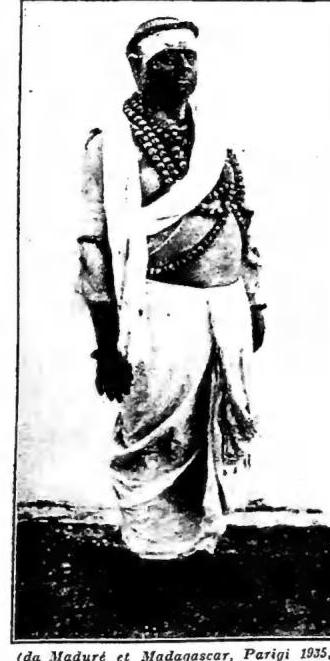
According to the missionary method in use in India during the 16th century, neophytes adopted Portuguese customs, dress, and even names. In this way, they became little accepted by the Hindus, who called them Pranguis. Roberto de Nobili S.J. (v.), however, introduced at the beginning of the 17th century in the Madura mission the method of adaptation. He adopted the attire of the Saniassi (penitents) and lived their life. After a thorough study of the customs of Brahmins and Hindus, he permitted his disciples and neophytes the following practices, which he considered indifferent and therefore licit: 1. the kudumi (tuft), a distinctive sign of caste; 2. the santal (mark on the forehead); 3. the cord, also a caste sign; 4. the usual ablutions. With this method of adaptation, De Nobili achieved some success among the Brahmins, but(from Madurè et Madagascar, Paris 1935, p. 227)
RITES, QUESTION of the - A Brahmin wearing the religious symbols of caste.
Even greater, however, were the difficulties created by some of his fellow Jesuits. De Nobili defended himself and obtained the approval of the Jesuit Father General Acquaviva. Against his method also stood the Archbishop of Goa, Mons. De Sa, who summoned De Nobili before his tribunal and that of the Inquisition of Goa. Of the two inquisitors, one approved De Nobili’s method, the other abstained from voting. In a synod convened in 1619, the Archbishop of Goa, the Dominicans, the Franciscans, and the secular clergy, including indigenous priests, were against De Nobili;
instead, the inquisitor D’Almeida, the Archbishop of Cranganore, Fr. Roz S.J., and all the Jesuits voted in his favor. The case was sent to Rome and to the Grand Inquisitor of Lisbon. The latter, Ferhao Mascarenhas, in 1621, and Gregory XV in 1623 in the bull Romanae Sedis, ruled in favor of De Nobili. Thus, for the moment, De Nobili’s method had prevailed, and the Jesuits employed it, dividing themselves into two groups: Saniassi priests for the higher castes, Fondara Swami for the lower castes and the paria. In Madura, Mysore, Trichinopoly, Marava, and other regions, the results were relatively good; in Madura, by 1704, the number of Christians had reached 90,000. Over the course of the century, further concessions were added to those of De Nobili.
New difficulties arose from the Capuchins, who from 1677 worked in the recent French colony of Pondichéry. In 1687, French Jesuits also arrived there, collaborating in the Madura mission and establishing their own mission in the Carnatic, following De Nobili’s method. Soon, accusations were sent to Rome against the Jesuits, and to support them, the Capuchin François Marie De Tours returned in 1703 to submit to Propaganda 36 questions concerning the Malabar rites, so called because they were in use in the Malabar province of the Society of Jesus. However, they have no connection with the Malabar rite of the so-called Christians of St. Thomas.
Meanwhile, Clement XI had entrusted the legate for China, Tommaso Maillard de Tournon, with the task of also examining the rites and customs of southern India. He arrived in Pondichéry on 6 November 1703, remaining there until July 1704. He gathered information on the practices in question, especially from the Jesuits Boucher and Bertoldi. On 23 June 1704, he signed a decree condemning, in 16 points, several practices permitted by the Jesuits. Tournon’s decree was confirmed by the Holy Office on 7 January 1706, and at the same time, a consultant was appointed for further examination of the question. The Jesuits Boucher and Laynez went to Rome. The latter, in 1707, published the Defensio Indicarum Missionum Madurensis..., which he also disseminated in India after his appointment as Bishop of Meliapore in 1708. Appealing to an «oraculum vivae vocis» of Clement XI, the Jesuits continued their method. Clement XI, however, renewed on 1 September 1712 the decree of the Holy Office of 1706, and the brief of 17 September 1712 reproached Mons. Laynez for not having intervened against the Malabar rites and for not having executed Tournon’s decree. On 24 July 1715, the Cardinal Prefect of Propaganda, Sacripante, sent to the Apostolic Vicar of Kweichow, Claudio Visdelou S.J., who was in Pondichéry, the brief for Mons. Laynez, who had meanwhile died on 11 June 1715, along with the decree of 1706, instructing him to enforce Tournon’s decisions on the Malabar rites. Visdelou promulgated the documents on 11 January 1716. The Jesuits protested and sent Fathers Pierre Martin and Broglia Brandolini to Rome, where the Malabar rites were examined again. Innocent XIII (1721–24) appointed a special Congregation, of which Prospero Lambertini, later Benedict XIV, was secretary. Brandolini published a justification, to which Fr. Lucino O.P., Commissary General of the Holy Office, responded.
The examination by the special Congregation continued under Benedict XIII (1724–30) and Clement XII (1730–40). Benedict XIII, with a brief of 12 December 1727, confirmed Tournon’s decree. In 1733, the decisions of Tournon’s decree, formulated in 16 doubts, were re-examined by the Holy Office, and the responses were confirmed in Clement XII’s brief Comperium exploratumque of 1734. Even with these decisions, the question was not settled, as some missionaries attempted to evade the brief. For this reason, Clement XII, with the brief Concredita nobis of 13 May 1739, insisted and imposed an oath of observance. The final word was given by Benedict XIV with the constitution Omnium sollicitudinum of 12 September 1744, which decided the question of the Malabar rites in accordance with the decree of 1734 and obliged the missionaries of Madura, Mysore, and Carnatic to take the oath.
The oath is summarized in these points: 1) obligation to use the Sacramentals, especially saliva and insufflations, in the administration of Baptism; 2) obligation to impose, in Baptism, the name of a saint from the Roman Martyrology, excluding the names of idols or pagan saints; 3) use of the Latin language alone or a translation into the Indian language, but with perfect adherence to the meaning of the names of the Holy Cross, the saints, and sacred things; 4) obligation to hasten the administration of Baptism to newborns; 5) prohibition of early marriages and the imposition of the nuptial necklace called taly, bearing the image of an idol; 6) prohibition for married Christian women to wear the taly; 7) prohibition of using the cord composed of 108 threads and dyed red, used by pagan women to hold the taly; 8) prohibition of using the superstitious ceremonies of pagan marriages, such as the circular cutting of hair on the heads of the spouses «ad tollenda maleficia», the use of the tree branch called aracismara, etc.; 9) prohibition of following the marriage rite consisting of breaking the coconut to derive superstitious omens; 10) prohibition of excluding from Confession women «menstruali morbo laborantes, non attenta diebus purificationis iuxta morem Gentilium»; 11) prohibition of following the pagan custom of celebrating «virginem prima vice menstruali morbo laborantem»; 12) obligation for missionaries to provide religious assistance to the paria even in their homes; 13) prohibition for singers and musicians to participate in the ceremonies of pagan temples; 14) permission to use bodily ablutions, excluding any superstitious circumstance of time and manner; and prohibition for missionaries to use bodily ablutions unless for natural needs, excluding any other purpose «etiam ad effectum ut existimentur Sanias seu Brachmanes»; 15) prohibition of marking the forehead with ashes of cow dung and using other white or red distinctive marks, according to superstitious pagan customs, and obligation to adhere to the sign of the Cross and the imposition of sacred ashes; 16) prohibition of reading the superstitious books of the pagans, under pain of excommunication.
BIBL.:
A. Launay, Histoire des missions de l'Inde, Paris 1898; H. Hosten, The Malabar Rites, in The Month, 1930, pp. 385-404; J. Dahlmann, Die Thomaschristen Indiens und die Malabarischen Riten, in Stimmen aus Maria-Laach, 1908, pp. 449-464; P. Dahmen, Die Malabarischen Riten, in Zeitschrift für Missionswissenschaft, 1911, pp. 1-24; A. Meersman, The Malabar Rites Revisited, in Indian Church History Review, 1967, pp. 1-18; G. Schurhammer, Robert de Nobili S. J., Roma 1964; Id., Die Malabarischen Riten, in Neue Zeitschrift für Missionswissenschaft, 1945, pp. 161-176; J. Wicki, Die Malabarischen Riten, in Neue Zeitschrift für Missionswissenschaft, 1946, pp. 1-16; A. Väth, Robert de Nobili der Brahmane von Madura, Aachen 1924.
A. MERCATI
The Jesuits all submitted, but they were permitted to assign some missionaries exclusively for the use of the Pariahs. This provision disappeared with the suppression of the Society of Jesus. The successors of the Jesuits in the mission of southern India, especially the missionaries of the Paris Seminary, were able to verify that the decisions regarding the Malabaric rites had been executed. Until the end of the 19th century, no difficulties arose in this matter. After the oath concerning the Chinese rites was abolished on December 8, 1939, on April 9, 1940, the missionaries in India were also dispensed from the oath regarding the Malabaric rites, «remaining firm the obligation to observe the rest of Benedict XIV’s prescriptions insofar as they are not modified by the Holy See». - Vedi tav. I.III.