
REDUCTIONS. – From the very beginning of Spanish colonization in America, the system of reductions was put into effect, following the instruction issued by the King of Spain in 1503, which ordered that nomadic Indians be gathered into villages, so as thereby to bring them to civilization, to a stable way of life, and to Christianity. Wherever the Spaniards encountered nomadic tribes not united in a fixed settlement, as with the Aztecs in Mexico, the Incas in Peru, and the Muiscas in Colombia, the missionaries therefore attempted to gather—
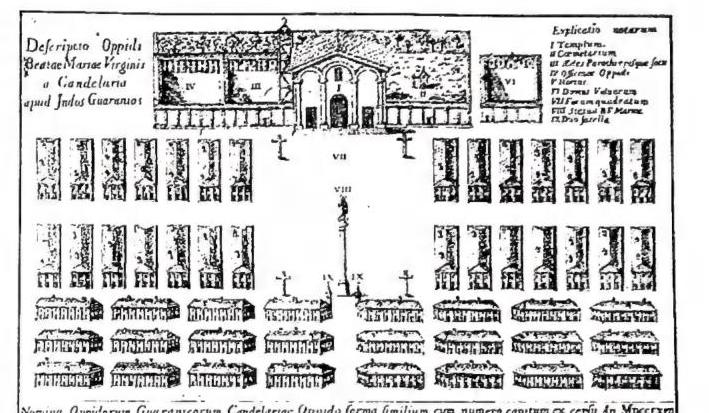
RIDUZIONI – Type of r. Descriptio oppidi Beatae Mariae Virginis a Candelaria, apud Indos Guaranios. Engraving of 1767 – Copy in the Vatican Library.
In the region of La Plata and Paraguay, the Franciscans had been the first to preach the Gospel successfully, such as s. Francesco Solano and Luis Bolaños; the latter in particular had founded r. for Guarani Indians. The Jesuits, who arrived in Tucuman in 1585 and in Paraguay in 1587, initially worked with little success among both the Indians of the encomiendas and the nomads. The Superior General Claudio Acquaviva and the visitor Esteban Paez then prescribed replacing the practice of itinerant missionaries with that of fixed settlements for the Indians, removing them from all outside influences. The project was approved by the Spanish court through the royal ordinances of Filippo III of 1606, 1607, and above all 1609. The governor of Paraguay, Hernando Arias de Saavedra, entrusted the Jesuits with three territories to be Christianized: one west of Asunción among the Guaycuru, a second in Paraná among the Guarani, and the third north of the Paranapané among the Guayra. The first mission failed. Among the tribes of the Guarani and Guayra, however, the Jesuits succeeded, founding the first r. in 1610. Among the northern Guayra, there were nine r. by 1628, although from 1628 to 1631 they were destroyed by the Paulistas. The Jesuits then emigrated south with 12,000 Indians. Here, from 1610 onward, the Jesuits had founded numerous r. among the Guarani, especially between the Paraná and Uruguay Rivers, and from 1628 also on the other bank of the Uruguay among the Tapi. These latter, too, were destroyed by the Paulistas in 1636 and 1638, so that these Indians likewise withdrew westward into the r. of the Guarani. Thus the territory of the Jesuit r. of Paraguay acquired its definitive boundaries, which remained stable until the expulsion of the Jesuits. For the purpose of defense against incursions by the Paulistas, the King of Spain permitted the Indians of the r. to bear arms; from 1641 onward they succeeded in defending themselves against them. At their apogee, in 1731, the Jesuit r. of Paraguay numbered 141,242 Christian Indians.
The great strength of the Jesuit r. lay in their isolation and their special organization: the land was the property of the community, excluding all non-Indians, including Spanish officials; private family property was reduced to a minimum. Food, clothing, and housing were the same for everyone. Supreme direction in temporal and spiritual matters, as well as jurisdiction, lay in the hands of the missionaries; for lower-level temporal administration, officials chosen by the community were appointed. Surplus products of agriculture and livestock breeding were transported to the market in the cities of the Spaniards, in order to procure the necessary supplies of metals, salt, etc., and to pay the contributions, in themselves modest, owed to the Crown. The layout of the individual r. was uniform: at the center stood the main square with the church, the missionaries’ house, the school, the workshops, and the common storehouse. From there, straight streets extended in every direction, and houses were built along them, with one provided for each family. Religion dominated both public and private life. Sacred functions began and concluded the day. Feast days were celebrated with great ceremony, music, and sacred hymns, followed after dinner by sacred and profane theatrical performances. Thus each r. formed a compact community of Christian Indians directed by the missionaries, with a certain theocratic and communistic organization.
Some imperfections of the r., such as the exaggerated guardianship exercised over them—which is understandable when the period and the Indians’ cultural condition are taken into account—as well as external religious and civil formalism, were already greatly exaggerated in the 18th century by the enemies of the Jesuits and were later taken up in the 19th century by Protestant writers such as Gothen and Pfotenhauer. Despite certain defects, the r. achieved excellent results in religious and moral education, which was always given first place, as well as in the stability of the peoples, colonization, and culture. For Spain, the r., despite their relative independence, did not constitute a state apart; rather, they were members of the colonial Empire.
Similar r. were founded by the Jesuits during the 17th and 18th centuries among the Chiquito, Chiriguani, and Mojo in Bolivia, among the Mayna on the Marañon River, and among the Otomachio on the Orinoco River. The system of the r. was also found in Brazil, introduced by the Jesuits, especially in the north of Maranhão, where flourishing r. were established during the 17th and 18th centuries.
Following the example of the Jesuits, the Capuchins too founded, in the 18th century, r. isolated from the outside environment between the Orinoco and Caroni Rivers in Venezuela. Toward the end of the century there were approximately 30 r. in the region, with approximately 25,000 Christian Indians.
The system of the r. was likewise introduced by the Franciscans in California, where from 1769 to 1823 they had founded 21 stations with 30,000 Christian Indians.
The system of the r. experienced a kind of revival in the African missions of the 19th and 20th centuries, though not in the strictly isolationist form of the Jesuit r. Thus, in the missions of the Fathers of the Holy Spirit, both in West and East Africa, Christian villages were founded; in East Africa as shelters and bulwarks against slavery, and in the West against overbearing paganism and the overwhelming influence of pagan chiefs. The Jesuits employed a similar system in the Congo and Zambesia. In the Congo, the so-called « Fermes-Chapelles » were first established: stations near the dwellings of the indigenous people, serving as centers for missionary schools and agriculture, with the aim of educating the young in work and removing the nascent Christian communities from the influence and power of pagan chiefs. After the Belgian government prohibited the « Fermes-Chapelles », Christian families preferably gathered in special Christian villages. The mission in Zambesia likewise employed the system of founding Christian villages.
With the progress of the missions, however, this system was abandoned everywhere because of its deficiencies and difficulties, such as the frequent divisions within the tribes, the Christians’ lack of zeal for converting their people, and the more or less justified suspicions of chiefs and colonial authorities.