
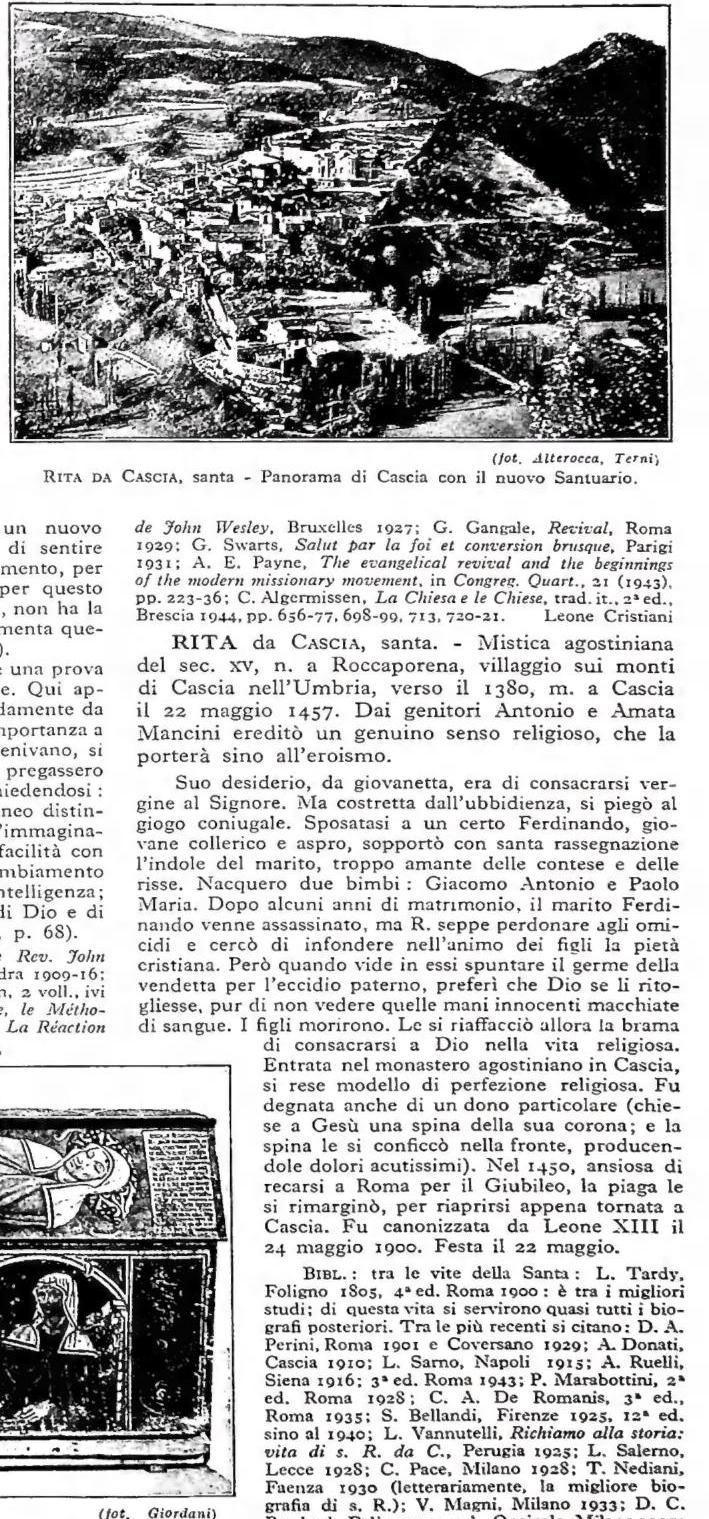
RITA DA CASCIA, saint. — Augustinian mystic of the 15th century, b. at Roccaporena, a village in the mountains of Cascia in Umbria, around 1380, d. at Cascia on 22 May 1457. From her parents Antonio and Amata Mancini she inherited a genuine religious sense, which would lead her to heroism.
As a young girl, her desire was to consecrate herself as a virgin to the Lord. But compelled by obedience, she submitted to the conjugal yoke. Married to a certain Ferdinando, an irascible and harsh young man, she endured her husband’s character with holy resignation, for he was excessively fond of quarrels and brawls. Two children were born: Giacomo Antonio and Paolo Maria. After several years of marriage, her husband Ferdinando was murdered, but R. knew how to forgive the assassins and sought to instill Christian piety in the souls of her sons. Yet when she saw the seed of vengeance for their father’s murder beginning to sprout in them, she preferred that God take them back from her rather than see those innocent hands stained with blood. The children died. Then her longing to consecrate herself to God in religious life re-emerged. Having entered the Augustinian monastery in Cascia, she became a model of religious perfection. She was also graced with a particular gift (she asked Jesus for a thorn from his crown, and the thorn pierced her forehead, causing her the most acute pains). In 1450, anxious to go to Rome for the Jubilee, the wound healed, only to reopen as soon as she returned to Cascia. She was canonized by Leo XIII on 24 May 1900. Feast day: 22 May.
S. Pesce-Gorini, Rome 1941; A. Gualandi, Bari 1950. For a fairly extensive bibliography on the Saint, v.: P. Cherubelli, R. da C. nei secoli, Florence 1941; by the same author: R. da C.: la santa del dolore, Florence 1942. For criticism of Vannutelli and Cherubelli, V. Morini, in Dalle Api alle Rose, 25 (1947), pp. 37–48. Davide Falcioni