Machine translation of the 1948–1954 Italian original. The original text is authoritative.
PORCELAIN. - It is one of the great classes into which ceramic products are divided (v.). Its body is artificially compounded cold from the ternary base of kaolin, feldspar, and quartz; it consolidates at a high temperature (from 1350° to 1420°) into a body at the onset of vitrification (conchoidal fracture); it is white, translucent, and cannot be attacked by steel or by most chemical reagents. As a coating it requires a feldspathic glaze; without coating, “with a marble grain,” it is called, in the French manner, biscuit, and is used for ornamental purposes. Typical (kaolinic) porcelain, also called hard porcelain, is of Chinese origin, but imitations of it are known, such as soft porcelain based on vitreous frits (Italian, of the sixteenth century, then especially French in the eighteenth century); phosphatic porcelain (or English porcelain, based on bone ash, obtained in England about the middle of the 1700s); and magnesian porcelain (or Italian porcelain, made between the eighteenth and nineteenth centuries at Vinovo [Piedmont] by G. A. Gioanetti).
The word porcelain is considered by some to be of Portuguese origin, because in that language it denotes a shell from the seas of the East, shining and white, precisely like porcelain. It should be noted, however, that Portuguese navigators set their course for the East Indies only at the end of the fifteenth century, whereas Marco Polo, who lived at the court of Cambalik (Peking) from 1271 to 1295, designates by this term that kind of tableware produced by the ceramists of the Mongol Empire, adding that it is exported « por mi le monde ». This is confirmed by historical information and surviving objects of a period much earlier than the Venetian traveller, which suggest that porcelain had been known to the Islamic world at least since the ninth century, whence it very soon passed into the West through Cairo, Byzantium, and Venice.
Its rudiments may be found in a type of porcelain stoneware with a greyish body made in the district of Yüch (Chekiang) about the first century A.D.; but the first true translucent porcelain, still somewhat ivory-coloured, appears under the T'ang dynasty (618–906). The product was further perfected under the Sung (960–1280); well known, for example, are the somewhat heavy pieces usually called celadon, with lightly incised or moulded decoration beneath a glaze of an indefinable glaucous colour, otherwise called hansai, and also ghuri and martabani; this production continued to be imitated under subsequent dynasties as well. Under the Ming (1368–1634) and the Manchus (after 1644), alongside the pieces known as “egg-shell,” so called because of the extreme thinness of their walls, there appeared very fine snow-white bodies also used for delightful sculptural works. French terminology (also retained for other varieties of Chinese porcelain) calls this type blanc de Chine. But the taste for colour produced superb monochrome tones (for example, the famous sang de boeuf reds and rouge-flambés, the lustrous enamels of the famille verte and the mirror-like black ones, the most delicate clair de lune, the less common imperial yellow), as well as sumptuous polychromies, such as those of the so-called “five colours.” Peculiar to the Ming is the white-and-blue class, widely disseminated and continued over time,
while a pale pink enamel, introduced from Europe into China shortly before the death of the emperor K'ang-hsi (1662–1722), gave rise to the famille rose. Once the Jesuits had been admitted into the country, they stimulated the production of pieces with religious subjects (“Jesuit porcelain”), while the wares more extensively intended for export to Europe, also with Western heraldic motifs, departing from the port of Canton, took their name from that place. Japan itself had been inundated by Chinese porcelain. Local production, perhaps begun in the seventeenth century, increased and developed during the following two centuries; thus the sumptuous porcelains called
Imari, after the port of Imari from which the products of the nearby Arita kilns were shipped, became known also in Europe, as did those called Kakiemono, after the name of a family of craftsmen long active in the field. It need scarcely be recalled that around the year 1700 Augustus III the Strong, Elector of Saxony and King of Poland, collected them in such considerable numbers as to form the celebrated Dresden collection.
But Europe had long avidly sought the ancient products of China, to which the Middle Ages attributed, one might say, miraculous virtues; they therefore became objects of precious gifts, eagerly coveted even by sovereigns. The manufacturing formula was long sought by alchemists, and there are reports (though no surviving objects) of special, fruitless attempts made at Venice, Urbino, Ferrara, and Milan. Since knowledge of kaolin, the indispensable element for producing true porcelain, was still lacking, the products eventually obtained could only be more or less successful decorative imitations. Indeed, the so-called “Medici porcelain,” made in the last quarter of the sixteenth century at Florence by Grand Duke Francesco I and the craftsmen and investigators employed by him, although representing an achievement of the genius of the patron and his collaborators, is shown by the approximately fifty surviving pieces to have been formed of a mixture of clay and vitreous frits, to which only the convenient designation of “soft” porcelain can be applied. Similarly based on vitreous frits was the product discovered a century later in France, at Paris and Rouen; it subsequently acquired its form and admirable decorative elegance at Sèvres with the establishment of that celebrated manufactory. There soft porcelain (or vitreous, or frit porcelain) continued to be produced until the early years of the nineteenth century, when the new director of Sèvres, A. Brongniart, replaced it with true kaolinic porcelain. Holland, Germany, and England also attempted to obtain that product. In the latter country, about 1750, bone ash was introduced into the body, following what had been done for nearly a century in Germany to obtain milk glass; this English phosphatic product was called bone-china, that is, bone porcelain. A few decades later, at Vinovo in Piedmont, magnesium silicates in the form of talc were employed by Vittorio Amedeo Gioanetti; and this type of magnesian porcelain, despite the brief duration of its production, may be regarded as the prototype of present-day cordierite porcelain, which industry uses for particular requirements (chemical and electrotechnical).
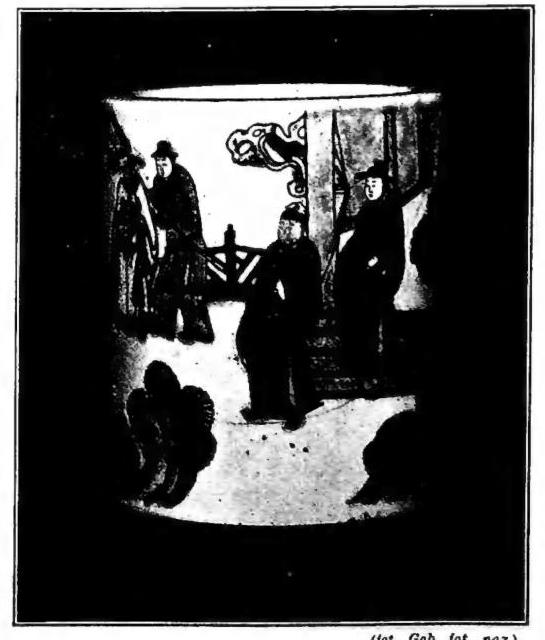
(from G. Morazzoni, Le p. italiane, Milan 1933, vol. III, 6) PORCELLANA – Chinese-type box for three. Cozzi Venetian Manufactories (18th century). (photo: National Photographic Cabinet) PORCELLANA - Chinese vase of the Ta-Ming dynasty (18th century). Rome, Museo di Palazzo Venezia.But the romantic quest for a way of composing true porcelain had reached a favorable conclusion around the year 1709 through the work of the German alchemist J. F. Böttger. Kept at work by Augustus III and having obtained kaolin, after exhausting research and experimentation, with the assistance of the scientist Tschirnhaus he was able to produce the first genuine European porcelain. Thus arose at Meissen the glorious Saxon manufactory which, for its products—admirable both technically and ornamentally—made use of the work of eminent chemists and artists, among them Herold, J. J. Kändler, Marcolini, and others. The secret of the process, despite the strictest precautions, could not be kept. Vienna had its own manufactory in 1718, Venice in 1720, and in 1733 Doccia in Tuscany, established by the Ginori family, whose name is still associated with one of the finest Italian productions; in 1740 a workshop was established at Capodimonte at the behest of Charles III of Bourbon, who in 1737 had married the daughter of the Elector of Saxony. Every state wanted its own particular production of hard-paste porcelain; patrons and industrialists devoted themselves to it out of enthusiasm and self-interest, and the manufacture of porcelain became a broadly European phenomenon, which often took on the character of a veritable “disease.” “Arcanists,” artists, and refined modelers devoted their work to its composition and plastic art. At first, the ornamentation followed the taste of the so-called chinoiseries, disseminated throughout Europe by Eastern embassies and then made even more commonplace by the works of European travelers (a typical example is that of Johann Nieuhof, sent by the East India Company to the Emperor of China, whose account appeared in Leiden in 1665 and in German translation four years later). The decorations and representations subsequently drew their inspiration from the Baroque and Rococo, which dominated Europe, taking their subjects above all from contemporary French prints; this applied not only to the forms of the vases and the richly decorated table services, painted with “third firing,” but also, more generally, to fashion, costume, the commedia dell’arte, pastoral scenes, cicisbeism, and the Watteau-like scenes of the period, together with war episodes, portraits of figures in plaques and half-length, genre figurines, animals, flowers, candelabra, and architectural ornaments applied to entire “cabinets” in princely residences. Christian religious expressions too, in addition to Buddhist ones, were notably represented in this noble material. Besides a rare Chinese plate with the Crucifixion, now in the Bergen Museum (Norway), one may cite various sculptures depicting the principal motifs of Catholic faith, executed in Italian, Spanish, German, and English workshops, such as the grandiose Deposition, from Doccia or Capodimonte, dating from about 1775 and now in the National Museum of Stockholm; as well as scenes from the life of Jesus and the Passion, fully modeled figures of the Virgin and Child, the Immaculate Conception, the Mater Dolorosa, and others; and also saints (for example, that of St. Carlo Borromeo, modeled by Linck in the workshops of Frankenthal around 1770, now in the Munich Museum, among others). - Vedi tavv. CXIX-CXX.
BIBL.: A. Brongniart, Traité des Arts céramiques ou des poteries, 1st ed., Parigi 1844; St. Julien, Histoire et fabrication de la porcelaine chinoise, there 1856; A. J. Jacquemart et E. F. Le Blant, Histoire artistique, industrielle et commerciale de la porcelaine, there 1862; Ch. Davillier, Les origines de la porcelaine en Europe, there 1882; G. Vogt, La porcelaine, there 1893; W. Rieke, Das Porzellan, Halle a. S. 1907; Ch. de Grolier, Manuel de l'amateur de porcelaines. Manufactures européennes, Parigi 1914; W. Burton, A general history of porcelain, Londra 1921; R. L. Hobson, The Catalogue of the George Eumorphopoulos Collection of chinese, corean and persian pottery and porcelain, there 1925; F. H. Hoffmann, Das Porzellan, Berlino 1932; G. Morazzoni, Le p. italiane, Milano 1935; G. Liverani, Catalogo delle p. dei Medici, Faenza 1936. Gaetano Ballardini
Cite this article
“PORCELLANA.” Enciclopedia Cattolica, vol. IX (1952), p. 1058. Azione Romana digital edition, https://azioneromana.com/article/porcellana.