
CERAMICS. — A generic term denoting every product obtained through the successive application of two technical processes: 1) the manipulation of more or less plastic clays, optionally combined with other ingredients, for the purpose of shaping, by hand or machine, objects of utility or ornament; 2) the firing of such objects, after they have been dried, at a suitable temperature in a special kiln. C. teaches the execution of these processes, which differ in the nature (and in the specific name) of the varieties corresponding to the various objects that can be produced (terracotta, faience, majolica, earthenware, stoneware, porcelain, refractory materials, etc.), according to the materials employed and the related techniques followed (firing temperatures ranging from approximately 850° to 1410°, depending on the type).
The beginnings of c. are certain in the Neolithic period, originally in dependence on primitive plaiting techniques. Indeed, a wicker basket lined internally with a clay mixture softened with water, after its separation from this casing owing to the natural contraction of the clay, gave rise to a vessel in its own right, which, first hardened in the sun and later, at a more advanced stage, by fire, became, through its successive practical and aesthetic transformations, both an instrument and an index of the progress of civilization.
In this way there also arose, together with the originally ovoid form of the vessel, the “impressed” ornament, evenly distributed over the object’s exterior surface; this ornament, subsequently, with the increasing use of more highly purified clays and coloring pigments, and with the more or less intensive recurrence of ornamental patterns, was replaced by painted vase decoration.
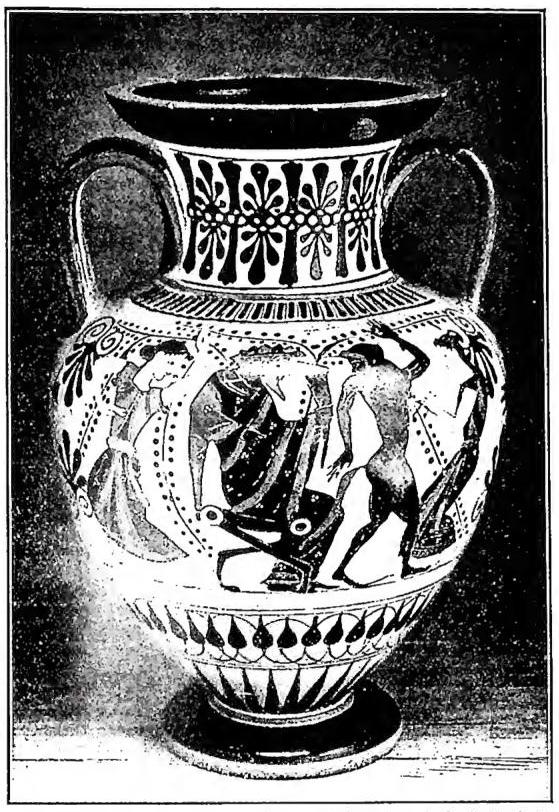
(courtesy of Prof. G. Ballardini)
CERAMICA - Attic black-figure amphora (6th century B.C.).
uniformity of firing and subsequently permits the application of particular chromatic techniques based on the variations introduced into the atmosphere of the firing chamber (oxidizing, neutral, reducing). The potter’s wheel is mentioned in various significant ways by ancient writers: from Homer’s celebrated passage concerning the “wheel” to the repeated biblical references as a moral admonition; and, throughout classical literature, references to this art, which truly creates form out of the formless, assume vivid, satirical and, generally, experiential values.
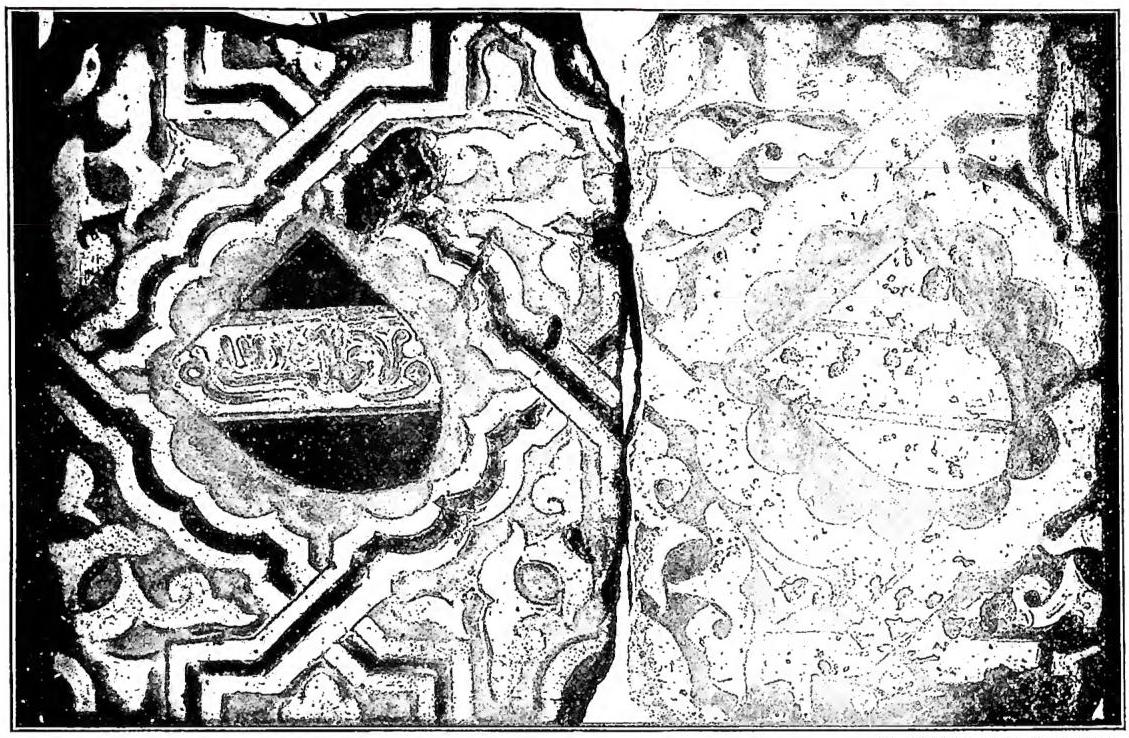
Learning to give the surface of the vessel a covering impermeable to liquids represented a new phase in technical progress and added to the practicality of everyday use a fundamental element of aesthetic enjoyment: colour. It may immediately be stated, by way of example, that the Eighteenth Egyptian dynasty, which produced coloured glass for coating its c., provided examples of a chromatic richness and delicacy of tones that have scarcely been surpassed: a technique that would endure for millennia and shine anew in the Hellenistic workshops, only to be transmitted, in forms suited to the new times, to the potters of Muslim Egypt and hence to the modern world. Muslim potters, spreading the use of metallic lustre (improperly called by some “reflection”), derived from it effects of exceptional beauty.
Greek potters, in their two successive techniques of vessel ornamentation, with “black figures” and with “red figures,” emphasized the linearity of an impeccable line, not only in decorative and animal ornament but also in the representation of the human figure, so that in the workshops of the 5th and 4th centuries B.C. they made that figure the focal centre of the decoration, demonstrating incomparable artistic skill. The Roman world preferred a solid c. with a “coralline” patina, delicately decorated in its finest examples according to Alexandrian taste with relief applications (“terra sigillata”). In this genre, between the 1st century B.C. and the 1st century A.D., the “Arezzo vases” are characteristic, although this technique, soon diffused throughout the provinces, especially in Gaul, subsequently supplanted there the imported model. Byzantine currents awakened around the lands of the western Mediterranean a form of production characterized both by sgraffito ornament and by an austere dichromy painted in dark purple and green, provided with a lead-based vitreous coating and surviving from older workshops, while the use of tin glaze, itself of very distant Eastern origin, would increasingly become established among us, as in Moorish Spain, during the first centuries after the year 1000. Thus, by the end of the fifteenth century, and even more so in the sixteenth, it became the basis of the exquisite polychrome paintings produced by Italian Renaissance craftsmen, inspired by fantasies, mythological and sacred “histories,” the compositions of Italian and German woodcut and copperplate engravers, and those of painters, especially of the Raphael school.
In the Robbian workshops, this glaze became the precious foundation of the white and turquoise of those exquisite sacred compositions; and in the workshops of the jug and vessel makers, especially those of Romagna, Tuscany, the Marches and Umbria, it would become the first of the means by which Italian art achieved predominance in the pottery of western and central Europe. It is therefore unsurprising that, toward the end of the sixteenth century, in France and, after France, in all civilized languages, the word faience, recalling the Romagnol city of Faenza—already a centre of a constantly renewed current of decorative elements in “maiolica,” and the birthplace of active and enterprising masters—came to designate a variety of ceramic production which among maiolica (v.) from the name of Majorca, a Balearic island that had formerly been an active emporium for the importation into Italy of lustred ceramics from the Spanish Levant.
The Far East, through the use of feldspathic clays requiring high temperatures, anticipated every other region in the production of hard pastes and hence of porcelain. The West became so enamoured of it that even its alchemists applied themselves to discovering its secret, until in Italy—first and especially at Florence, after the initial unsuccessful attempts elsewhere—under the patronage of Francesco de’ Medici (1575–85), a “soft” (non-kaolin) variety was produced, appropriately called “Medici porcelain,” of which rare examples remain.
Finally, between 1709 and 1710, the German alchemist G. F. Böttger, using Saxon kaolin, produced the first examples of European hard-paste porcelain; the first factory was consequently founded at Meissen and was soon imitated, despite prohibitions and stringent measures. Venice already had the Vezzi factory in 1720; in 1735 the Ginori manufactory was founded at Doccia, where production continues to this day to the glory of Italy; and in 1743 the royal factory of Capodimonte (Naples) was established, followed in due course by others throughout Europe (v. PORCELLANA).
Only recently have other bodies for firing at high temperatures been studied and produced for particular industrial, technical, and sanitary requirements; this has opened new fields for a more thorough technological and scientific study of production.
The dispute is of interest which, beginning from more or less solid etymological foundations, has divided and continues to divide scholars regarding the scope to be assigned to the content of the word c. and consequently concerning its definition.
In any event, c. can be classified into c. with a porous body and c. with a compact body. The porous-bodied types are terracotta, faience, and soft earthenware; the compact-bodied types are hard earthenware, stoneware, and porcelain. Their definitions follow.
Terracotta: a body of more or less properly constituted marly composition; it produces highly iron-oxide-colored and porous products, generally without a coating.
Faience: a clay-based body; it produces porous, more or less colored products, with a transparent siliceous-lead coating (marzacotto, cristallina, or glaze) applied to the piece after it has been fired. This variety is called maiolica when it is coated with an opaque covering, generally white and based on tin oxide (tin glaze). If the coating consists of a veil of white earth (earth of Vicenza, earth of Siena), called slip, applied to the unfired piece, an inferior variety is obtained (slip-coated faience, bianchetto), which, once painted, is covered with cristallina in a single firing.
Earthenware: a body based on clay, kaolin, quartz, and feldspar; it produces white, resonant, opaque products, with a siliceous-lead coating (glaze), more or less hard (soft earthenware, hard earthenware, according to the proportions of the ingredients and the degree of firing).
Stoneware: a body based on clay and feldspar; it produces brownish or grayish, more or less vitrified, opaque, resonant, hard products (those with an alkaline coating obtained with sodium chloride are called salt-glazed stoneware). A light-colored variety is also used for artistic purposes.
Porcelain: a body based on kaolin, quartz, and feldspar; it produces white, homogeneous, resonant, hard, impermeable, more or less translucent products, with a feldspathic coating (those without a coating are called biscuit in French usage).
There are also various c. products: refractory materials, steatite, hlinker, dental porcelain, abrasives, etc. - Vedi Tavv. LXXX-LXXXI.