
MAIOLICA. — This is a variety of ceramic ware (v.), consisting of a clay-based mixture that fires to a color ranging from red to flesh-pink. Its products, called after the first firing by the generic term “biscuit,” are covered with a glassy coating rendered opaque by tin oxide (or by other opacifying agents), generally white, called “glaze.” On this, using colors based on metallic oxides capable of withstanding the second firing (approximately 920°),
and therefore called “high-fire” colors, the decoration is applied with a brush or by other means; the object is then covered with a “varnish,” more commonly a silico-lead glaze, and fired a second time.
During this second firing the glaze melts, fixing the colors and rendering the object impermeable to liquids; the varnish, through its transparency, gives the surface a greater brilliance: for this reason it is called “glass glaze” or “crystalline glaze.”
The products made of clay mixture, coated while still unfired with a veil of white earth (“Siena earth,” “Vicenza earth,” or “engobe”), decorated with a brush or by sgraffito, covered with “crystalline glaze,” and fired only once were erroneously called “half m.” The basic colors, as has been said, based on metallic oxides ground in water, are green from copper, violet from manganese, yellow from antimony, blue from cobalt, etc. These “high-fire” colors differ from those called “low-fire,” since the latter, being more fusible, are applied by means of resin to glaze already fired at 920° and fixed upon it by a third firing (that is, “third fire” or “muffle firing”) at approximately 650°.
A complementary decorative effect (“metallic lusters”) can be obtained by applying metallic salts (most commonly of copper, silver, and bismuth), dissolved in diluted acetic acid or dispersed in vinegar with calcined kaolin, to the glaze after it has already been decorated and fired, and then firing it a third time at ±700° in a reducing atmosphere.
The “metallic-reflection” ornament (gilding) is obtained by painting the parts to be gilded on the glaze after it has already been fired, using “liquid gold” (gold chloride dispersed in a resinous substance), and firing at ±700° in a normal atmosphere. The same applies to silvering.
The term m. is the Tuscan diminutive form (cf. Inferno, XXVIII, 82) of the name Maiorca, an island in the Balearics and one of the ports of the coastal-trade route which, from the workshops of the eastern Iberian peninsula, toward the end of the fourteenth century and still more in the following century, imported into Italy the highly admired ceramics gleaming with golden lusters and catlike iridescence, often bearing the coats of arms of the great Italian families. Only after the middle of the sixteenth century did that name come to designate the entire production with tin glaze, independently of decoration by third firing.
The opinion is still widespread that Italian maiolica-makers learned their art from masters who had immigrated here from the East. Yet the medieval “encyclopedias” attest that, long before the year 1000, the use of tin glaze (already well known to the decorators of the ancient East) had also become common knowledge in Italy.
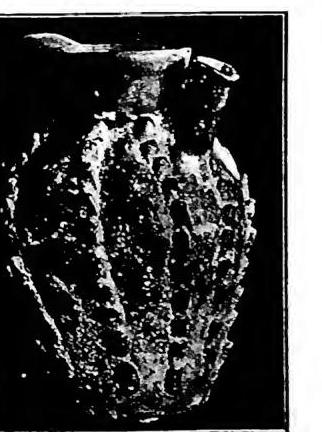
Certainly, the development toward the higher forms of the technique occurred gradually. In the early Middle Ages, and still almost until the year 1000, ordinary production displays that phase
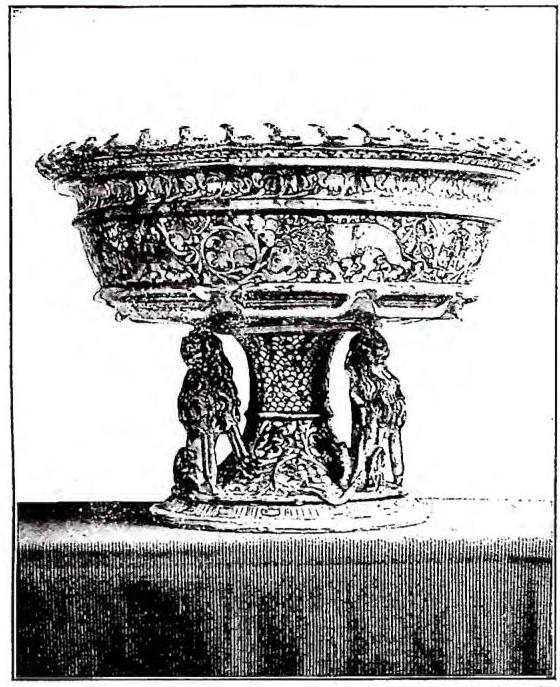
(Alinari photograph) MAIOLICA - Glazed and relief-decorated vase with floral and animal motifs (15th century) - Paris, Louvre.
The renewed taste for color would then bring about the application, to the body of the vessel, of a coating of white earth (“engobe”), upon which the ornament could be incised or even painted, but which had to be protected by a vitreous coating rendering its surface impermeable to liquids.
Examples are also found among those “basins” or bowls that Romanesque architects set into buildings, especially religious ones, with which the Italian cities were being adorned, in order to enliven the sober tones of brickwork: Italian-type basins or bowls that accompanied the polychrome and iridescent ones imported by renewed Mediterranean trade from Egypt, Syria, and Moorish Spain. The fusion, within a single technical process, of the means of concealing the natural color of the biscuit and making it impermeable by means of a single coating through the application of glaze constituted a conquest from which, from the 12th century onward, the entire development of this art would proceed. For thus the glazed coating, that is, m., became the ground upon which, through the work of excellent masters, those prestigious paintings were spread that won universal admiration, to the point of being considered a particular aspect of the Italian civilization of the 15th and 16th centuries.
The legion of these first artisans remains anonymous, and only scant relics of their work are known; a Petrus orzarolus worked in Faenza in 1142; a Martinus orciolarius in Florence in 1195; a Petrus vascellarius in Orvieto in 1211. And from this “archaic phase” of production, better studied in the pieces that have emerged from Orvieto and Faenza, what remain above all are jugs with increasingly whiter glaze, bearing the first ornaments painted in purple and green, with geometric, floral, heraldic, and animal motifs, also derived from prototypes of the East and Byzantium by way of the Iberian Levant.
The human figure is rarer and more tentative; only in the subsequent phase (called “severe style” because of the gravity of its decorative forms and the overall sobriety of its chromatic treatment) would it increasingly tend to become the focal center of all decoration. In the second and third decades of the 15th century, while the range of vase forms became richer (for example, with jugs, spherical vessels on a high foot, handled pouring vessels shaped like small barrels, albarelli for pharmaceutical drugs, etc.), alongside the purplish black produced by manganese, the black and brown produced by iron, and the brilliant green due to copper, there appeared the turquoise of the Levantine “zaffera,” introduced by Venetian merchants, until this color, lightened into a beautiful cobalt blue, would become a monopoly of the German mines.
The extensive and increasingly “human” production of the workshops operating in the “severe style” can be divided according to the dominant motifs in their ornaments, or the exotic patterns that were soon assimilated by the Italian workshops. Splendid are the products of the first two families: the “green” and the “relief zaffera” (of which the Florentine and Faentine examples have been best studied), which cover the first half of the century. The “Italo-Moorish” family—soon exhausted—the “Persian palmette,” “peacock feather,” and “Damascene” families extend to, and somewhat beyond, the end of the 15th century, the period in which the motifs of the Renaissance were fully introduced.
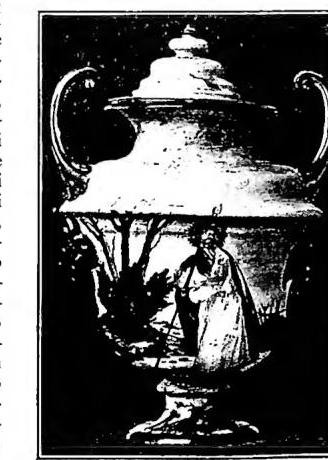
(Alinari photograph)
MAIOLICA — Painted vases with the saints: Pietro, Antonio Abate and Giovanni Battista. Raphael school (mid-16th century) — Loreto, Treasury of the S. Casa.
intense emotional force of the whole, while the ornamental repertory, drawn from the ancient «grotesques», discovered and disseminated only shortly before, rendered with an agile hand and exquisite interplay of polychrome, adds grace to the work, which is no longer obscure, no longer confusable with ordinary utilitarian production, but coveted by the client and «marked» by its own maker, who is aware of its worth. The masters of this «new style», through contact with lords, whose heraldic requirements they also satisfy, and with humanists and scholars, whose advice they follow, form a school of painting whose «individual masters» excel from 1490 to 1525.
This is the culmination of the «Faenza canon», whose precious and refined qualities subsequently crystallize around the products of the «Casa Pirota», of pronounced «beautiful style». But already in the third decade of the 16th century, this «first phase of istoriato» is followed by another, which treats the ornamentation of majolica as a genuine form of painting, extending it across the entire surface of the dish and often distorting it for the viewer, given the very shape of the vessel on which it is drawn. The personality of the maker, stimulated toward virtuoso execution, becomes the handmaid of a richer sense of colour, now dominated by the note of tawny hues. A school thus emerges whose leaders are found in the Duchy of Urbino. And while at Deruta, in Umbria, majolica is also decorated with lusters of greenish-gold and violet, at Gubbio, then belonging to the Duchy of Urbino, mastro Giorgio Andreoli applies his opulent golden, «ruby» and iridescent «reflections» to the majolica that the other workshops send him in competition with one another: a shining phenomenon whose fame still endures. Later, in 1569, the duke of Urbino granted the Lanfranco family of Gabicce, active in Pesaro, a privilege «for having found the means of putting real gold on earthenware vessels and adorning them with gold work».
In the Roveresque State, first at Casteldurante (called Urbania from 1635 in honour of Pope Barberini), then at Urbino, its distinguished capital, Nicolò Pellipario (d. before 1547) produced excellent, carefully considered paintings on aristocratic table services and on large display dishes, which would establish a school. Cultivated, versatile, supremely skilled, rich in taste and inventiveness, with a palette at once delicate and expressive, he is the head of the new school, which would find its finest followers in Francesco Xanto Avelli da Rovigo and in Nicolò’s own relatives, who at their new seat would assume the surname Fontana.
This manner of «historiating» earthenware with rich polychrome paintings based on warm colours, but making extensive use of half-tones, spread to the principal Italian workshops, which often treated it with particular local accents. Large «credenze», rich supplies of pharmacy jars, such as that of the duke of Urbino, later donated to the Treasury of the S. Casa of Loreto, trays, pouring vessels, inkstands and other shaped objects became expressions of this taste. Urbino offered it as a gift to the court of Spain, while the king of France wished to obtain it from Faenza by magic («per incanto»). Mythology, sacred history and costume were put to use, and the subjects, formally derived also from engravings, especially those of Raphael’s school, were most often illustrated by captions painted on the backs of the pieces. The affixing of the maker’s or workshop’s «mark» became customary.
The «second» and «third istoriato», with their richly polychrome ornaments «a raffaellesche» and «a cammei», would become articles of export abroad as well, from the workshops of the Metauro region and their followers. And just as in the early years of the 16th century the «Faenza-style» Francisco Nicoloso had painted majolica admirably in Seville, so now the masters of the Urbino manner (from Urbino itself, Pesaro, Casteldurante, Faenza, Venice and other places) would spread and teach this art in France, the Netherlands, certain regions of Germany, England, and later also in the Moravian and Bohemian lands, giving rise there to the particular class of «habane» majolica.
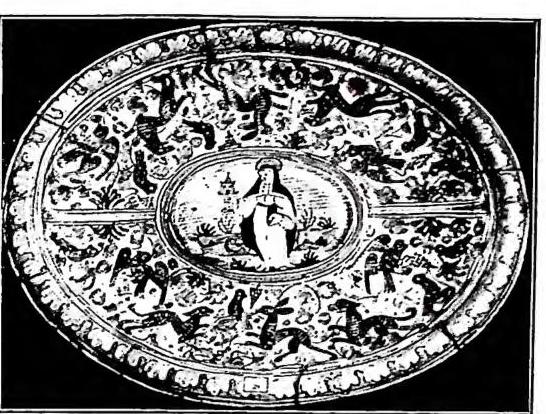
(courtesy of mons. A. P. Frutasi)
MAIOLICA - S. Chiara, Plate from the Deruta factory (early 17th century) - Assisi, Franciscan Museum.
the term « faenza » enters the language of France, and from this the word folence will be adopted, with slight variations, by the other European languages and will become—and still remains—the significant homage of the entire continent to an exquisite form of Italian art.
In Italy, however, during the second half of the sixteenth century, because of satiety with an overly widespread product, its diminished formal qualities, and a new orientation of taste, a lively reaction arose against this style, which has been called « fiorito ». The Faentine workshops once again led the way, as they had always been exceedingly numerous and abundantly productive. Virgiliotto Calamelli and « Don Pino » (Leonardo Bettisi) may be cited as the forerunners of the new taste for the « bianchi », to which, naturally, the increasingly broader interest now directed toward Chinese porcelain was not unrelated. Thus, from the opulent polychromies of the palette of the « metaurensi » maiolica painters, one passes to a range of simpler harmonies, and very often, on the velvety, rich glaze, such as had never been seen before, airy, lively, threadlike designs are traced, either solely in blue or accompanied by sparse touches of green and yellow: a coat of arms, an image of a putto or saint, or a concise impressionistic composition provides the entire decoration. Ballardini had already given this style, executed with an easy and rapid hand, the name « compendiario », to emphasize its incisive expressiveness. It too conquered the Italian workshops, until, during the seventeenth century, signs of another, different decorative manner began to emerge from other parts of Italy—Liguria, Tuscany for a brief period, and Abruzzo. The Ligurian manner—in Savona, Albisola, and Genoa—developed according to distinctly Chinese models, at first adopting exclusively on the white or slightly bluish glaze a blue pigment, also applied in skilful washes, to paint summary, pleasing fantasies of birds and putti in flight, sailing galleys, and landscapes of dense foliage, rocks, and clumps of sharp-leaved plants.
It should be noted that this repertoire was at this time also common to the Dutch and German, English and Portuguese workshops. Somewhat later, polychrome depictions of animals and trees would recall the manner developing during that period at Talavera in Spain.
Montelupo fiorentino, in the first half of the seventeenth century, alongside its large and small jars with broad green foliage, mottoes, and whimsical motifs, produced a series of plates that one would readily call « picaresque ». Painted boldly, in a somewhat buffoonish manner, but not lacking the « grandioso » inherent in the period, they show caricatures rendered in a coarse, popular polychromy: bravi and musketeers, people on horseback or standing with comic bravado, in duels or battles, with pikes, firearms, flags, and drums, offering the extremes of a grotesque Spanish style. Accompanying these are images of peasants in curious attitudes, sketched incorrectly but with appealing skill. Castelli di Teramo, on the other hand, returned to the « istoriato », often spread across the entire surface of the piece, but enclosed within frames decorated in Baroque designs, with broad vegetal scrolls, architectural elements, putti, etc. The palette is « languida »: muted greens, reddish yellows, and blues applied in washes; sometimes touches of gold. The landscape, however, is treated with exemplary sensitivity. There are also broad paintings of complex sacred and mythological scenes, as well as interiors, executed with rare mastery. The exceptionally industrious families of the Grue and the Gentile share the honor of this production, which introduced innovation into painting on m. in southern Italy.
With the eighteenth century, the m. of northern Italy became a clear follower of foreign models, especially Dutch and French ones. Such were the Bérain designs disseminated by the Provençal workshops of Moustiers; such were the styles of the three « Luigi » of France; and such was the imitation—also using « petit feu » colors, applied with rare skill and effectiveness to the already fired glaze—of the widely disseminated Oriental porcelain, and especially of the German porcelain influenced by the impetus originating in Strasbourg. Alongside the chinoiseries, which by then dominated the entire ornamental world, there appeared the whimsical forms of the rocaille, decorations « a fiori indiani » and « a fiori tedeschi », and the « alla giapponese » ornamentation based on Imari models, in which gold, often replaced by yellow, was added to red and green.
A « nuovo compendiario » may be seen in the « macchiette » and « rovine » of the final period of the century. But, beyond porcelain, a material that was always relatively precious, m. would find itself competing with the new ceramic, which spread rapidly and, for commercial as well as practical reasons, came to prevail over every other product: English « terraglia », perfected by Wedgwood. It soon conquered all the markets of the world, and m., defeated in the harsh economic struggle as a widely marketed art manufacture, would be reduced to popular uses (m. rusticane) or become a refined product made in imitation of ancient masterpieces, or serving to affirm the genius of individual craftsmen in the finest ceramic workshops. - Vedi tavv. CXXIII-CXXIV.
BIRL.: B. Rackham, Guide to Italian m., Victoria and Albert Museum, London 1933; id., Catalogue of Italian m., Victoria and Albert Museum, there 1940; G. Ballardini, Corpus della m. italiana, I, Rome 1933; II, there 1938; id., La m. italiana dalle origini alla fine del Cinquecento, Florence 1938. Gaetano Ballardini