
FIGLIE DELLA CARITÀ DI SAN VINCENZO DE' PAOLI (Parigi). — Religious institute founded by s. PALAI (v.) and by s. Luisa di Marillac (v.). Its origins go back to 1617, when s. Vincenzo established the first Company of Charity at Châtillon-les-Dombes (Bresse), or, more precisely, to 1629, when the Company moved from rural parishes into the great urban centers (Paris, parish of S. Salvatore). The ladies of the city, who were not always able personally to perform the necessary services for the poor, often entrusted them to their own
servants, to the detriment of those assisted. S. Vincenzo then conceived the idea of associating with the ladies some good young women who would devote themselves to the practice of charity. The young women from the countryside seemed to him best suited to this purpose; he therefore chose several and distributed them among the various companies of Paris. But after some time experience showed that they first had to be known and formed; thus a kind of community was begun. The work was entrusted to Luisa di Marillac, the widow Le Gras, president of the « Carità » of S. Nicola, who received three or four of them into her home on 29 November 1633.
The people called them « F. della C., servants of the sick poor »; and this name has remained, together with the primitive gray habit « in the country style » and its headdress, which in the nineteenth century became the characteristic « cornette » still worn today. The first rule dates from shortly after 29 November 1633. From morning to evening, a life of piety permeates the charitable activity of the F. della C. « To leave God for God, » s. Vincenzo used to repeat, meaning that, when necessary, the sisters must know how to give up prayer itself in order to serve the poor, whom, in the spirit of their vocation, they recognize as their masters. For 27 years (1633–60), s. Vincenzo devoted himself with fatherly love to their formation. His weekly « conferences », recorded by the sisters, make up two large volumes.
Legislation. S. Vincenzo’s constant concern was that his daughters should neither be regarded nor regard themselves as religious, according to the juridical concepts of the time. He therefore eliminated from their vocabulary everything that evoked the idea of a religious community. The Institute is called the Company; the novitiate, the seminary; the superior, its servant; the residence, the house. Vows were permitted experimentally to Luisa di Marillac and four other sisters on 25 March 1642. It was definitively established that they should be « private and annual only ». The day of 25 March, the feast of the Annunciation of the Most Blessed Virgin, is the date consecrated to the renewal of these annual vows, when the F. della C., already free in herself, offers herself to the Lord with renewed fervor. The purpose of the Institute is defined by its founder in these terms: « To give oneself to God in order to love him and serve him in the person of the poor, assisting them bodily and spiritually. » That is, to devote oneself to one’s own sanctification and that of others through the practice of charity. To the initial work of « visiting the poor in their homes » were later added teaching girls, caring for foundlings (1638), convicts (1640), the elderly, and wounded soldiers (1653). The archbishop of Paris, G. F. Gondi, approved it on 20 November 1646 and again on 18 January 1655. The King granted letters patent in November 1657, and Parliament registered them on 16 December 1658. After the death of s. Vincenzo, his successors took steps to consolidate and preserve the founder’s work from any alteration. Renato Alméras, the first successor
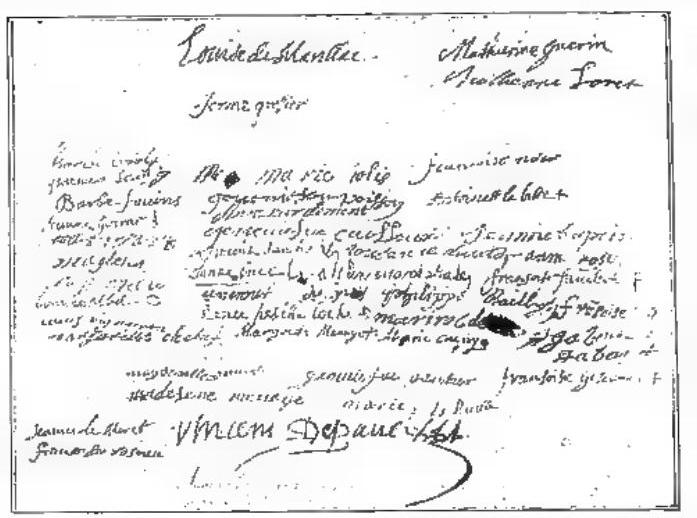
FIGLIE DELLA CARITÀ DI S. VINCENZO DE' PAOLI — Act appointing the first officers: signatures of the first F. della C. (8 August 1633) following that of Luisa di Marillac — Paris. National Archives.
FIGLIE DELLA CARITÀ DI S. V. DE' PAOLI - FIGLIE DELLA CROCE
(1660–73), obtained from Cardinal de Vendôme, the Pope’s legate, the pontifical approval, and also revised and ordered the common rules, subsequently promulgated by his successor, Edmondo Jolly (1672–97). In 1718 Giovanni Bonnet (1711–33) promulgated the constitutions, which establish the conditions of admission, the organization of the Company in general and of the individual houses, the formalities of elections, etc. Before entering the Institute, the young woman remains a postulant for three months; she is then admitted to the seminary (novitiate) for a year of probation, after which she dons the habit proper to the F. della C. Five years after entering the seminary, she makes her holy vows for the first time “without any special solemnity,” and thereafter renews them annually. The supreme authority in the Company belongs to the superior general of the Congregation of the Mission, on whom, by a legitimate tradition that has never been interrupted and was officially confirmed by Leo XIII (25 July 1882), it depends, and to whom the vow of obedience is directed. The Company is governed by the superior of the motherhouse, elected every three years and assisted by a Council of sisters, likewise elected every three years, who hold the offices of assistant, bursar, and secretary. To this organization, established by the first regulations, was added in the 18th century the grouping of various houses into provinces, each headed by a sister as visitor, with her own Council, and a priest of the Mission appointed by the superior general as director.
At the death of s. Vincenzo, the Company had 51 houses; in 1700, 300 with 1,000 sisters; in 1790, 430 with 4,300 sisters. The French Revolution dissolved it together with all the other religious communities. Many of them, in secular dress, continued their service to the poor secretly. Several of them suffered martyrdom. In 1809 Napoleon restored their legal existence, but attempted to remove them from the jurisdiction of the superior general of the Congregation of the Mission. It took all the firmness of the Congregation’s vicar general, Domenico Hanon (1807–16), to resist the emperor, at the cost of imprisonment at Fenestrelle (1811–14). From 1815 onward, their growth no longer ceased, and in the 19th century the Company reached every part of the world.
As the membership and houses increased, so too did the works, with the result that the F. della C. have stood in the front line of every form of assistance developed in modern times. The names of Sister Rosalia Rendu (1787–1856), the “spiritual mother” of the Conferences of s. Vincenzo founded by F. Ozanam, and of Sister Giuseppina Nicoli (1863–1924), “the artist of charity in Sardinia,” remain associated in this field with the most varied and ingenious initiatives. The sisters work in hospitals, ambulances, sanatoria, maternity and childcare institutions, dispensaries, convalescent homes, boarding houses, colleges, workshops, etc. The free schools resumed their activity at an increasing pace after 1830. The kindergartens, where the F. della C. were the first to introduce the Froebel and Montessori methods, flourish everywhere. Numerous are the religious-social associations created and directed by the F. della C.: it is enough to mention the patronages and, in France, the women’s trade unions, now a national organization, conceived and organized with astute insight by Sister Milcent in 1902. The association of the Daughters of Mary, which traces its origin to s. Caterina Labouré (v.), with approximately 500,000 members and 4,000 centers, belongs to this field, as do that of the Angels, of the Miraculous Medal, of the Lulisine, of the Oratories, etc. Foreign missions also occupy a place of honor, and at present the Company has 4,339 missionary sisters spread across Asia, Africa, and Oceania. Some of them have sealed their ministry of charity with martyrdom. Also to be recalled, in the 19th century, are the manifestation of the Miraculous Medal to s. Caterina Labouré (1830), of the Green Scapular to Sister Giustina Bisquayburu (1840), and of that of the Passion to Sister Apollina Andriveau (1846).
The organization and aims of the F. della C. served as an example to other Companies founded in more recent times.
At present (1949), the F. della C. constitute the largest female religious force in the Church, with approximately 45,000 sisters and 4,000 houses divided into 33 provinces. - Vedi tav. LXXXIV.
At present, 120 religious live in 12 houses, all in Italy, dedicated to supporting and promoting public adoration and to assisting parish priests in their spiritual and social ministry.