
SEMERIA, GIOVANNI. – Barnabite orator and writer, born at Coldirodi (Imperia) on 26 September 1867, died at Sparanise (Caserta) on 15 March 1931. At the age of 15 he entered the Barnabite novitiate at Monza. In Rome, having completed his philosophical and theological studies at S. Apollinare and at the Ateneo di Propaganda Fide, he was ordained a priest on 5 April 1890; in 1892, at the University of La Sapienza, he obtained a degree in letters, and then, in 1897, at Turin, one in philosophy. His first apostolic labors were among the pupils of the oratory of the Sacred Heart, directed by Fr. Baravelli, and later among the workers, boys, and wretched inhabitants of the Verano district.
Meanwhile he attended the Sunday circle of Giulio Salvadori and was already publishing essays on history, theology, and biblical criticism; together with Fr. Savi he also began the series of his brilliant lectures in the hall of S. Carlo ai Catinari. In 1892, at the behest of Leo XIII, he took part in Genoa in the Catholic Congress of Social Studies. In September 1895
1. A Levite in the time of David (I Par. 15:8, 11).
2. Son of Obededom, of the family of Korah (ibid. 26:4).
3. A prophet in the time of Rehoboam, who, in God’s name, forbade the king to wage war against the rebellious tribes of the north (I Reg. 12:22–24). The same man foretold the victory of Pharaoh Shishak (II Par. 12:5 ff.).
4. A false prophet contemporary with Jeremiah, who fostered false hopes both in Babylon and in Jerusalem. Ge-
from Rome he was sent to Genoa as vice-rector and professor at the «Vittorino da Feltre» Institute, and for 17 years he was its driving force. From 1904 he was also director of the S. Alessandro Sauli Youth Circle, where, in November 1897, together with Fr. Ghignoni, he had founded the Higher School of Religion for the study and dissemination of Christian history and thought. At the same time, in the church of the Vigne, he conducted those regular courses of Sunday homilies which for 11 years drew all cultured Genoa from Advent until Lent, when he left to preach the Lenten course in the principal cities of Italy.
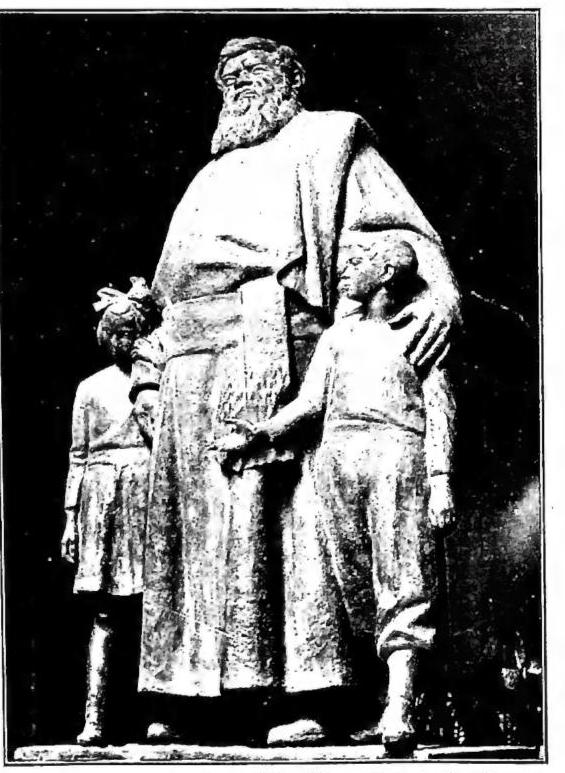
(courtesy of the sculptor A. Monteleone)
SEMERIA, STEFANO — Monument to Fr. S. by the sculptor Alessandro Monteleone — La Spezia, Istituto P. S. Monte Rosso.
for Italian workers and began a course of weekly Dante readings. In the summer of 1915, Gen. Cadorna summoned him to Udine as chaplain to the Supreme Command; in reality, he seemed to be chaplain to the entire army. Tireless in the trenches, hospitals, concentration camps, and rear areas, he became very popular among officers and soldiers; until Christmas night 1918, when in the cathedral of Trieste he intoned the Te Deum of peace. Immediately afterward, together with Fr. Giovanni Minozzi, he founded the Opera naz. del Mezzogiorno d’Italia for the war orphans of southern Italy. On 5 and 8 March 1931 he gave his last lectures in Genoa and Montecassino. On 15 March death overtook him among his little orphans at Sparanise (Caserta).
Today the Opera naz. del Mezzogiorno, entrusted to Fr. Giovanni Minozzi and to the Pia Società dei discepoli, comprises 25 orphanages, 76 nursery schools and workshops, 5 mountain and seaside colonies, a home for the elderly, and 2 women’s teacher-training schools.
At the Scuola di religione and in the church of the Vigne in Genoa, S. wrote the books with which he placed himself at the head of the scientific and religious renewal in Italy: Venticinque anni di storia del cristianesimo nascente (Rome 1900); Il primo sangue cristiano (there 1901); Dogma, gerarchia e culto nella Chiesa primitiva (there 1902); Scienza e Fede e il loro preteso conflitto (there 1903); Gi'innì della Chiesa (there 1903; reprinted in 1926 under the title: Poesia divina); L'eredità del secolo (there 1900); Il pensiero di s. Paolo nella lettera ai Romani (there 1903); Le vie della Fede: Contributi apologetici (there 1903); La Messa nella sua storia e nei suoi simboli (there 1903), and thereafter many pamphlets, with lectures, panegyrics, and commemorations, as well as articles in scholarly journals and various daily newspapers.
After the war, despite the fact that his activity was carried out almost exclusively in charitable works, in an infinity of lectures and speeches on behalf of his orphans, and in the compilation of his monthly journal Mater Divinae Providentiae: Mater orphanorum, he did not neglect his autobiographical volumes: Memorie di guerra (1924) and Nuove memorie di guerra (1928), I miei ricordi oratori (1927) and I miei tempi (1927), I miei quattro Papi (Leone XIII, Pio X, Pio XI, Benedetto XV), in two small volumes (1930), and a third, posthumous, on Benedetto XV.
Under the auspices of the Opera naz. del Mezzogiorno, the following were collected in small volumes: I Vangeli delle Domeniche, Le Epistole delle Domeniche, Le Beatitudini, La Famiglia, and other minor works; under the auspices of the Confratelli, the Pater noster, Maria ideale di virtù, La morale e le morali, La Messa (3rd ed.). The apologetics courses of the Scuola di religione from 1903 to 1912 and almost all the sermons, including the famous Quaresimale di S. Lorenzo in Damaso of 1897, remain in manuscript.
In the history of the Church in Italy, S. remains less as an original thinker than as an exceedingly fruitful and lucid promoter and disseminator of Christian thought and history, a fascinating and brilliant lecturer and orator, and above all an apostle of charity.
Virginio M. Colciago