
KLOSTERNEUBURG. – Near Vienna (Austria), an abbey of the Canons Regular of St. Augustine of the Austrian Congregation, founded around 1106 by Margrave St. Leopoldo (canonized in 1485) of Babenberg and by his wife Agnese, daughter of the Emperor Enrico IV, on the site of a Roman castle (Canabiaca) and near the “new castle” of the Babenbergs (hence the name); until 1133 it was a collegiate church of Secular Canons, presided over as second provost by the son of St. Leopoldo, Ottone, who later became a Cistercian monk and bishop of Frisinga and made himself famous for his philosophy of history (Chronicon and Gesta Friderici). In that year su-
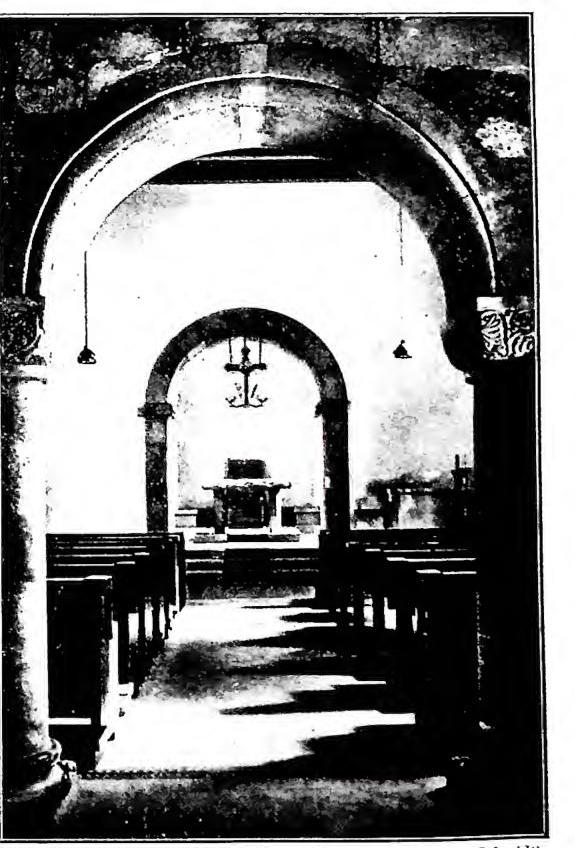
(courtesy of Canon S. Schmidt) KLOSTERNEUBURG - Interior of the small church of S. Geltrude (12th century).
Despite the many calamities caused by the wars of the Hussites and the Turks (in 1683, thanks to the lay brother Marcellino Ortner, it successfully resisted a siege lasting 10 weeks), and especially by the French wars, it always recovered new strength, tenaciously restoring monastic discipline after periods of decline. As the foundation and burial place of s. Leopoldo, K., under the Habsburg dynasty, rose to become a national shrine, thus escaping the suppression of the convents decreed by Giuseppe II. Among its provosts, besides Blessed Artmanno, the following should be remembered: the 6th, Wernher, elected bishop of Gurk in 1194, and the 62nd, Federico Gustavo Piffl, cardinal-archbishop of Vienna (d. 1932). In 1735 K. was incorporated into the Congregation of the Canons Regular of the Lateran Savior, and its provosts consequently bear the title of «Lateran abbots». Since 1796 it has had a philosophical-theological institute, attended by the professed clerics of the abbey itself and of other nearby houses of the Order.
The Library contains 1,245 manuscripts, 900 incunabula, and more than 150,000 volumes, arranged according to modern principles. In 1936, on the occasion of the eighth centenary of its foundation, Pius XI raised the abbey church to the rank of minor basilica. In the more recent period, K. was suppressed by the National Socialist government (1941–45), but was spared wartime damage and looting. At present it comprises 67 priests and 8 professed clerics, 7 novices, and 27 parishes, almost all in Vienna, with approximately 80,000 souls.
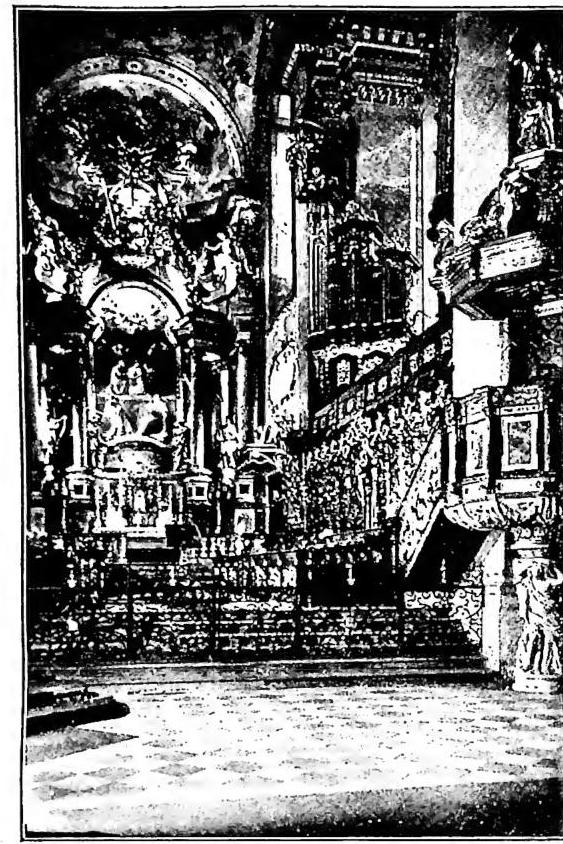
WORKS OF ART. – K. is particularly rich in works of art, among which the abbey church deserves mention: a three-naved Romanesque basilica, built, following Rhenish models, in the years 1114–36; its Baroque decoration dates from the seventeenth and eighteenth centuries (notable are the choir and the high altar, designed by Mattia Steindl). Of great artistic value is the Chapel of S. Leopoldo (formerly the chapter house), with precious stained-glass windows from the fourteenth and fifteenth centuries, a seven-branched bronze candlestick in the Romanesque style, and the famous « Verduneraltar », executed in 1181, by order of Provost Wernher, by Nicola of Verdun as a covering for the rood screen, and representing, in 51 enamel panels on a gold background, in typological form, the entire history of the Redemption. In 1329 it was made into a winged altarpiece, whose rear wall was decorated with four tempera paintings inspired by Giotto. This is the most distinguished work of Romanesque and Gothic art north of the Alps.
Also to be admired at K. are the cloister (thirteenth–fourteenth century), the « Madonna di K. », a fourteenth-century stone sculpture, the so-called « Albrechtsaltar », a beautiful altar created around 1440 by Giacomo of Kaschau. The imperial residence, which forms a unit with the abbey, commissioned by Emperor Carlo VI and built in the period 1730–40 to a design by Donato d’Allio (conceived on too grandiose a scale, only one third of it was completed), contains frescoes by Daniele Gran in the « marble hall » and stucco work on the ceilings of the so-called « imperial rooms ». In the Picture Gallery, noteworthy are works by the « Danube school » (Donauschule), bronzes and ivory sculptures; and in the treasury, the archducal standard of 1616 and exquisite goldwork in the Romanesque, Gothic, and Baroque styles.
LITURGICAL APOSTOLATE. – In recent times K. has become renowned for its liturgical apostolate among the people (volhalturgisches Apostolat). For this purpose Fr. Pio Parsch founded there in 1926 his monthly journal Bibel und Liturgie, later joined by the weekly Lebe mit der Kirche, intended for the broad masses of the people. In 1923 he published the first liturgical calendar (Liturgiekalender), which, under the title Das Jahr des Heiles, a guide through the liturgical year, subsequently went through 13 editions and was translated into Italian (L'anno liturgico), French, Hungarian, Portuguese, Icelandic, and Japanese. The abbey’s establishment of a large modern printing house (St. Augustinus-Druckerei), sold after its suppression in 1941 by the National Socialists and reconstituted in 1950, made possible the wide dissemination of liturgical publications: liturgical texts, pamphlets, illustrations, and propaganda leaflets. – Vedi tav. XLV.