
PARABOLA (παραβολή from παραβόλλοι “to place near, to compare, to liken”). — A literary genre not unknown to Greek and Roman authors (cf. ARISTOTLE, Rhetoricorum libri, II, 20; CICERO, De inventione, I, 30; Epist. ad Lucil., 59,6; QUINTILIAN, Institutiones orat., VIII, 3), used by rabbinic writers and in an unsurpassable manner by Jesus Christ in His teaching. It consists of a comparison or similitude, extended throughout a brief narrative drawn from an ordinary event, in order to inculcate a moral or spiritual truth. It is distinguished from a mere example by its literary form, centered on the comparison, and often by its breadth.
The subject of the comparison or image developed, which is in itself highly plausible, is usually drawn from human life; in the fable, on the other hand, preference is given to the fantastic representation of the animal or vegetable kingdom. The parable is distinguished from allegory in that the latter is based on a metaphor and follows different principles in interpretation. In fact, whereas in a perfect allegory each metaphorical element has a corresponding element in the moral or ideal world, in the pure parable only the formal object or central idea highlighted in the narrative constitutes the doctrinal element to be elevated to a higher order. In practice, however, the distinction between the two genres is not always simple, since allegorical elements are frequently present in a parable and purely supplementary or explanatory details in an allegory. In such a case, in the interpretation of the parable one must take into account these special teachings inherent in the allegorical parts, while disregarding whatever results only as a supplementary hint in the allegory.
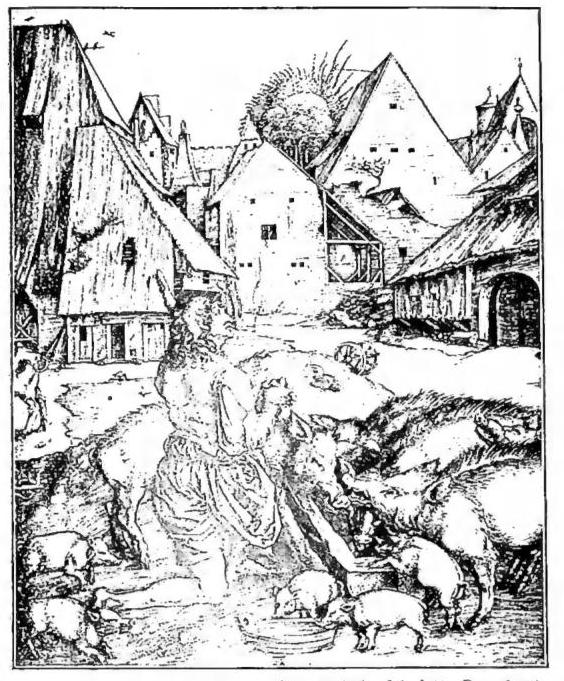
PARABOLA - The Prodigal Son. Engraving by A. Dürer (16th century).
The parable is a characteristic literary device, already recognized by Roman rhetoricians (cf. Cicero, De oratore, III, 38; Quintilian, op. cit., VIII, 3, 15) as an effective means of conferring beauty and appeal upon a literary composition, as well as rendering moral instruction more accessible and perspicuous.
An important question still arises concerning the purpose Jesus had in mind in His abundant use of the parable. From the differing interpretations of a famous text (Mt 13:10–15; cf. Mk 4:10–12; Lk 8:9 ff.) there emerges either the theory of a vindictive justice or that of mercy. Some affirm that Jesus resorted to this language in order to punish with a moral and intellectual blindness—caused by the obscurity or difficulty of the parable—the culpable unbelief of the Jews: He would have aimed at hardening their hearts, as foretold in Is 6:9 ff.; the light, offered under the veil of metaphorical language, in ill-disposed intellects would have produced an ever greater increase of blindness. Thus do not a few Catholic exegetes express themselves (Maldonatus, Knabenbauer, Fonck, Durand, Skrinjar, etc.). This interpretation rests upon the most probable exegesis of the Isaian text, but seems little consonant with the intrinsic character of the parable, which aims at simplifying an abstruse concept, and with the entire mission of Jesus: for this reason M.-J. Lagrange, F. Prat, J. Huby, J.-M. Vosté, U. Holzmeister, H. Höpfl, L. Pirot, etc., see in the parable a means dictated by goodness and pedagogical insight, to enlighten the minds of the hearers. The obscurity of the expression would be occasioned by the difficulty of the idea to be inculcated and by the desire to arouse more keenly the curiosity of those who listened.
Jesus was always ready to explain His parables to docile and desirous minds (cf. Mt 13:36 ff.; Mk 4:10 ff.). He would gladly have adopted the same method with all, but because of the indifference of the crowd the parable, an excellent means of illustrating a truth, in practice produced a culpable intellectual obtuseness through its inevitable obscurity. What was a manifestation of divine goodness and mercy, not of a punitive or vindictive will, only through the fault of the hearers is transformed into an occasion of spiritual darkness and sin. It is a divine grace rejected by a perverse will. This is the interpretation dictated by the entire historical context of the Gospels, even though it encounters no slight difficulties in the text cited above.