NIELLO

Image from page 1095

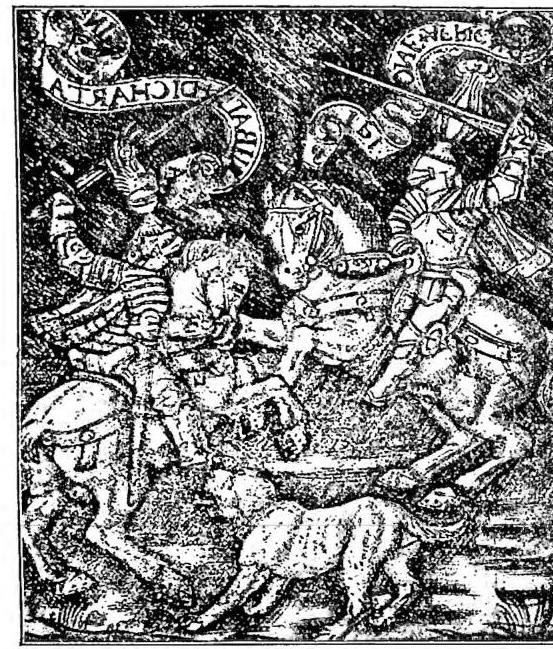
NIELLO. – The name derives from the Latin *nigellum*, indicating a particular type of goldsmithing work in which a black paste, composed of copper, silver, sulfur, and lead (according to some, only silver and lead), is inserted into the recesses carved into a plate of gold, silver, or sometimes copper. Due to the similar technique, it was often confused with *agemina* or damascening.

This technique, known in classical antiquity, was used from the early centuries of the Christian era for ecclesiastical furnishings. However, few examples of medieval works remain. On the other hand, production flourished in the 14th and 15th centuries, especially by goldsmiths and engravers from Florence, among whom Maso Finiguerra stood out. For this reason, and because artists often made a mold of the plate before completing the work—filling the engravings with soot and oil and then taking proofs on damp paper—Vasari believed that copperplate engraving originated in Florence around 1460 thanks to Maso Finiguerra. This is false, as engravings predating this period are known to have existed beyond the Alps.

Though less intensely, the *niello* technique also developed outside Florence with artists such as Turino, Caradossi, Tagliacarne, Porta, Francia, and his pupil Raimondi, who may be considered the last in this tradition, continuing to work until the early 16th century, when it had already fallen into disuse elsewhere; so much so that even Cellini failed to revive II.
**NIEKOLLO** – **NIEITZSCHE FRIEDRICH WILHELM**

**Niepokalanej (Little Knight of the Immaculate)** for boys, since 1933, with 165,000 monthly copies; the *Maly Dziennik* (*Little Daily*), a widely circulated Polish Catholic political and religious newspaper since 1935, with 150,000–250,000 copies on weekdays and Sundays.

But war came (1939–45), and these, like other branches, were severely affected. Since 1945, N. has been reorganizing its departments and sections, though its apostolate has been hindered. In recent years, notable achievements include: the editorial staff’s resumption of *The Knight* (July 1945; 650,000 monthly copies in 1947–48, now reduced to 80,000 after the communist government, on May 18, 1949, confiscated all its printing machinery); the cultural section, with the restoration of the Library and the establishment of a Marian study center, including an antiquities museum and a Gymnasium attended by 250 external students; the charitable-assistance section, which collects and distributes food, clothing, and various goods to the poor across the region; the firefighting unit, which in 1947, on the 15th anniversary of its establishment, received national recognition from the communist government, awarding gold, silver, and bronze medals to 10 friar firefighters; the construction department, whose members built in 1948–50 a grand votive temple to the Immaculate Mediatrix of All Graces (62 m long, 18 m wide, 16 m high; tower 50 m with the Cross), the most beautiful monument of N.

**

BIBL.:** V. KOLBE and MILIZIA DELL'IMMACOLATA. Giovanni Odoradi