
OLIVIERI, PIER PAOLO. — Sculptor and architect, b. in Rome in 1551 and d. there in 1599. In both his architectural and sculptural works he is bound to the very particular taste of the end of the century dominated by the Catholic Reformation, an academic and cold taste manifested in that manner of defining forms with an abstract clarity lacking vitality, upon which a richness of pre-Baroque decoration is at times grafted.
The church of S. Andrea della Valle, begun in 1591 (and later continued by Maderno), and the ciborium and altar in the transept of S. Giovanni in Laterano (1598–99), more sober and poorer in detail than the earlier church, clearly reveal the characteristics indicated above. Although more original in his sculptures, he is no less absorbed by the atmosphere surrounding him. In general, his works display a meticulous, insistent, analytical study of details, examined and rendered with excessive care, due in part to the influence of northern sculptors working in Rome during those years, which sometimes causes him to lose sight of the overall view. In the statue of Gregorio XIII in S. Maria in Aracoeli, signed and datable to 1576–77, he treats the marble with supreme skill, enabling him to convey the differentiation of the material in the linen, damask, and embroidered portions of the Pontiff’s garment; to the face, however, he is unable to give life and character. In the Monument to Gregorio XI in S. Francesca Romana, he seems
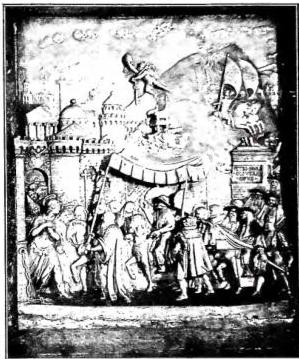
His works are also found outside Rome: a bas-relief depicting the Death of Caesar in the Villa della Volpe near Siena; a tomb bearing a signature and dated 1590 in the Metropolitan Museum of Nuova York; and a statue depicting Friendship in the Louvre.