
HOROSCOPE (ὠρακάπης). — The term h. in astrology designates the precise moment (ὠρα) at which one observes (σκοτσίν) the position of the stars that rise above the horizon at the instant of an individual’s birth. The exact determination of this moment is necessary in order to establish the individual’s future, and also to question the stars during the course of his life, though always subject to the position they occupied at the moment of his birth.
As can be seen, the h. is firmly connected with divinatory astrology, which rests on the following principles: a) the stars exert a preponderant action in the equilibrium of the universe, which is influenced by the characteristic qualities of each of them; b) this influence is determined by the position, at a given moment, of the stars in the heavens and may be positive or negative, that is, favorable or adverse. Each of the 7 planets (Moon, Mercury, Venus, Sun, Mars, Jupiter, Saturn) has its own house (οἶκος, mansio) in one of the 12 signs of the zodiac, where it draws its greatest energy (Firmico) and from which it exerts its influence. Moreover, once these planets had been identified with particular ages of life (e.g., Moon = earliest childhood, Mercury = youth, etc., up to Saturn = decrepitude [Ptolemy, IV, 9]) and certain good or bad characteristics had been attributed to the signs of the zodiac, it was held that there existed a very close analogy and bond between the child being born and the star that at that moment rises in the sky; at the horizon, therefore, where the stars possess all the vigor of youth, astrology placed the h., that is, the precise point at which the moment of birth is connected with destiny.
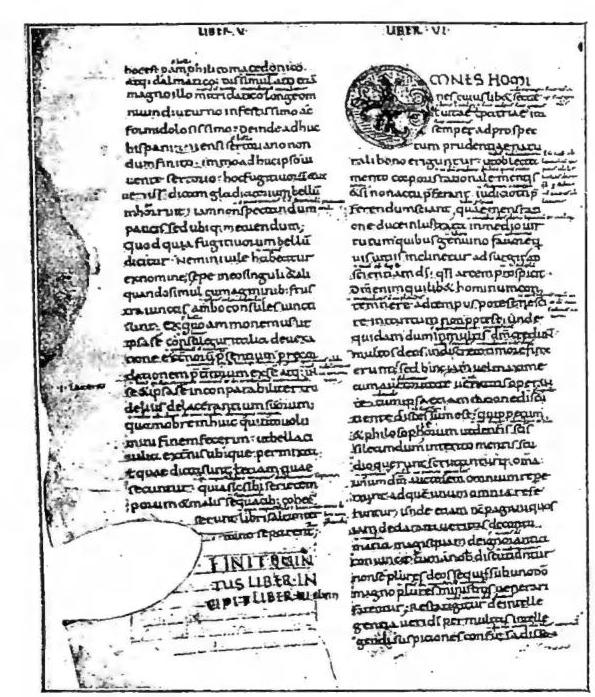
OROSIO, PAOLO — Historiae adversus paganos libri VII. Beginning of Book VI with illuminated initial and glosses (first half of the ninth century). Vatican Library, cod. Reg. lat. 296, f. 67°.
decoration in temples, on tombs, coins, etc. In Greece (where the term also denotes the instrument for determining the position of the stars, which was supposedly invented by Anassimandro: Diogene Laerzio, II, 1), the o. was used only from the Alexandrian period onward (cf. Esichio and Suida, s. v.; cf. also Clemente Alessandrino, Strom., VI, p. 757). At Rome, it was dealt with particularly during the Augustan age by Manilio, and in the fourth century by Firmico Materno, who wrote a treatise on astrology: Matheseos libri VIII.